Working out how to choose a childcare centre usually starts with a list: location, hours, cost, maybe a curriculum name you’ve half heard of. Those things matter, but they won’t tell you what a day actually feels like for your child, or how safe they’ll be when you’re not in the room.
This guide walks through what matters when comparing centres: the type of care, accreditation, curriculum, cost, and what’s genuinely included, plus the harder-to-judge things like staff training, consistency, and cultural safety, and what to ask about each on a tour.
Before you compare individual centres, it helps to know which type of care you’re actually looking for:
A centre on your commute, or close to home, makes the daily routine easier to sustain over years, not just weeks. Check opening and closing times against your actual work hours, including pickup buffer time, not just the advertised hours.
Waitlists are worth asking about early. Demand varies a lot by suburb and age group, and popular centres can fill rooms well ahead of an expected start date, so it’s worth enquiring even if you’re still a few months from needing a place.
Every approved education and care service in Australia is assessed by its state or territory regulatory authority against the National Quality Standard (NQS), which covers seven quality areas including educational program, safety, staffing and governance.
Services are rated on a five-point scale, from Significant Improvement Required, through Working Towards NQS, Meeting NQS and Exceeding NQS, up to Excellent. The current rating has to be displayed at the service, and you can also check it on the ACECQA national register before you visit.
A high rating is a genuinely useful filter, but it’s a point-in-time assessment. It’s still worth asking how the centre keeps standards up between assessments, not just what the last rating said.
Australia’s national curriculum for children from birth to five is the Early Years Learning Framework, known as Belonging, Being and Becoming. It’s delivered through a mix of play-based exploration and more structured, educator-led experiences, and every approved service has to base its program on it.
Where centres differ is in how that plays out day-to-day: how much outdoor and nature-based learning is built in, how school readiness is approached in the lead-up to kinder, and what else sits alongside the core curriculum.
Ask to see a sample daily program, and how much of it is outdoor and child-led versus structured and desk-based, especially in the lead-up to school. There’s no universally right balance, only the one that suits your child.
A short visit tells you a lot: whether outdoor space is genuinely used or just present, whether rooms are set up for the age group in them, and whether the pace of the day looks calm rather than rushed.
Ask how meals are handled, including any dietary or allergy requirements specific to your child, and how rest and sleep are managed for younger children. Ask to see the menu and how allergy management actually works day to day, not just whether it’s “catered for.” A centre that can show you the process, rather than describe it in general terms, is the one actually doing it.
The Child Care Subsidy is the Australian Government’s main support for families, paid directly to your provider to reduce the fee you pay out of pocket. What you receive depends on your family’s combined income, the hours of recognised activity (work, study or similar) you and your partner do, and the type of care you use, so it’s worth checking your own circumstances against the current settings rather than assuming a standard rate applies. Try our Child Care Subsidy calculator here.
Beyond the subsidy, ask exactly what’s included in the daily fee and what’s charged separately. Nappies, incursions, excursions and late pickup fees can all sit outside the headline price at some centres. Ask for the full fee schedule up front, not just the daily rate, so you’re comparing real cost to real cost.
Find out how the centre keeps you in the loop day to day: an app, a diary, or conversations at pickup, and how quickly you’d hear about anything significant. A good orientation process for a new enrolment matters too, since how a centre settles your child in during the first weeks says a lot about how it operates generally.
Family involvement is also worth asking about, beyond the standard newsletter. Ask how families are actually brought into the centre’s life, not just informed about it, and how often that happens rather than once a year.
Secure entry, supervision and a clean, well-maintained centre are the baseline, not the differentiator.
The more useful question is what happens around the edges: who’s actually in the room with your child, how well they know them, and what they’ve been trained to do if something goes wrong.
Secure entry, supervision and a clean, well-maintained centre are the baseline, not the differentiator.
The more useful question is what happens around the edges: who’s actually in the room with your child, how well they know them, and what they’ve been trained to do if something goes wrong.
All educators in Australia work towards or hold an approved qualification, and services have to meet ongoing professional development obligations under the National Quality Framework. That’s the floor, not the ceiling, and it’s worth asking each centre what sits above it.
Ask specifically what training happens beyond the legal minimum, and how often. A centre with a real answer, rather than a vague “we’re always training,” is the one that’s actually invested in it.
Beyond the standard “what’s your ratio” question, these go further:
A centre that answers these specifically, rather than in general terms, is one that has actually thought about them.
A website and a brochure can only tell you so much. Book a tour at each centre on your shortlist and pay attention to how educators actually talk to children, not just how the space looks in photos.
Online reviews are a useful second check, particularly patterns across many reviews rather than any single one. Look for what comes up repeatedly, good or bad, rather than the best or worst single comment, and weigh how long the reviewer’s child was actually enrolled.
Choosing a centre also means choosing the community your child spends their days in. A culturally safe centre doesn’t just avoid causing harm: it actively builds children’s understanding of, and respect for, different backgrounds and experiences, including Aboriginal and Torres Strait Islander culture and history.
Ask how this actually shows up day to day, not just on a cultural awareness day once a year. A centre that can point to something specific and ongoing is doing more than ticking a box.
Every one of those questions has a real answer here;
The best way to judge all of this for yourself is to book a tour and see a centre running on a normal day.
Book a tour at one of our childcare centres today and experience the Choklits difference for yourself.
Long day care runs from a dedicated centre with a team of educators, usually for eight hours or more a day. Family day care is based in an educator’s own home, often in smaller groups, which some families prefer for babies and toddlers.
It’s paid directly to your provider and reduces your out-of-pocket fee. The amount depends on your family’s combined income, the hours of recognised activity you do, and the type of care, so it’s worth checking your own circumstances rather than assuming a flat rate.
Ask about staff training beyond the legal minimum, how leave and absences are covered, and how long the educators in your child’s room have been at the centre, alongside the standard questions about supervision and emergency procedures.
Ratios are set nationally and increase as children get older. Ask each centre to confirm its current ratio and National Quality Standard rating rather than relying on a general figure, since exact numbers can vary by state.
Look for it in the everyday program, not just a single event on the calendar: regular, embedded learning about different cultures and backgrounds, including Aboriginal and Torres Strait Islander history and perspectives.
Choosing a childcare centre is rarely about finding the one with the longest list of features. It’s about finding the team that will actually be consistent, well trained and genuinely present for your child, day after day.
A silver teapot tips and pink water spills across a wooden tray already scattered with rose petals, gold stars and a sequin or two. Somebody is misting the whole scene with a purple spray bottle. Somebody else has decided the little tin bowl needs more petals, then fewer, then more again. It looks like a tea party for fairies, and in a way it is. It is also a stretch of deep, focused learning, and the child who walks away with wet cuffs and pink fingertips has been far busier than they look. This is messy play at Choklits. If you have ever wondered what your child actually gets out of it, beyond a good time and a change of clothes, this article is for you. Below we cover what messy play is, the benefits of messy play at each age from six months to five years, what the research says, and the themed sessions our messy play specialist Asten runs across our Croydon, Ringwood and Surrey Hills centres.
Messy play is open-ended play with materials that change when a child handles them. Water, paint, sand, mud, clay, foam, coloured rice, cooked pasta, shaving cream, bicarb fizz. There is no finished product and no correct way to do it. The child decides whether the paint is for painting, pouring or squeezing between their fingers, and that decision is where the learning starts.
Sensory play is the broader category. It covers any play that feeds the senses, including plenty that is not messy at all, like a basket of textured fabrics or a tray of dry autumn leaves. Messy play is the corner of sensory play where touch leads and the material gets everywhere. Most of the benefits below apply to both, but messy play tends to offer the richest version of them, because the materials keep changing as the child works.
One thing messy play is not: a craft with a mess attached. If every child is meant to finish with the same painted paper plate, that is craft, and craft is lovely. Messy play is when the material itself is the point and the child is the scientist.
Asten has been part of the Choklits family since 2001. She is our Educational Leader and our messy play specialist, and she is the person our educators call whenever a room needs some inspiration to create an engaging sensory play activity.
What sets Asten apart is that she does not treat messy play as a generic tub of goop. She designs themed sessions, and she takes them to all three Choklits services, so children at Croydon, Ringwood and Surrey Hills each get to experience them. A theme might be a famous artist, a season, a favourite story or a place, and it shapes every choice on the table: the colours, the materials, the tools, the words the educators use, and the small surprises tucked into the setup.
Her Monet water lily potion play is a good example. Metallic paint swirled into water in a tuff tray until it looked like the surface of a pond. Teapots and cups filled with shimmering potions. Plastic lilies and leaves, green spaghetti standing in for pond weed, tapioca pearls in purple and pink, and small plates of bicarb and citric acid that fizzed to life the moment a child poured water on them. It opened a whole month themed around world famous artists, and from a few steps back it looked a lot like the painting.
Asten also works with rescued and recycled materials wherever she can. Strainers from risotto tubs, clean jar lids, cardboard from our nappy deliveries, and pasta and rice that local restaurants can no longer serve but that is perfect for play. She sources from Reverse Art Truck in Ringwood and NQR too. As she puts it, we do not waste food here.
If you would like to watch a setup come together, follow Choklits on Instagram, where we post one of Asten’s play setups every Sunday.
It is easy to assume the main benefit of messy play is that children enjoy it. They do, and joy is reason enough. But underneath the fun, a great deal is happening. Here is what messy play tends to build, and why.
Sensory processing and brain development
Young children learn about the physical world mostly through touch. When a child squeezes cold paint, presses a palm into wet sand or lets tapioca pearls slide between their fingers, they are gathering information about weight, temperature, texture and resistance, and their brain is sorting that information into categories it will draw on for the rest of their life. Every new texture is another entry in the file. Children who get plenty of varied sensory experience in the early years often find new sensations easier to handle later on, from a scratchy school jumper to a food they have never tried.
This is the benefit that surprises parents most. Researchers at the University of Iowa studied how 16-month-olds learn the names of non-solid things like applesauce and pudding, and found that toddlers who poked, squished and generally got messy with the substances were better at learning the words for them. The reasoning is simple once you see it: gooey things do not hold their shape, so a child has to explore what the stuff is made of before the word can stick.
There is an everyday reason too. Messy play is full of talk. Educators narrate what is happening (that one is cold, this is sticky, look, it is dripping) and children reach for describing words they rarely need at the block corner. Slimy, gritty, foamy, lumpy, drippy, fizzy. These are words you learn with your hands.
Pouring from a teapot without tipping it, squeezing the trigger of a spray bottle, pinching a single star out of the water, scooping rice into a cup. Each is a small workout for the muscles of the hand, wrist and forearm, and for hand-eye coordination. They are the same muscles a child will later use to hold a pencil, do up buttons and control scissors. Messy play builds them without a single worksheet in sight.
Early science and maths thinking
Messy play is usually where children first meet cause and effect in a form they can control. Pour water on the bicarb and it fizzes. Add more water and the paint goes pale. Tip the cup and the tray floods. Children make a prediction, test it and adjust, which is the scientific method in miniature. They meet early maths in the same way: full and empty, more and less, heavy and light, how many scoops it takes to fill the bowl. The Early Years Learning Framework describes this as children developing skills such as problem solving, inquiry, experimentation and hypothesising. In practice, that is a tuff tray on a Tuesday morning.
There are no wrong answers at a messy play tray, which makes it a low-pressure place to try things. A child who worries about getting things right can pour and mix without any way of failing. For many children the repetitive, rhythmic parts of messy play (stirring, sifting, scooping) are also soothing, in much the same way kneading dough or running your hands through sand can be for adults. Our educators often use a tray to help a child settle after drop-off or after a big feeling, and Raising Children Network suggests messy play as one healthy outlet for toddlers’ emotions.
Social skills and communication
A shared tray is a shared project. Children negotiate who gets the teapot, notice what a friend is doing and copy it, hand over the spray bottle when asked (eventually), and talk about what they are making. For toddlers who are just starting to play alongside and then with others, messy play gives a natural reason to interact, with none of the pressure of a game with rules.
Creativity and imagination
Because there is no finished product, children are free to decide what the materials are. The pink water is tea, then potion, then soup. The petals are food, then decorations, then treasure. A theme gives that imagination something to hold onto, which is exactly why Asten builds her sessions around a story rather than a random assortment of stuff.
Babies (around 6 to 12 months)
Messy play for babies is all about safe-to-mouth materials and simple textures: cooked pasta, yoghurt with a drop of food colouring, cool water, edible finger paint, jelly. The benefits are mostly sensory and motor: learning to grasp, release, pass something from hand to hand, and get used to new textures. Sessions are short and everything is taste-safe, because a baby’s first instinct is to put it in their mouth, and that is a perfectly good way to explore.
Toddlers (1 to 3 years)
lets them find out at their own pace: pouring and filling, mixing colours, squishing, dumping out and starting again. The big gains here are language, fine motor control and the early cause-and-effect thinking that underpins later science and maths. It is also where many children first practise sharing space and materials with someone else.
Preschool and kinder children (3 to 5 years)
Older children bring more to the tray: stories, plans, predictions. A themed setup lets them connect what they already know (Monet painted water lilies; fairies would probably drink flower tea) to what they can make with their hands. At this age messy play supports more complex problem solving, longer concentration, richer descriptive language and collaborative play, and it strengthens the hand for the writing that is coming. The EYLF’s picture of a confident and involved learner, curious, persistent and imaginative, looks a lot like a four-year-old at a well-designed messy play table.
Anyone can put out a tray of shaving cream, and there is nothing wrong with that. Asten’s themed sessions do something extra.
Parents rightly want to know that the fun is safe. Every messy play session at Choklits follows the same rules.
Some children dive straight in. Others hang back, hold their hands out to be wiped, or point at the tray and say no. This is completely normal, and it is not a problem to fix. Sensory preferences vary a lot between children, and a child who cannot stand slime this month may love it by spring.
At Choklits, no child is ever made to touch anything. Educators offer a bridge instead: a spoon, a paintbrush, a cup, a long-handled scoop. Tools let a child take part at arm’s length and move closer only when they are ready. Watching counts too. A child who stands beside the tray narrating what their friends are doing is learning plenty. Over weeks, most reluctant children edge in on their own terms, and the confidence that comes from choosing to touch something new is worth far more than being hurried into it.
If you notice strong reactions to textures at home as well, from clothing labels to certain foods, it can be worth mentioning to your room leader or your maternal and child health nurse, who can help you work out whether any extra support would be useful.
Parents tell us all the time: I love that you do this here, because I would never do it at home. Fair enough, and we are glad to handle the big messes. If you would like a small version at home, a few principles keep it manageable.
For step-by-step ideas, including a sensory rice box and a recycled construction site, see our earlier post, The Magic of Messy Play.
Messy play sits naturally under Outcome 4 of the EYLF V2.0, where children become confident and involved learners, and under Outcome 5, where they become effective communicators. It also touches the other three: children express preferences and make choices (Outcome 1), care for materials and learn about reuse (Outcome 2), and build physical skill and a sense of calm (Outcome 3). Messy play is part of our CHOKLITS+ program.
From around six months, with taste-safe materials and close supervision. At Choklits, messy play begins in our nursery rooms.
Messy play is one kind of sensory play. Sensory play includes any play that engages the senses, messy or not. Messy play is the hands-on, gets-everywhere kind, and it tends to give the richest sensory experience.
Messy and sensory play is a regular part of the play based program in every room. Asten’s themed sessions run on top of that and rotate across all three centres.
Every room keeps up-to-date allergy information for its children, and the materials for a session are checked against it. If your child develops a new allergy or intolerance, letting your room leader know is the most helpful thing you can do.
They will get wet and probably marked. Paint and food-based materials are generally washable, and a spare set of clothes in the bag means nobody has to go home damp.
The best way to understand messy play is to watch a child in the middle of it. You are welcome to book a tour at Croydon, Ringwood or Surrey Hills and bring your little one along. Ask about Asten’s next themed session while you are there, or follow Choklits on Instagram, where a new play setup from Asten goes up every Sunday. Questions about our program are always welcome through our contact page.
Dear Choklits families,
Spring has arrived at Choklits, bringing brighter days, fresh garden growth, and a new seasonal menu for 2026. This season’s meals are designed to be colourful, nourishing, and full of variety, helping fuel busy little bodies as children learn, play, explore, and grow.
Our menu is approved by Nutrition Australia’s Healthy Eating Achievement Program and aligns with the Early Years Learning Framework (EYLF). This means every meal is planned to support children’s health, learning, wellbeing, and developing relationships with food.
Across our four-week rotating menu, children will enjoy a balanced mix of wholegrains, lean proteins, legumes, dairy and dairy alternatives, fruit, and plenty of vegetables. Spring brings wonderful opportunities to add colour, freshness, and variety to the plate, while continuing to offer familiar favourites that children know and love.
This season’s menu includes bright pasta and rice dishes, nourishing meat and vegetable meals, seafood options, and plant-based recipes. Children will be encouraged to explore different flavours, textures, and ingredients through meals such as:
Morning and afternoon tea will continue to include seasonal fresh fruit, yoghurt, homemade breads and slices, vegetable dips, crackers, and other wholesome snacks. Gluten-free and dairy-free alternatives are available where needed, and Choklits continues to operate as a nut-free centre.
At Choklits, mealtimes are an important part of the day, not simply a break between learning experiences. They are opportunities for children to develop independence, practise self-help skills, communicate with friends, and build confidence as they make choices and try new foods.
Our spring menu supports children to:
Every day offers balance: carbohydrates for energy, protein for growth, dairy or alternatives for bones and teeth, and fruit and vegetables for fibre, vitamins, and minerals.
This spring, Chefs Jordan, Lai, and Tayani will once again lead our Plant to Plate program, giving children hands-on gardening and cooking experiences throughout the season.
For our younger children, the focus is on building early skills. They may practise holding child-friendly utensils, washing herbs and leaves, tearing soft greens, safely mixing ingredients, and exploring the smells, colours, and textures of fresh produce.
For our older children, the experience follows the full seasonal cycle. They will help plant seeds, care for the garden, notice when produce is ready, pick and wash what they have grown, chop with appropriate safety tools, cook, and taste the results.
Children are often more willing to try new foods when they have grown or helped prepare them. Plant to Plate helps reduce some of the barriers families can face at home, turning “I don’t like that” into “I made that”. The program supports EYLF outcomes around wellbeing, confidence, connection, and learning through real-world experiences in a calm and joyful setting.
Thank you for trusting us to nourish your children each day. Our Spring Menu 2026 brings fresh flavours, balanced nutrition, and rich learning, on the plate, in the kitchen, and in the garden.
We look forward to a season filled with curiosity, colourful meals, new discoveries, and joyful mealtimes.
If you have any questions on our new menu please head to our Facebook and Instagram pages or pop in and see us when you’re next at the service.
Here’s to our Winter Menu,
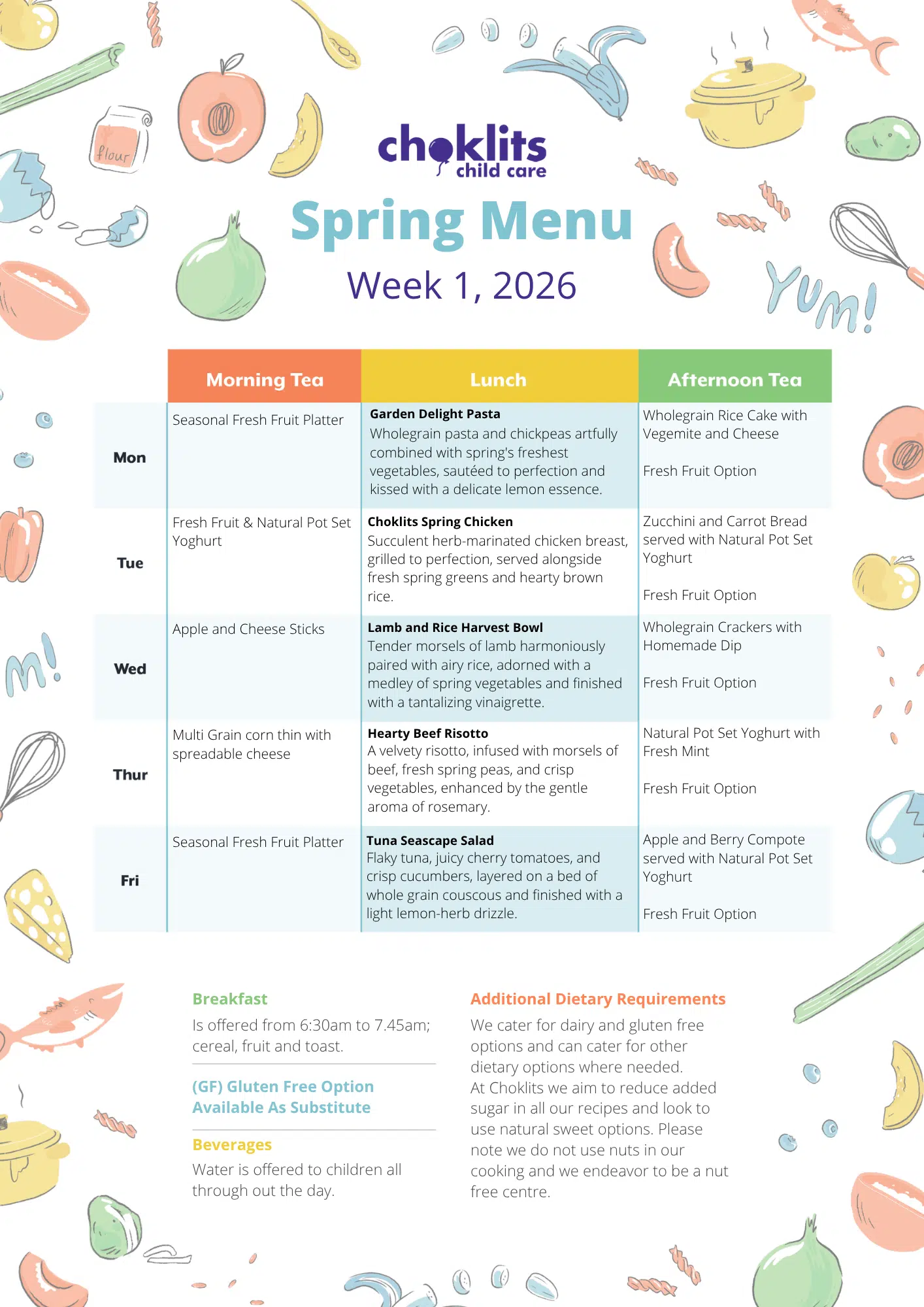
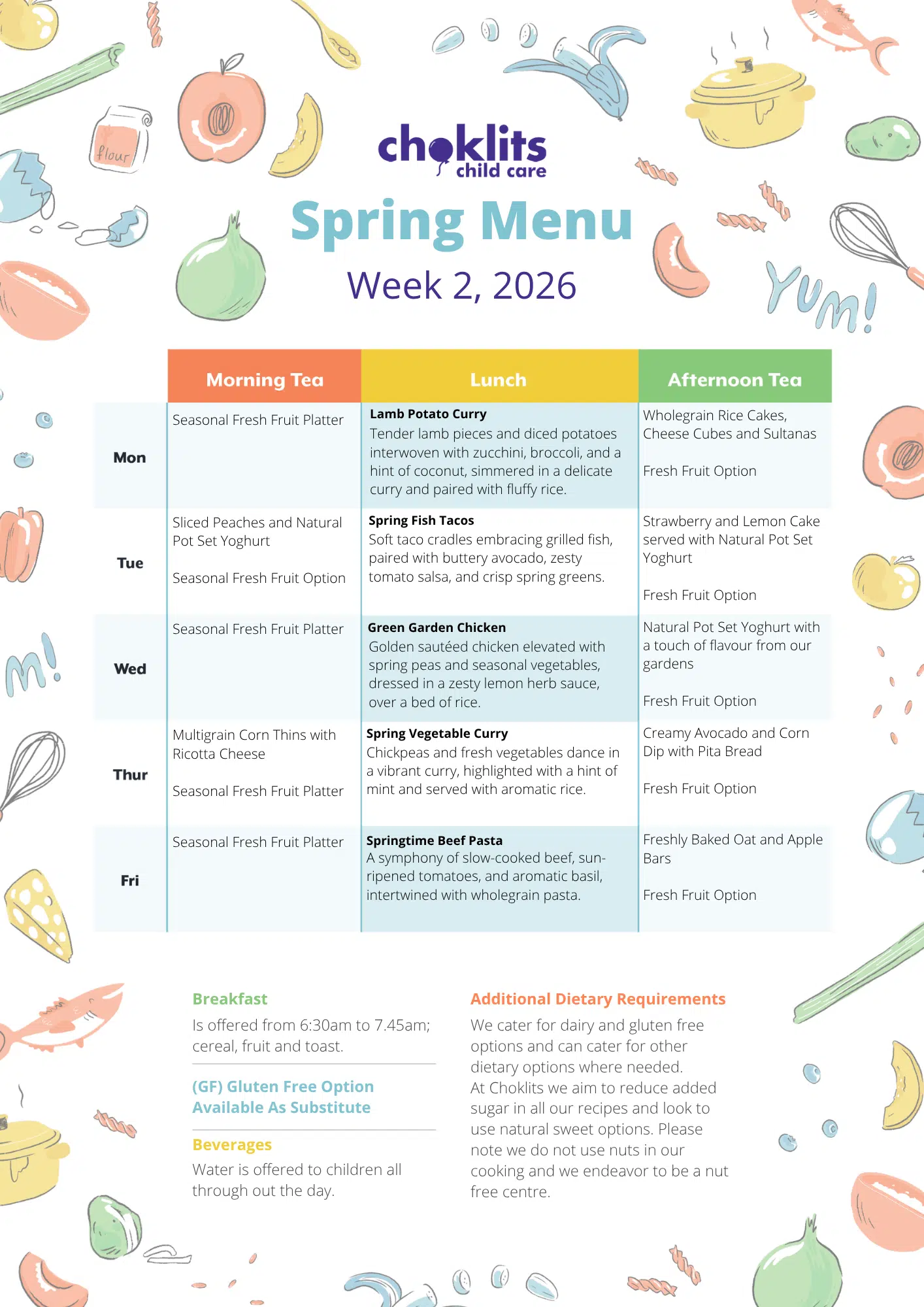
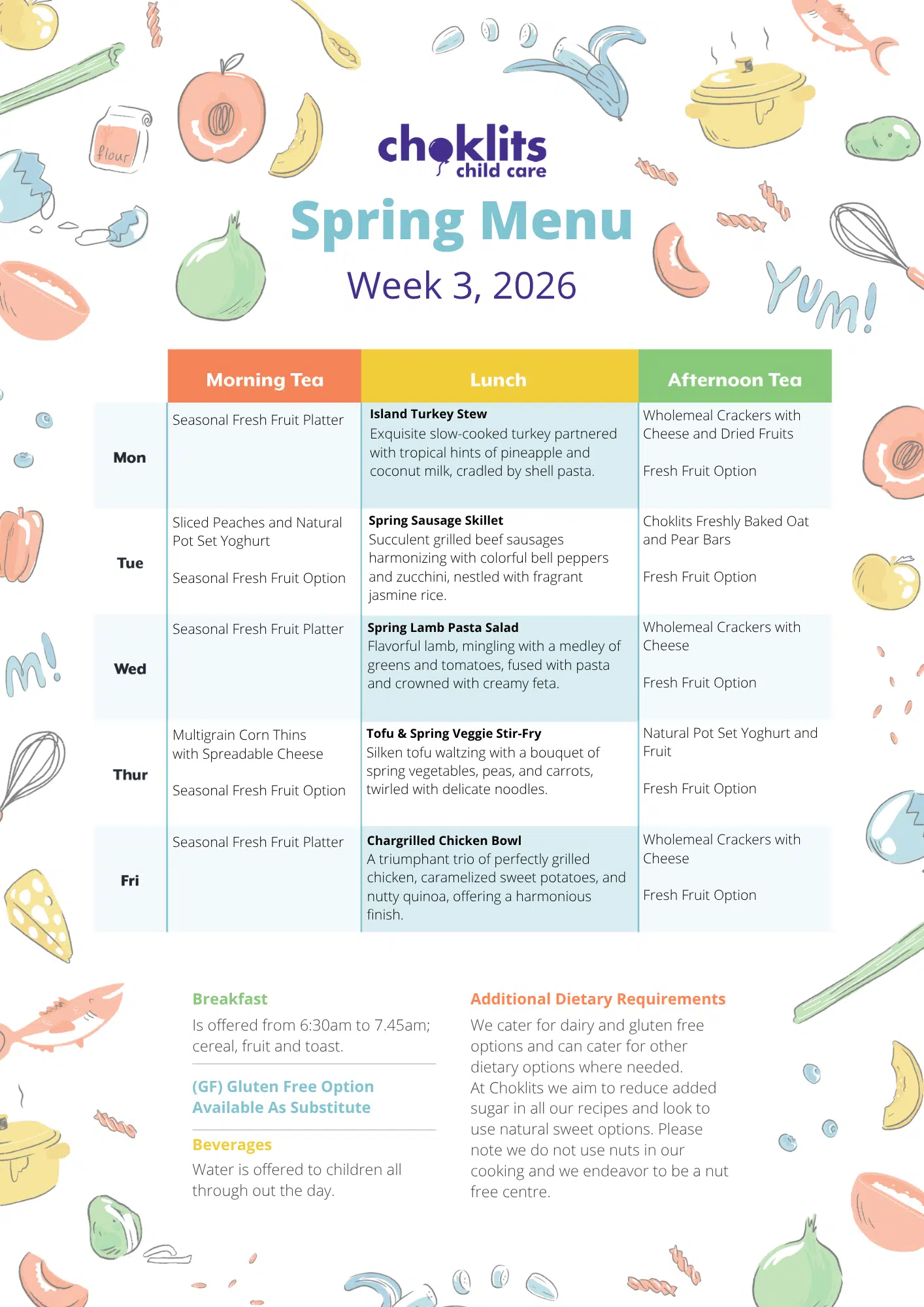
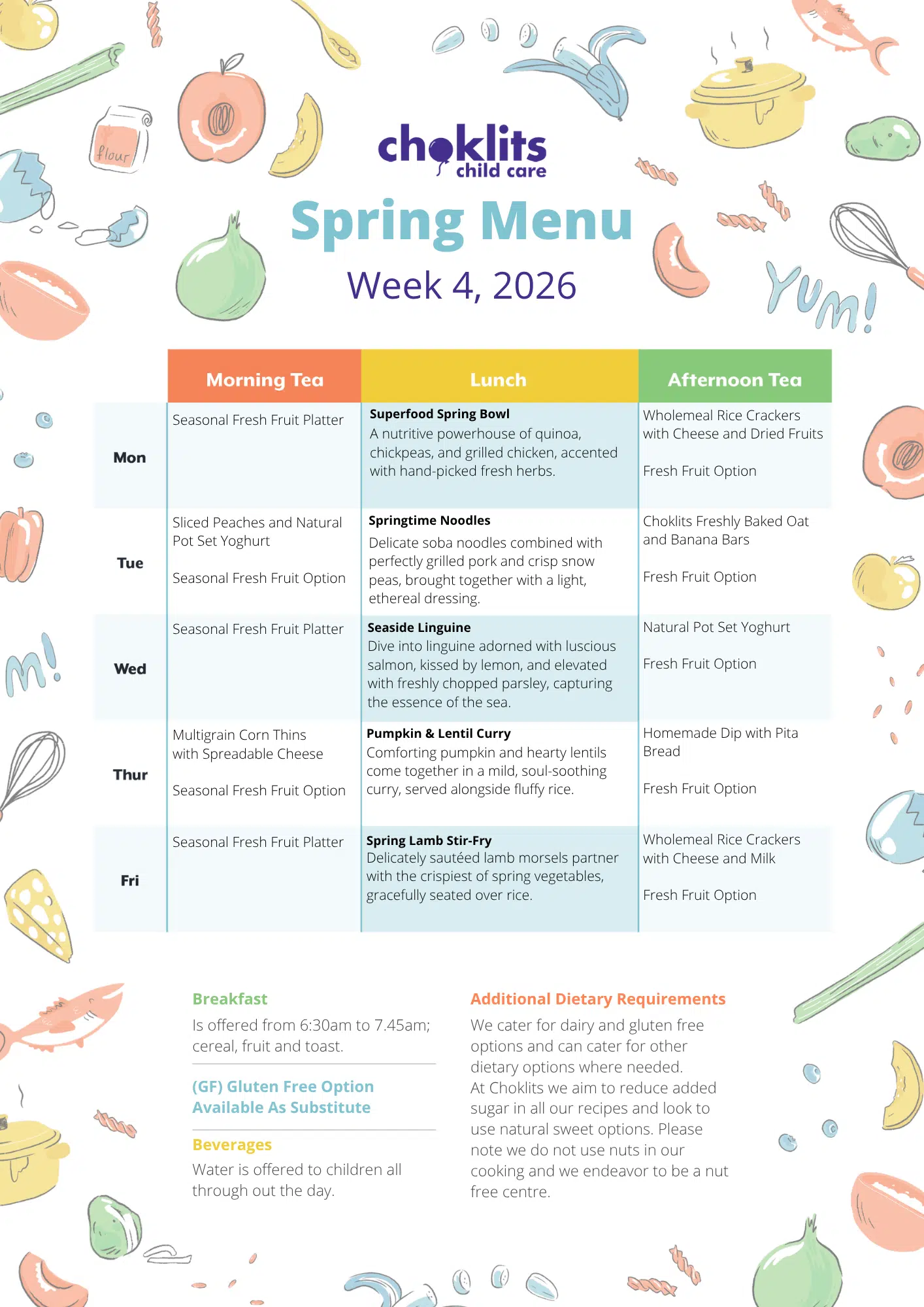
Dear Choklits families,
As the crisp air of winter settles in, we are thrilled to unveil our brand new Winter Menu for 2026. Thoughtfully designed to provide warmth and nourishment, this season’s menu is brimming with hearty, wholesome meals that celebrate the best of fresh, seasonal produce.
In keeping with our unwavering commitment to your child’s health and development, our menu is, as always, approved by Nutrition Australia’s Healthy Eating Achievement Program and meticulously aligned with the Early Years Learning Framework (EYLF). Every dish served at Choklits is crafted to support not only physical well-being but also foster learning and growth.
Throughout the week, your child will delight in a diverse array of warm, flavourful meals that are both comforting and packed with essential nutrients. Highlights from this season’s offering include:
Each lunch is complemented by a morning and afternoon tea offering, which includes seasonal fresh fruit, wholesome snacks like homemade muffins, and nourishing options such as yoghurt and vegetable sticks with dips. Our dedicated team also ensures that gluten-free, dairy-free, and other dietary needs are always carefully accommodated.
At Choklits, our food program extends beyond mere nutrition; it is an integral part of our educational philosophy. The EYLF underscores the significance of healthy eating in shaping children’s sense of wellbeing, identity, and belonging. Mealtimes at Choklits are cherished opportunities for children to:
By interacting with a menu rich in colour, texture, and cultural diversity, children develop healthy habits and a positive relationship with food, invaluable skills that will benefit them throughout their lives.
This winter, we are excited to continue our beloved Plant to Plate program, led by our talented chefs. This hands-on initiative empowers children to forge a direct connection with the food they consume, involving them in every stage of the process, from planting and nurturing to harvesting and preparing fresh produce straight from our centre gardens.
For our younger children, the program focuses on exploration and developing foundational skills. They will learn how to safely handle child-friendly utensils and engage all five senses as they experience the soil, the scent of fresh herbs, and the wonder of plant growth.
Our older children will participate in a full seasonal cycle, helping to plant seeds, care for the garden, pick the produce, and finally, prepare and taste the delicious meals they have helped create. This empowering process nurtures practical life skills and a profound sense of accomplishment.
Crucially, children who are actively involved in growing and preparing their own food are significantly more likely to try new vegetables and dishes. The Plant to Plate program effectively breaks down barriers, transforming “I don’t like that” into “I made that!” This program beautifully supports the EYLF’s emphasis on learning through play, fostering autonomy, and building a strong sense of identity and connection with the world around us, all while having immense fun.
We take immense pride in the thoughtful dedication that goes into every plate of food served at Choklits, and we are even prouder to witness the joy and enthusiasm with which the children embrace it. The Winter Menu 2026 exemplifies our ongoing commitment to health, sustainability, and joyful mealtimes.
Thank you for trusting us to provide not only safe and delicious meals, but experiences that help your children learn, grow, and thrive.
If you have any questions on our new menu please head to our Facebook and Instagram pages or pop in and see us when you’re next at the service.
Here’s to our Winter Menu,
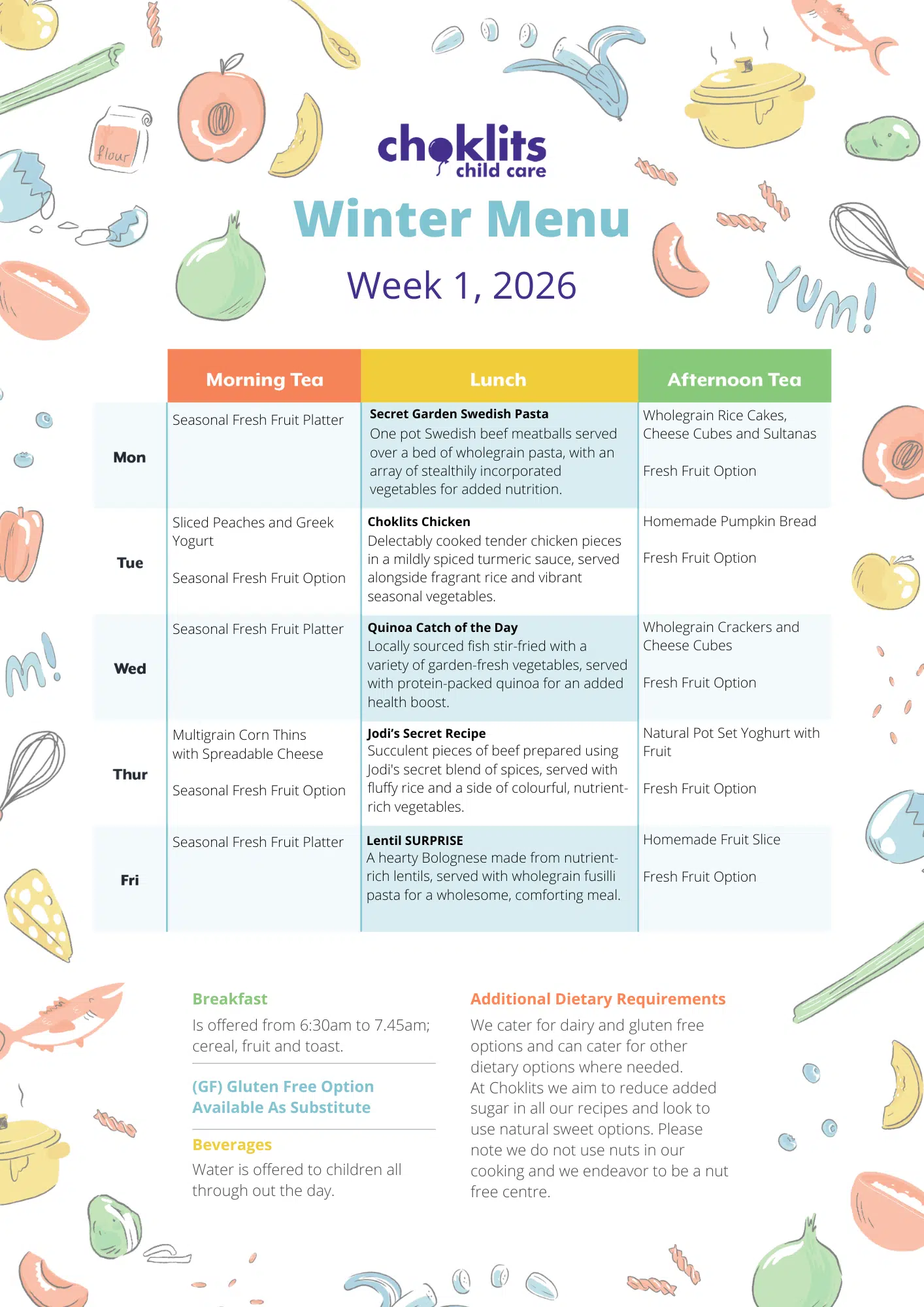
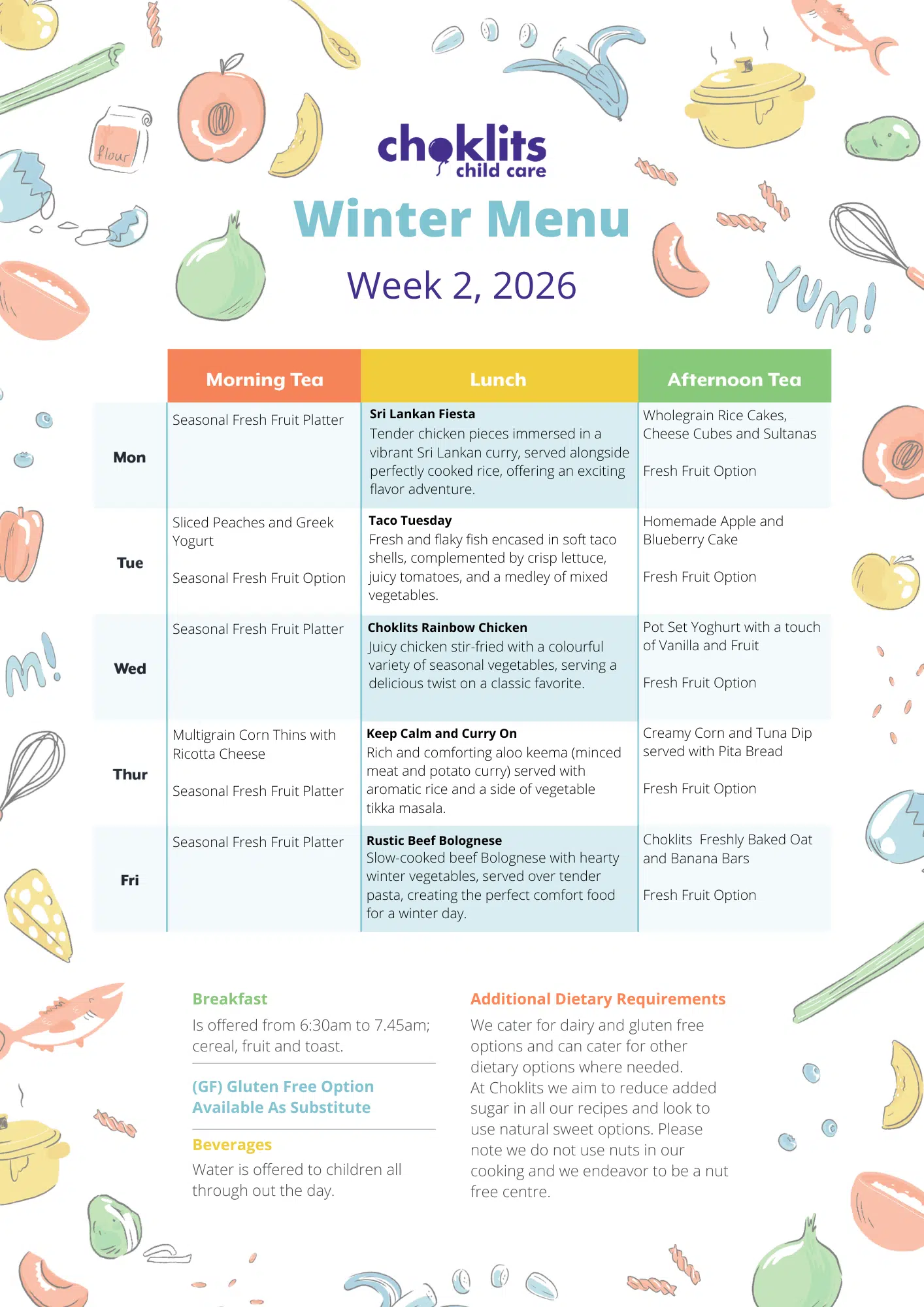
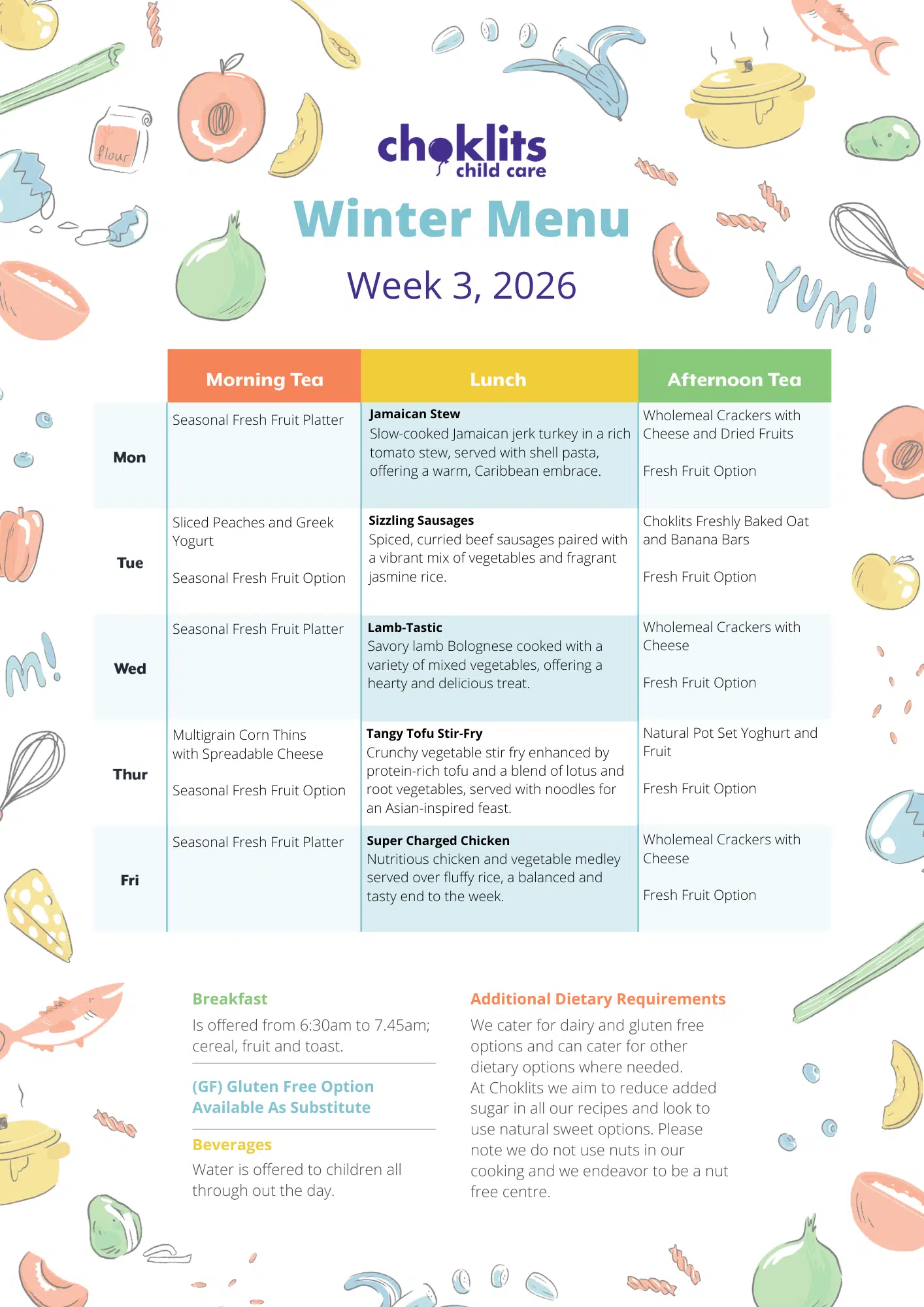
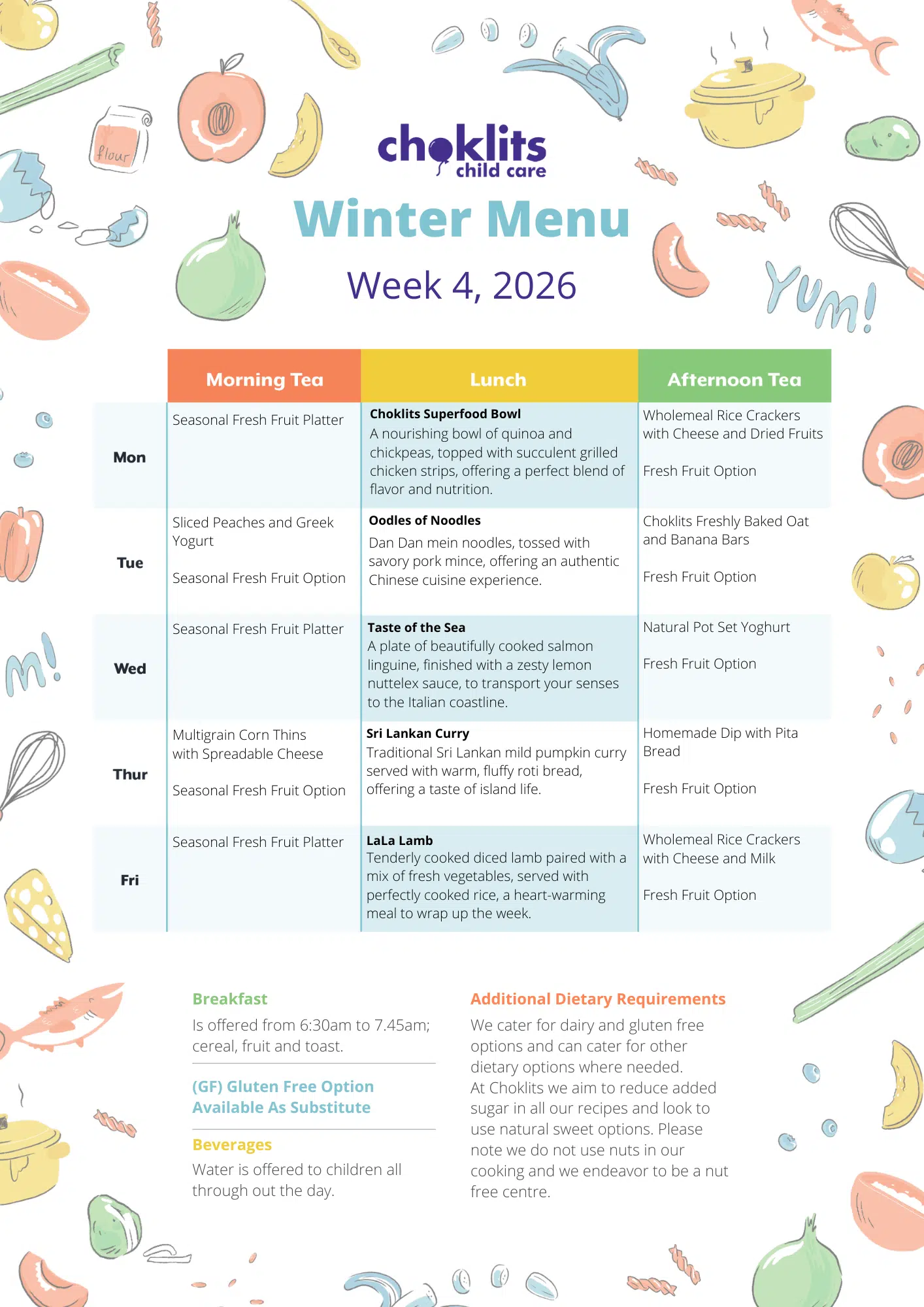

Dear Choklits families,
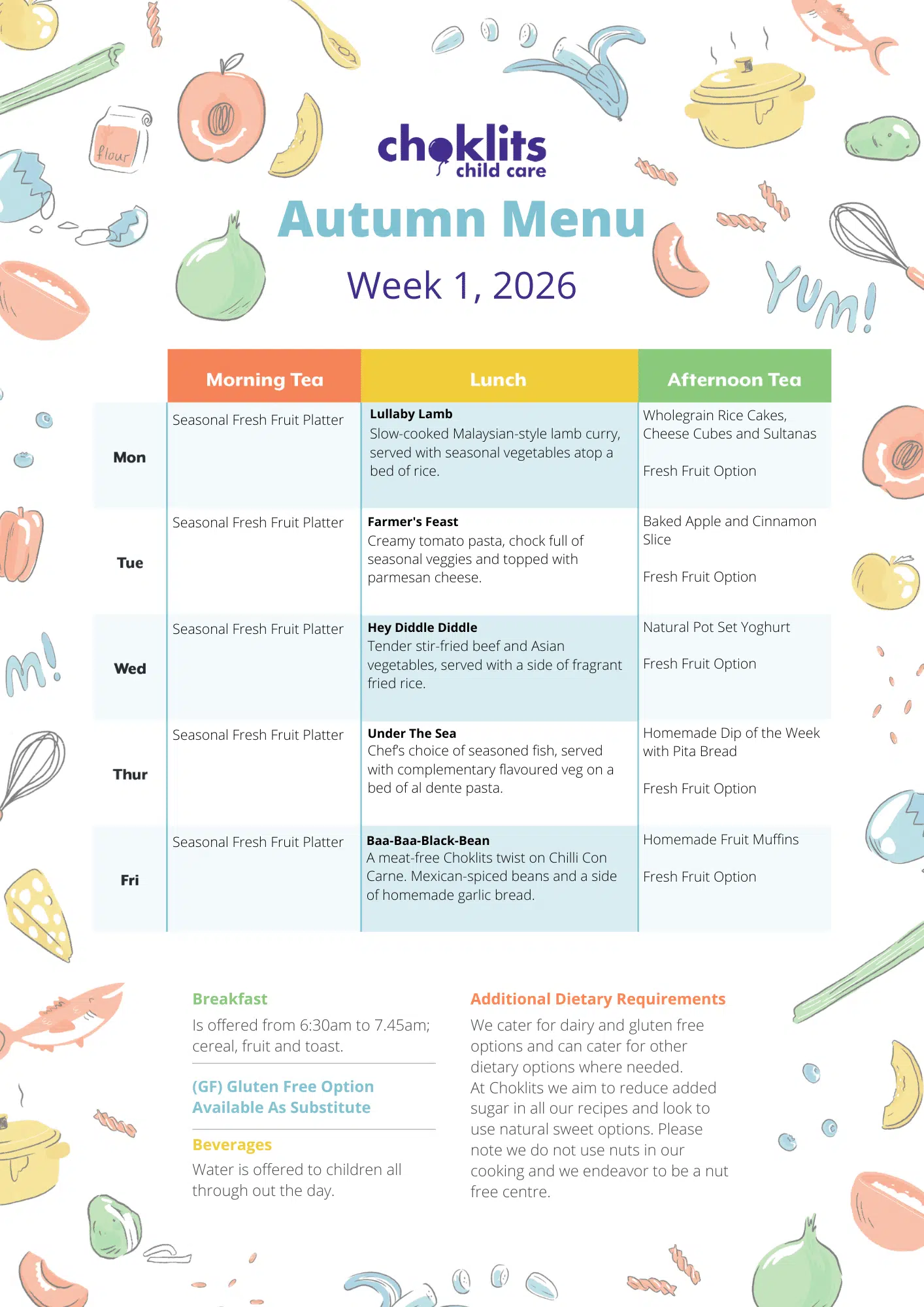
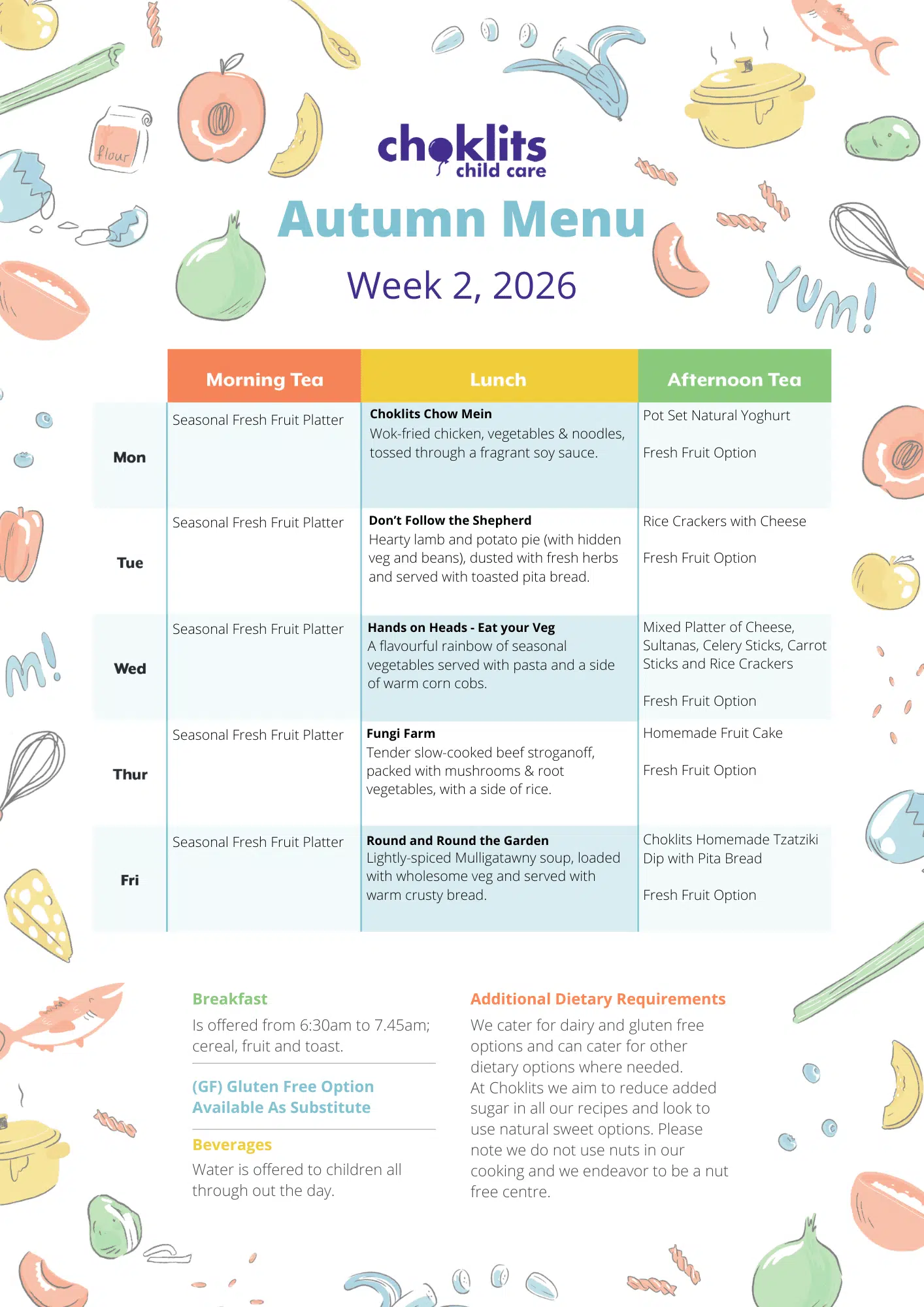
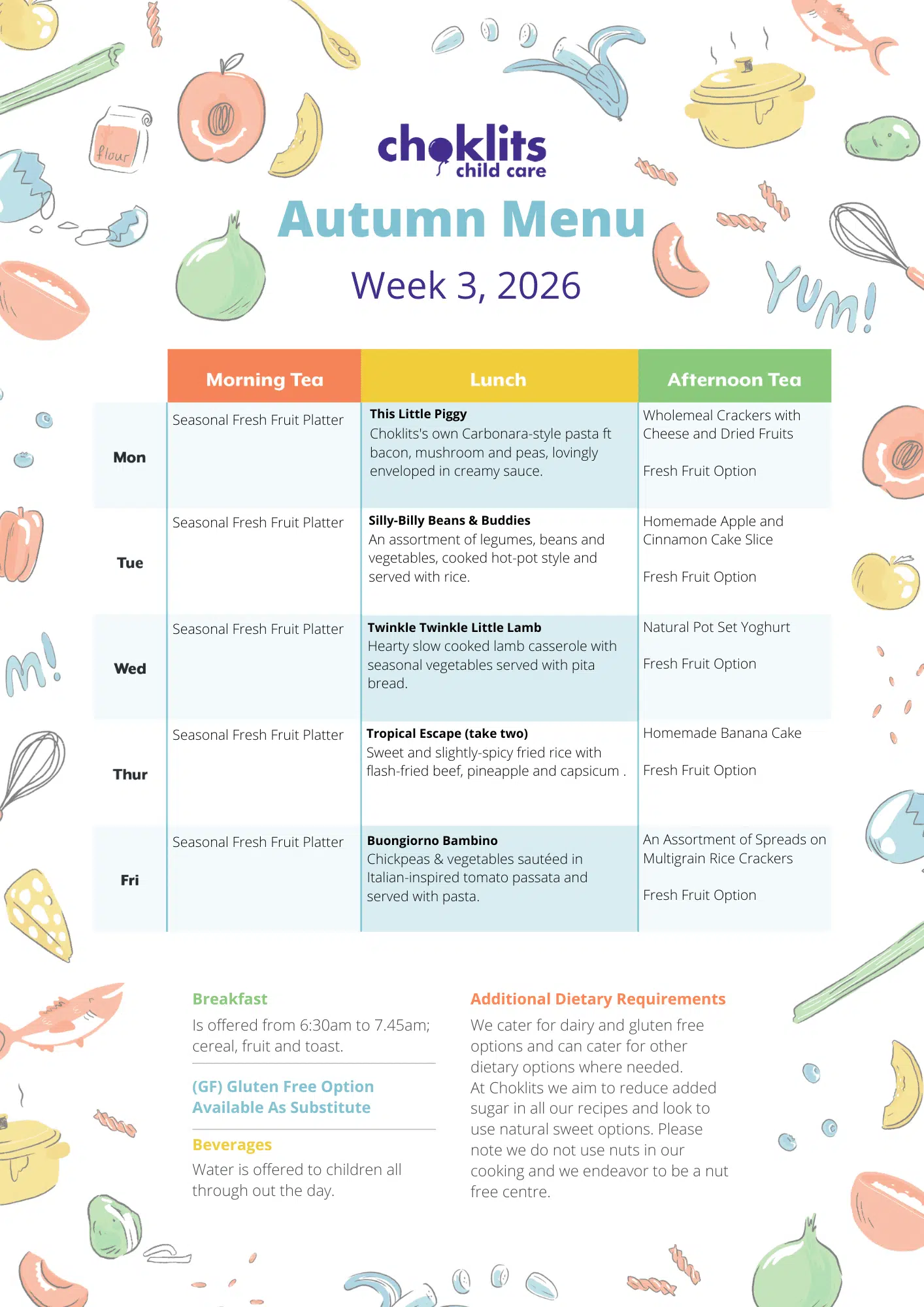
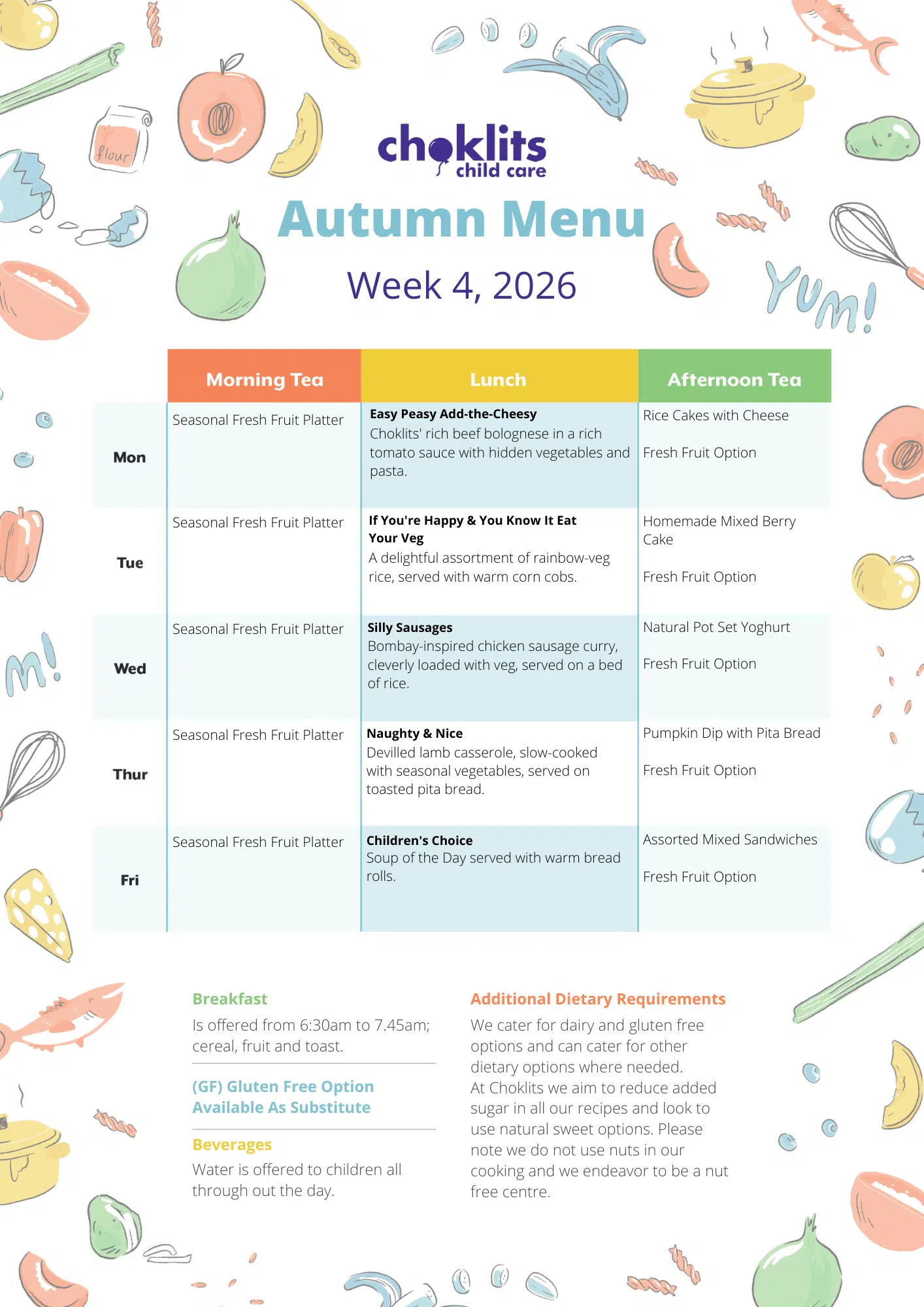
The leaves will again start to fall at Choklits which means we’re excited to introduce our Autumn Menu for 2026. This season’s menu focuses on comforting meals, balanced nutrition, and fresh seasonal produce designed to support your child’s health and wellbeing each day.
As always, our menu is approved by Nutrition Australia’s Healthy Eating Achievement Program and aligned with the Early Years Learning Framework (EYLF). Every meal is thoughtfully prepared to support not only growing bodies, but also children’s confidence, independence, and enjoyment at mealtimes.
Autumn is a time for warm, nourishing dishes that feel satisfying without being heavy. Across our rotating menu, children will enjoy:
Each dish is designed to provide the right balance of protein, wholegrains, healthy fats, and fresh produce to fuel active days of learning and play.
Autumn produce brings natural colour and flavour to the plate. Pumpkin, sweet potato, root vegetables, leafy greens, and fresh herbs feature throughout the menu. These ingredients not only taste great, but also provide important nutrients that support immunity and steady energy during the cooler months.
Where possible, we continue to incorporate ingredients from our centre gardens, helping children connect food to its source and understand the journey from soil to plate.
At Choklits, mealtimes are about more than nutrition. They are social, calm, and part of daily learning. Through shared meals, children:
This aligns closely with the EYLF focus on wellbeing, identity, and confidence.
We remain committed to meeting the individual needs of every child. Dairy-free, gluten-free, vegetarian, and allergen-aware options are prepared with the same care and attention as every other meal. Our kitchens continue to operate as nut-free environments to prioritise safety.
Balanced nutrition, reduced added sugar, and fresh ingredients remain at the heart of our food philosophy.
Autumn brings a slower pace and a sense of warmth, and our menu reflects that. We are proud of the care our chefs and educators bring to each mealtime experience.
Thank you for trusting us to nourish your children each day. We look forward to a season filled with comforting meals, shared conversations, and happy, healthy children.
If you have any questions about our new menu, please visit our Instagram or Facebook and pages or stop by the office when you’re next at Choklits.
Warm regards,
Matt, Jade, Deb, & the Choklits Child Care Team
Hello Choklits Community,
Each year, between Christmas Day and January 1st, we take time to reflect on our year at Choklits and pen our Annual Letter. That’s us above, Choklits Owners Jade and Matt, along with our twins, Abigail and Hubert.
Choklits is a family business, and along with our fabulous team we own and operate Choklits ourselves. Both Abigail and Hubert attended Choklits long before they became confident primary schoolers with leadership roles for Grade 6. We live and we breathe Choklits, our children will probably tell you we take it a little too seriously, and we definitely talk about it way too much!
We believe progress is happiness which is probably why we enjoy this, nothing makes us smile more than helping our team grow, develop and seeing the impact they have for all the children who come to Choklits.
This year was especially challenging for early childhood education due to broader industry factors. Despite the challenges, we are grateful for the way our community stayed connected and supportive, and for their understanding through it all.
Leading Choklits is a great privilege and we thank you for being part of our community. We are very proud of the entire Choklits Team and everything they have achieved in 2025.
We certainly had an action packed year…
As we know children learn through real experiences and connections with their world, some beautiful community moments we shared include our team facilitating several excursions almost every week, including Arcare visits, Bush Kinder, Kew Traffic School. We had over 600 incursions and our very first cross service group excursion where our kindergarten classes all came together and visited Chesterfield Farm. It was an amazing experience for everyone, including ourselves.
We had several visits from Allied Health Professionals and Dr Rob visited us every week to help both our team and children stay in tiptop shape.
A particular highlight for us was hosting international visitors at Choklits Surrey Hills, where Abby and Zac led an impressive curriculum presentation in Mandarin for eight visiting educators from China. This moment reflected both the strength of our program and the confidence of our educators in articulating practice at a global level.
To date, six students from China have participated in and experienced our curriculum firsthand. More recently, principals from Chinese schools visited Choklits Surrey Hills to observe and review the high-quality practice embedded within our program. Their feedback recognised the outstanding work of the Surrey Hills team and the strength of our pedagogical approach.
Notably, this international interest has grown organically through the advocacy of our existing families, who shared their positive experiences of the Choklits program within their global networks. This speaks to the trust, reputation, and impact of our work within the community.
As a result of these connections, we have been invited to Shenzhen in 2026 to further share and showcase our curriculum and approach. This is an opportunity we are greatly looking forward to.
Thanks to the dedication and professionalism of our team, Choklits has come a long way over the past 10 years, and this milestone stands as a powerful reflection of the quality, commitment, and vision that continues to drive our organisation forward.
One of our key strategic priorities this year was strengthening cross-service collaboration. Under the leadership of our Area Manager, Deb Prelorenzo, educators were supported to work collaboratively across locations to share expertise, reflect on practice, and lift quality consistently across the group.
A strong example of this has been the work of our room teams. Each team engaged in structured visits to all services, observing practice, exchanging ideas, and building a shared understanding of high-quality pedagogy. This ensured that every educator had the opportunity to contribute, learn, and grow through professional dialogue and collective practice.
We also welcomed a number of new team members to the Choklits family throughout the year. Their willingness to engage, build strong relationships, and actively contribute to our collaborative culture has further strengthened our learning community.
Looking ahead to 2026, Deb’s focus will be on deepening this collaboration through more intentional professional learning, strengthening reflective practice, and embedding consistent leadership rhythms across services. This will support sustainable improvement, shared accountability, and continued growth in educator capability and service quality.
Learning sat at the centre of everything we did. Across the year, we supported children to build confidence, wellbeing, thinking and communication, in line with the Early Years Learning Framework.
A highlight for 2025 was the introduction of our Wellbeing, and Physical Educational Programs which are only available at Choklits. These programs were created from within our team and led by educators who bring passion and skill to their craft:
The additional programs we offer in addition to the standard curriculum continue to be one of the main reasons families choose Choklits.
We completed the Ringwood playground upgrade. It remains one of Melbourne’s biggest outdoor child care play areas, and we love seeing children use it for movement, exploration, nature play and group games.
We are still finalising facility plans for each service in 2026 with our Maintenance Manager Dominic, but the consistent improvement and upgrades theme will continue throughout the year.
Our end of year celebrations team decided we should extend our awards beyond just tenure this year, and we agreed. We went to our community and the votes came in fast!
A huge thank you to our incredible parent community. Across our services we received over 300 votes for our team. Even more special, every single team member received at least one vote.
As owners, we are so proud of this incredible group of humans who pour so much into the children and the Choklits community every day.
Here’s a recap of our winners-
Choklits Champion (voted by the Choklits Team)
Educator Award (voted by parents)
Emerging Leader Award (voted by the leadership team)
One of the things we are most proud of at Choklits is our team tenure. In an industry known for high turnover, we feel privileged to have educators who choose to grow their careers with us, year after year. At Choklits Ringwood, we now have 10 current team members who have been with us for 5+ years, with some heading quickly towards 10 years!
In 2025, we proudly presented four 5-year Tenure Awards to:
We always say that Choklits is special because of our people: children, families and the team.
And the year would not be complete without a visit from Santa with a sack of books for all our children. The Chokliteers Get Ready for School was a big hit and the 8th book we have produced, the 6th in the Chokliteers series. The book was authored by Matt and illustrated by David Brewer and designed to demonstrate how we support children at Choklits with routines, confidence and transition-to-school readiness.
The world may be going more digital but our love of all things literacy remains strong, we believe books are an essential part of childhood and we feel it’s important we do our part.
We are excited to build on our strong foundations and focus on continued growth and innovation across Choklits. Key priorities include:
With a clear vision and a strong, connected team, 2026 promises to be an exciting year of growth, learning, and opportunity.
We obviously couldn’t deliver our service without our amazing team across our locations. Our Area Manager Deb Prelorenzo has flourished in her role and provided all our Directors with great support, mentorship and guidance throughout the year.
Our Directors, Savannah at Croydon, Zac and Surrey Hills and both Janine and Jenny at Ringwood, deal with more than anyone sees (or gives them credit for) on a daily basis and we are super proud of them all and the teams they’ve built.
Our team has grown to over 120 and each of them plays a vital role for Choklits families. It’s all the times they go above and beyond that makes Choklits, Choklits. We especially thank them for each and every time they put their own needs aside because a child, a parent or another one of our team needed them. You guys truly are the best!
Thank you all for being part of Choklits. Whether you have been with us for years or you joined us in 2025, we are grateful for your trust and support. We’re looking forward to 2026, it’s going to be our best year yet!
Enjoy the holiday period, we know you deserve it!
Learning is Everywhere!
Choklits Owners
—
Previous year’s letters-
2022 Annual Letter
Dear Choklits families,
Summer is back, and so is a new season of fresh meals for our children. Our Summer Menu 2026 is full of bright flavours, simple ingredients, and plenty of variety to keep children happy, nourished, and ready for busy days of play.
All meals are approved by Nutrition Australia’s Healthy Eating Achievement Program and aligned with the Early Years Learning Framework (EYLF). This means your child’s meals support both their wellbeing and their learning, every day.
Summer brings a colourful mix of wholesome meals, with plenty of vegetables, fruit, wholegrains, and protein to fuel growing bodies. Highlights from this season include:
Fresh fruit, yoghurt, and small homemade snacks are available during the day to complement the menu. Our team makes sure children with specific dietary needs have appropriate options prepared just for them.
Summer produce plays a big role in this menu. You’ll see bright vegetables, fresh herbs, and seasonal fruits across lunches, morning teas, and afternoon teas. Many herbs and ingredients are harvested straight from the Choklits gardens, giving children a chance to experience food from garden to plate.
The EYLF highlights that mealtimes are part of learning, not separate from it. With this menu, children:
By offering familiar meals alongside new tastes, we help children feel safe while developing confidence and curiosity.
Children come with different needs and preferences, and the Summer Menu 2026 reflects this. Our chefs prepare vegetarian meals, dairy-free and gluten-free alternatives, and allergen-safe options daily. Mealtimes are inclusive, calm, and predictable, helping every child feel comfortable and supported.
We’re proud of the care and creativity our chefs bring to every dish. The Summer Menu 2026 gives your children the nourishment they need and the variety they enjoy during these long, warm months.
If you have any questions about our new menu, please visit our Facebook and Instagram pages or stop by the office when you’re next at Choklits.
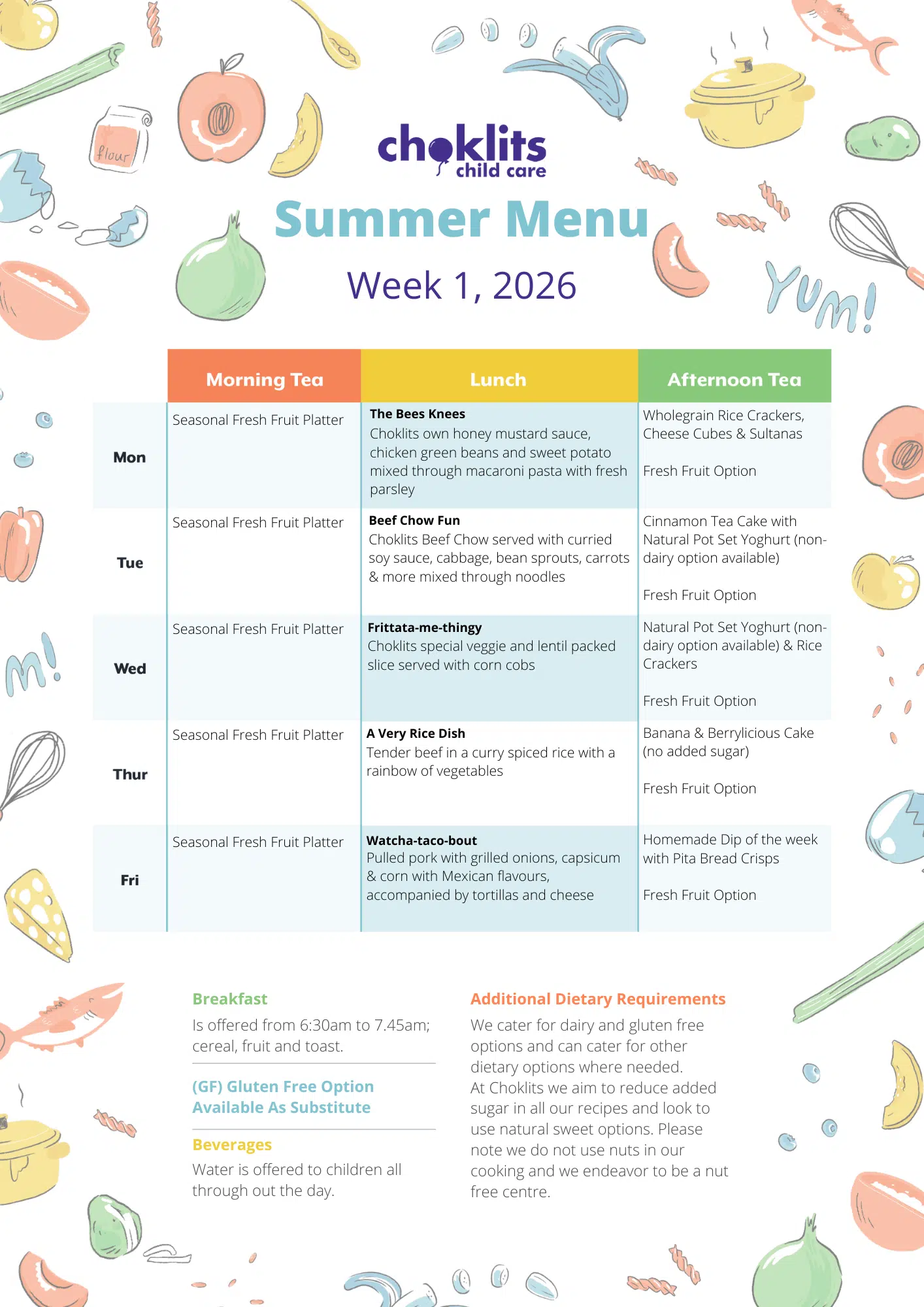
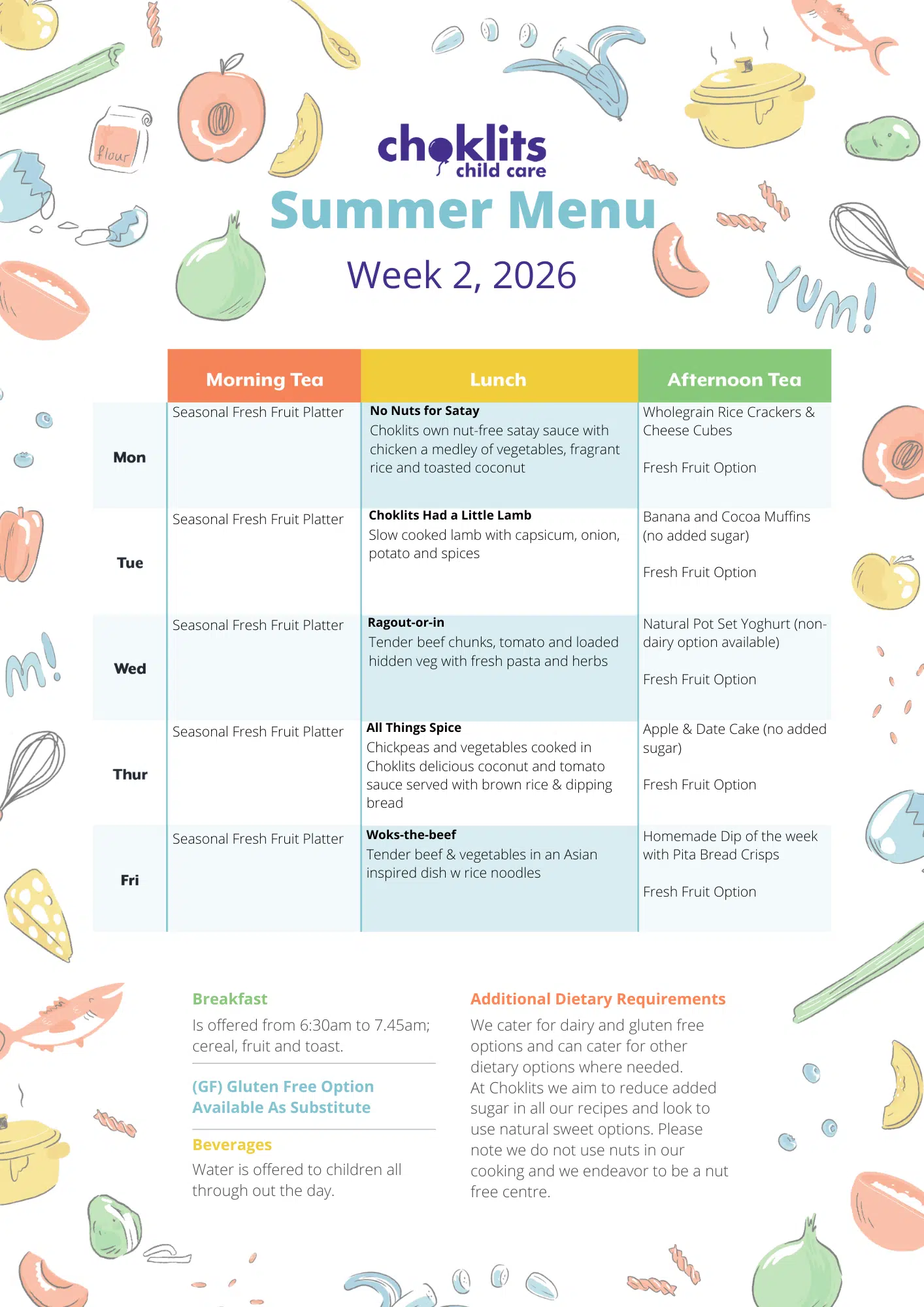
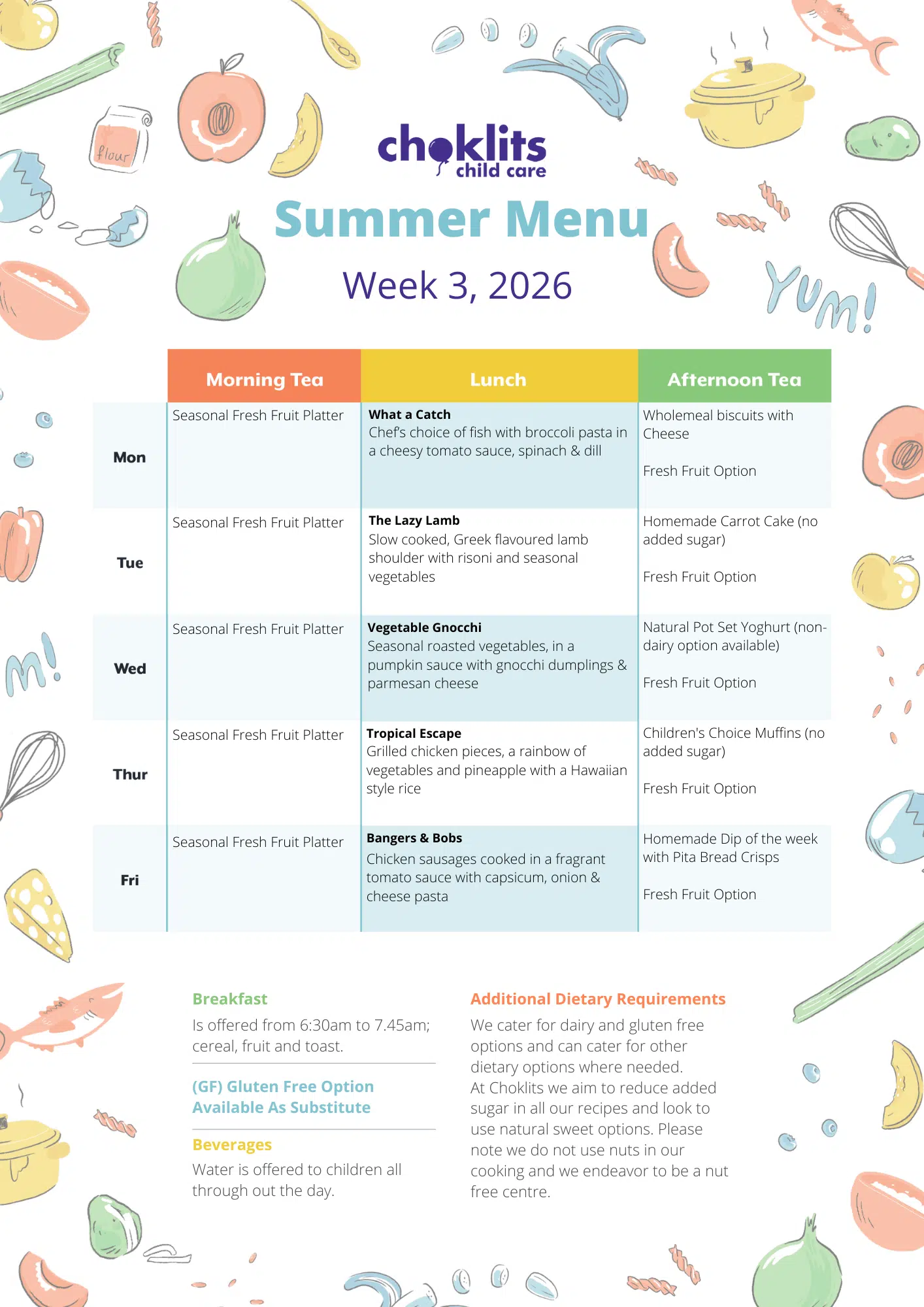
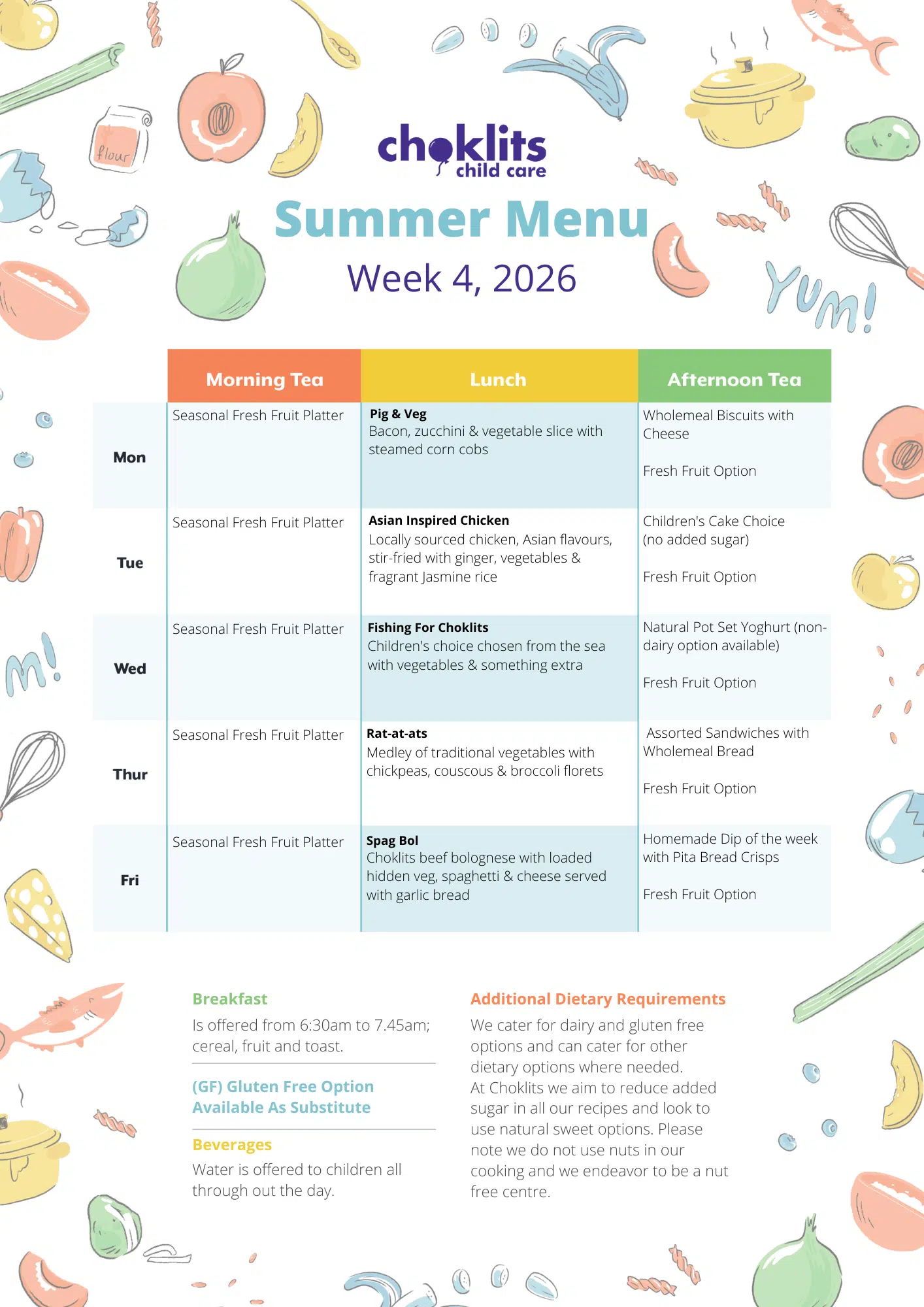
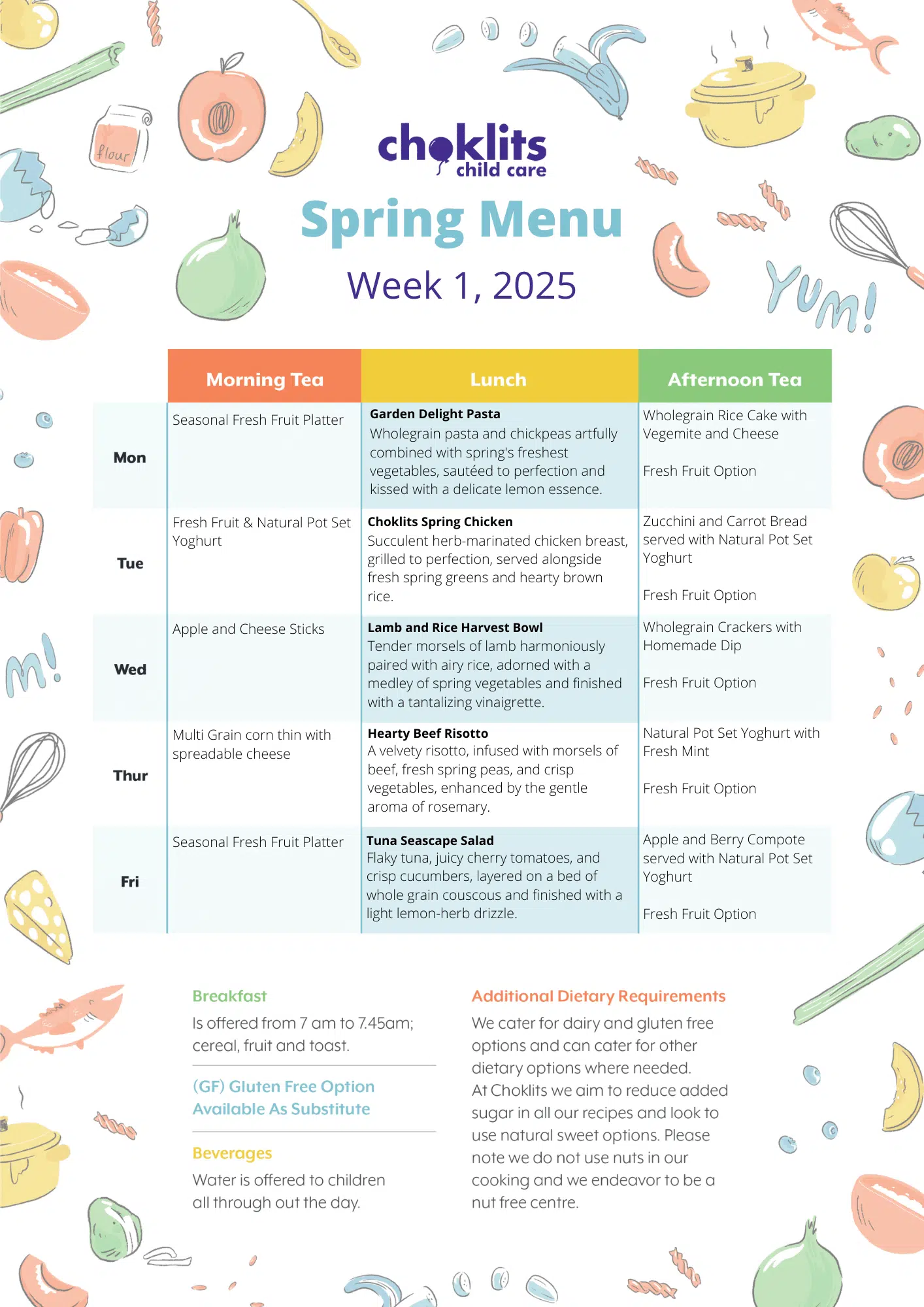
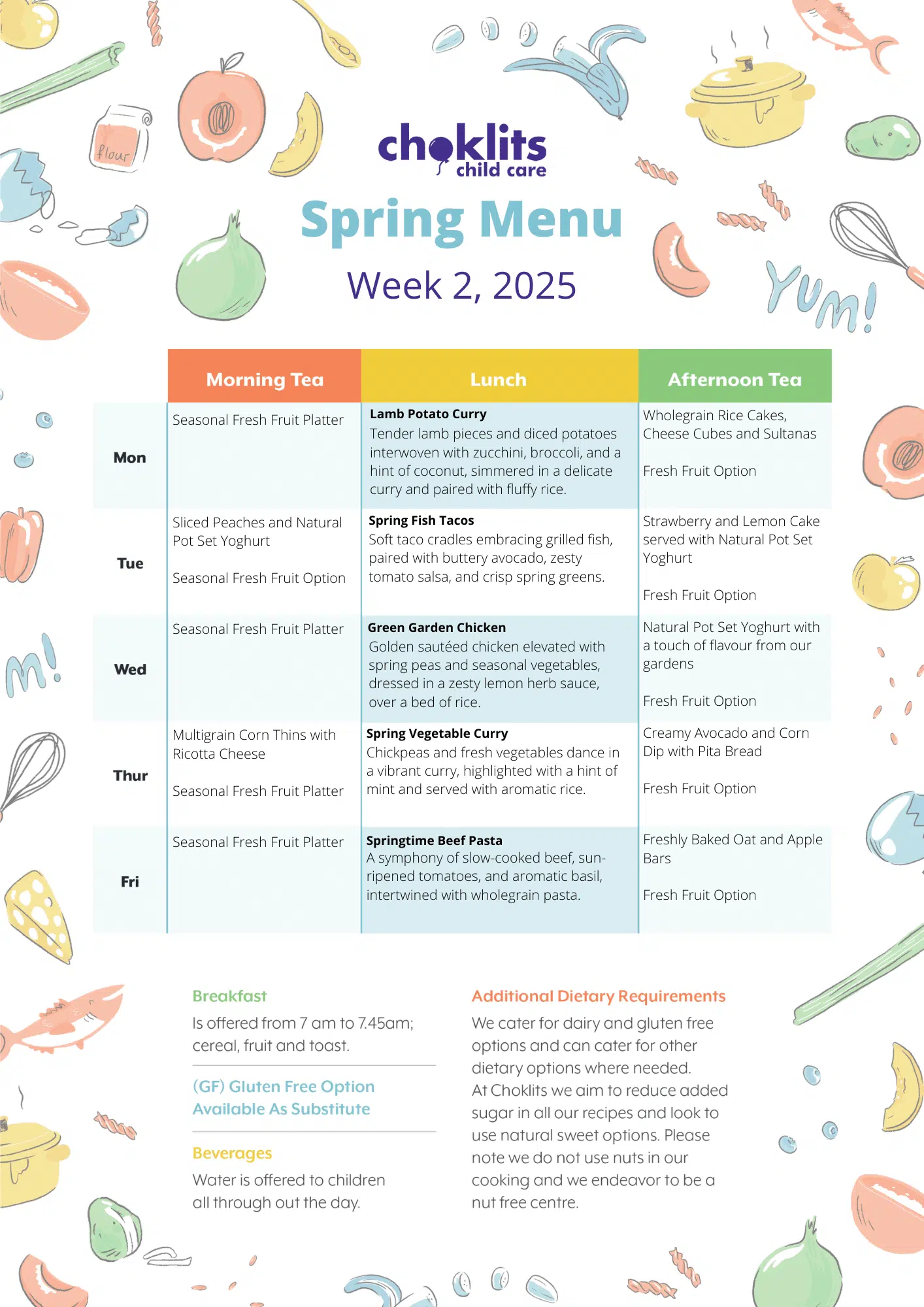
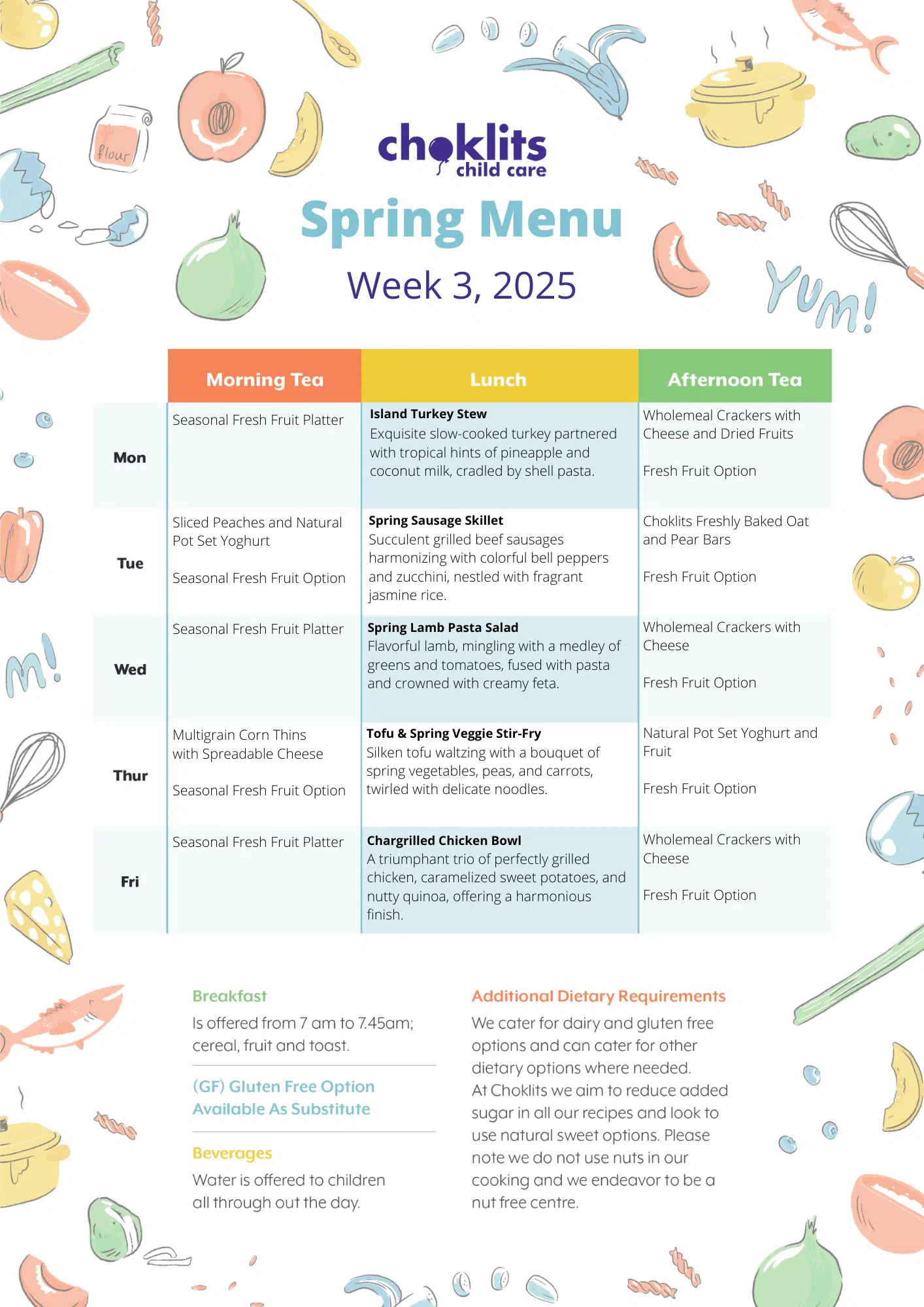
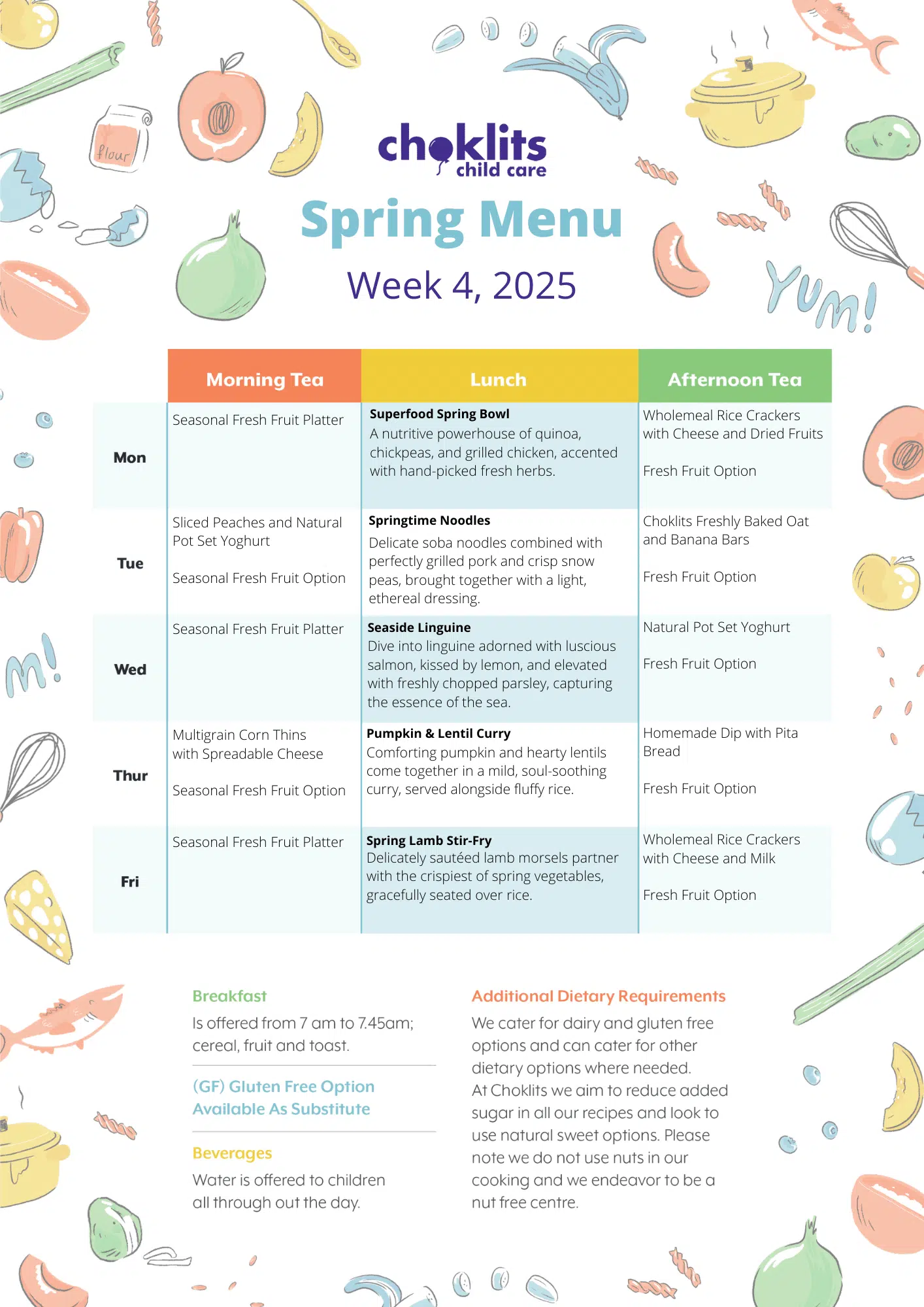
Spring is here, and so is our fresh Spring Menu for 2025! It is packed with light, colourful meals that suit the season and fuel busy little bodies. Our menu is approved by Nutrition Australia’s Healthy Eating Achievement Programme and aligns with the Early Years Learning Framework (EYLF). That means every meal supports children’s health, learning, and a positive relationship with food.
Across the four weeks, children will enjoy a mix of wholegrains, lean proteins, legumes, dairy, fruit, and plenty of vegetables. Highlights include:
Morning and afternoon teas feature seasonal fruit, yoghurt, homemade breads and bars, dips with crackers or pita, and other simple, nourishing snacks. Gluten-free and dairy-free alternatives are available, and all our services continue to be a nut-free.
The EYLF reminds us that mealtimes are part of learning. Our spring menu encourages children to:
Every day offers balance: carbohydrates for energy, protein for growth, dairy or alternatives for bones and teeth, and fruit and vegetables for fibre and vitamins.
This spring, Chefs Jordan, Lai and Tayani will again lead our Plant to Plate programme, giving children hands-on gardening and cooking experiences.
We have learned that children are far more likely to try new foods when they have grown or helped prepare them. This reduces some of the barriers families face at home and turns “I don’t like that” into “I made that”. The programme supports EYLF outcomes around wellbeing, confidence, and connection to the environment, while building real-world skills in a fun, calm setting.
Thank you for trusting us to nourish your children. Our Spring Menu 2025 brings bright flavours, balanced nutrition, and rich learning – on the plate and in the garden. We look forward to a season of curiosity, tasting, and joyful mealtimes.
If you have any questions about our new menu, please visit our Facebook and Instagram pages or stop by the office when you’re next at Choklits.
Zac remembers what it felt like to be a high-energy five-year-old. That’s how old he was when he first stepped onto a judo mat – and honestly, it changed everything. Now, with over 10 years of experience teaching in schools, Zac is bringing his passion for judo to Choklits every month!
But judo isn’t just about throws and takedowns. It’s a martial art, a sport, and maybe most importantly, a way to help children grow in all kinds of ways – physically, socially, and emotionally.
Judo is a Japanese word that means “the gentle way.” It was created way back in 1882 by Dr Jigoro Kano, who believed that using technique – not just strength – was the key to success. Today, judo is even an Olympic sport!
At Choklits, we know young children learn best by doing. Through movement, play, and connection with others, they build skills that last a lifetime. Judo fits right in.
The Early Years Learning Framework (EYLF) highlights the importance of physical wellbeing. Judo supports this beautifully – it helps children build strength, balance, and confidence, all while having fun.
Judo helps children move in smart, safe ways. One of the first things they learn is how to fall. It might sound simple, but it’s a big deal. In judo, this is called ukemi – a skill that helps prevent injuries, whether they’re on the mat or playing at the park.
Zac teaches this step-by-step, making sure every child feels safe and supported. And while it might look like just tumbling to the outside eye, children are actually learning how to protect themselves – and that’s powerful.
All of this connects with EYLF Outcome 3: Children have a strong sense of wellbeing. They’re not just moving; they’re learning to trust their bodies and their growing abilities.
Judo isn’t wild or chaotic – it’s actually very structured. Each class follows a clear plan, and children learn to listen, concentrate, and remember what comes next. That kind of quiet focus takes practice.
And the more they try, the better they get. Sure, sometimes a move doesn’t work the first (or fifth) time. But that’s okay. In fact, it’s expected. Zac gently encourages children to keep going, and over time, they begin to believe in themselves a little more.
This growth in confidence and persistence supports EYLF Outcome 1: Children have a strong sense of identity.They’re discovering they can do hard things – and that feels pretty amazing.
You might think judo is a solo sport – but it’s not. Children work in pairs, learning to be patient, take turns, and help each other. One child’s success depends on how well they listen and work with their partner. That builds a quiet kind of teamwork that sticks.
Before and after class, everyone bows to Zac and each other. It’s a small gesture, but it means a lot. It teaches that we respect ourselves, our teachers, and the space we’re learning in.
These shared rituals support EYLF Outcome 2: Children are connected with and contribute to their world. Through judo, they learn that respect isn’t just taught – it’s practiced.
Judo is about using your body to protect yourself – not to hurt others. And that’s an important difference. While children do learn self-defense basics, the focus is on staying calm, being aware, and using skills responsibly.
It’s not about being aggressive. In fact, judo often helps children who struggle with emotional regulation find a calm and positive outlet. They learn where their energy can go, and how to use it in a safe way.
This directly connects to EYLF Outcome 4: Children are confident and involved learners. Judo helps them manage their emotions and actions through controlled, guided movement.
Every child is different. That’s why Zac designs each class with flexibility in mind – so all children feel included and challenged in the right ways.
Room leaders will continue to observe your child’s progress and share notes about what they’re learning and how they’re growing through judo. That way, you’ll see the links between their movement and their overall development.
At Choklits, we believe early learning should be active, joyful, and meaningful. Judo brings all of that – and more. Children move their bodies, grow their minds, and build strong relationships, all while having a really good time.
Consider exploring judo as an enrichment activity for your child – the lessons learned on the mat truly do extend into every aspect of life, creating stronger, more confident learners who are well-equipped to face future challenges.
We’re excited to have Zac and his energy at Choklits, and we can’t wait to see the smiles, the progress, and the proud little bows after class.
—
Want to learn more about how we incorporate physical activity and character development into our programs? Book a tour to visit our center and see our activities in action. Follow us on social media for regular updates and ideas you can try at home.
Looking for more information about our approach to holistic child development? Contact Choklits Child Care to learn about our programs and how we make every day special for our children.
—
Composed by Choklits Owner Matt Reynolds
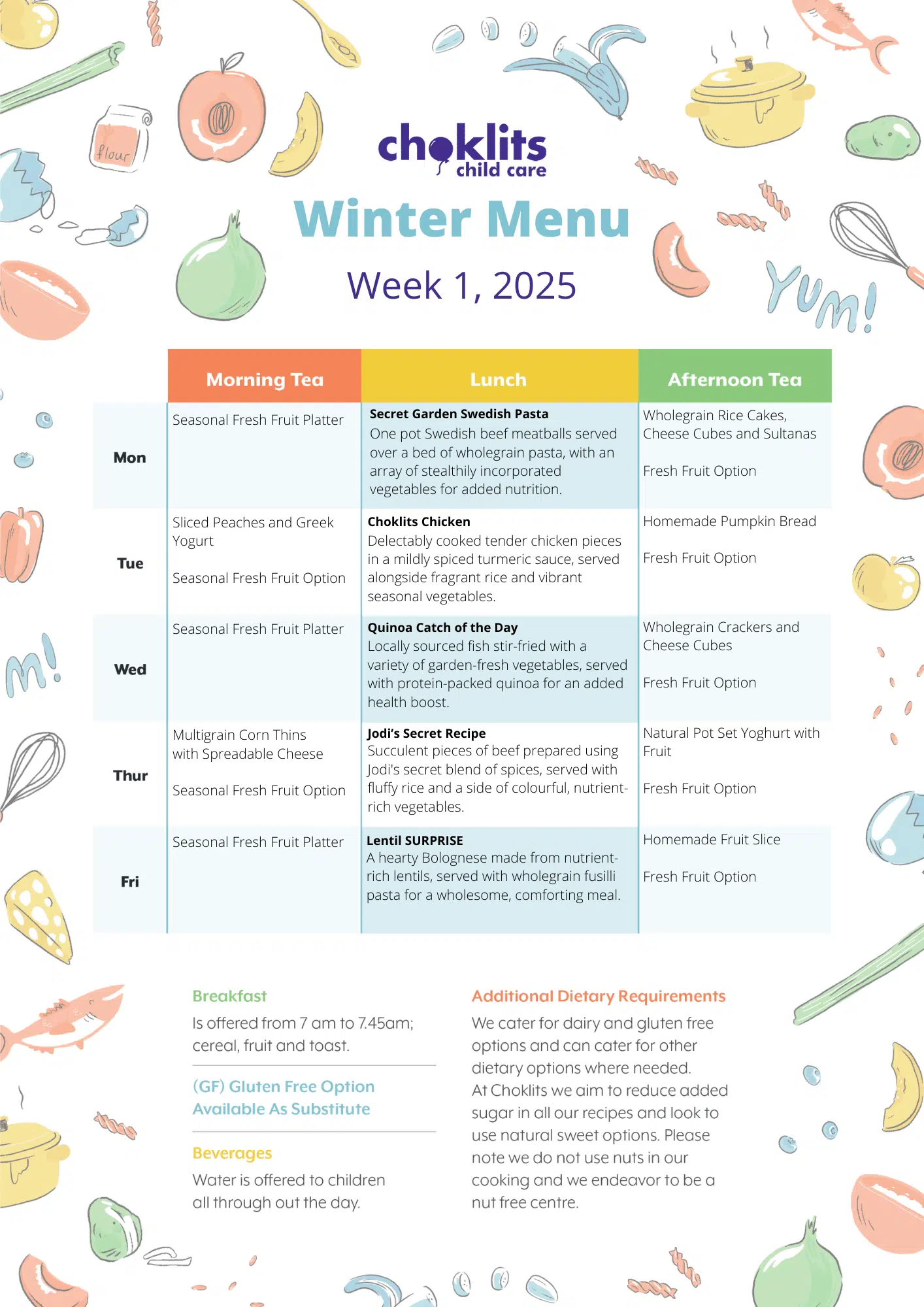
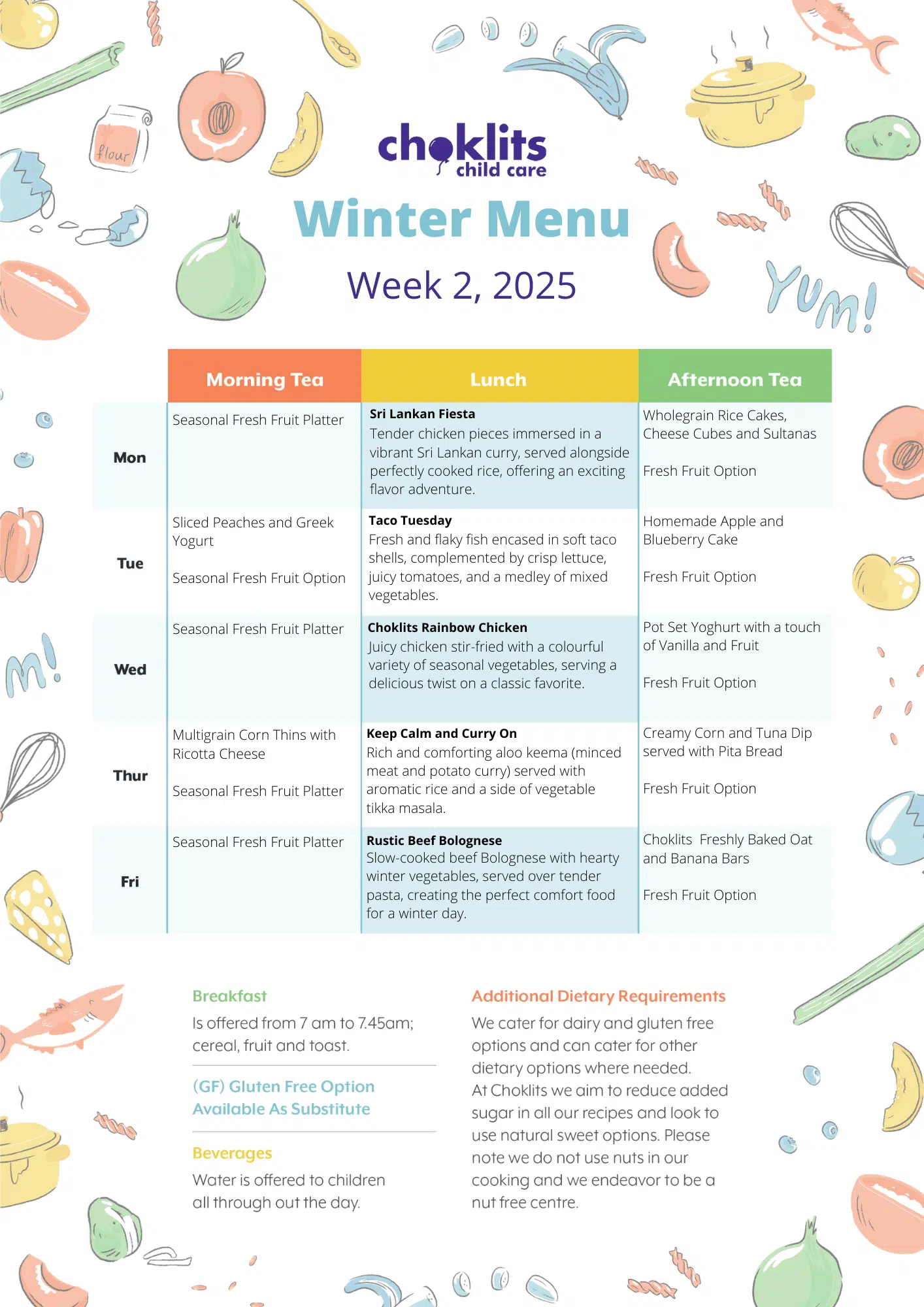
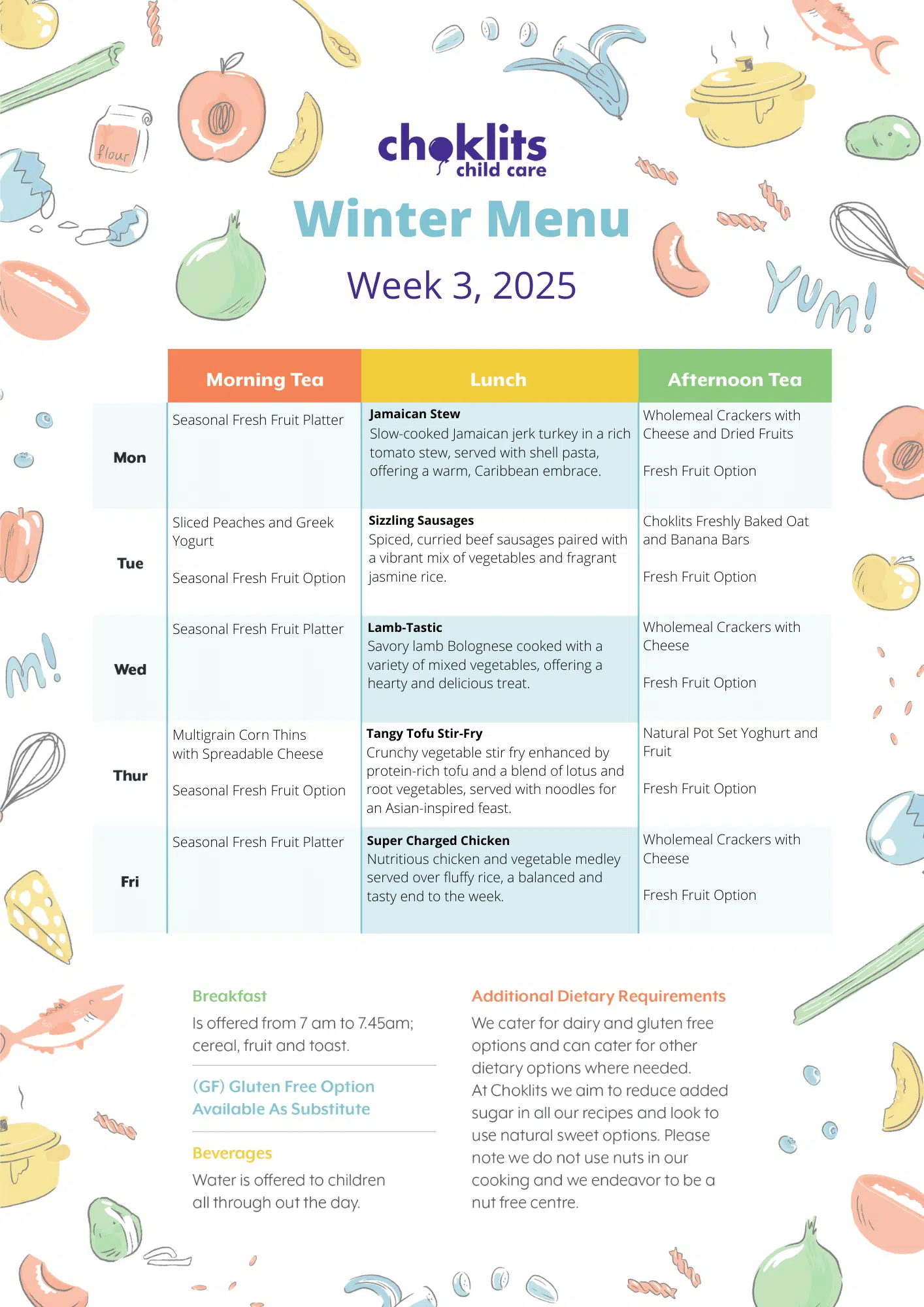
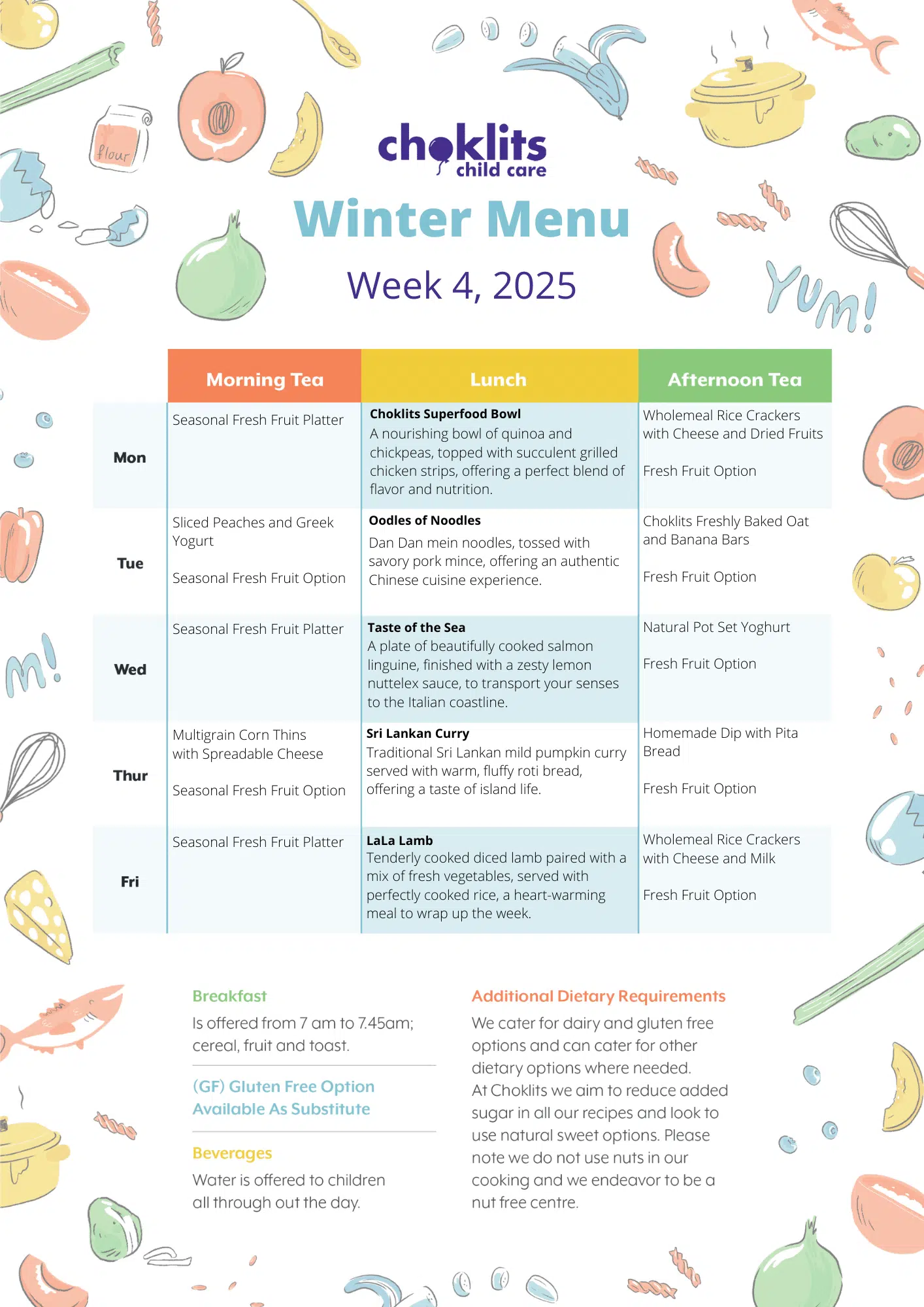
As the cooler weather settles in, we’re excited to share our brand new Winter Menu for 2025. Designed to nourish growing bodies and warm little tummies, this season’s menu is filled with hearty, wholesome meals that celebrate fresh, seasonal ingredients.
As always, our menu is approved by Nutrition Australia’s Healthy Eating Achievement Program and carefully aligned with the Early Years Learning Framework (EYLF). That means every dish your child enjoys at Choklits supports not just their health, but their learning and development too.
From Mondays to Fridays, your child will enjoy a variety of warm, flavourful meals that are both comforting and packed with goodness. Highlights from this season’s offering include:
Every lunch is complemented by a morning and afternoon tea offering, including seasonal fresh fruit, wholesome snacks like homemade oat bars, and nourishing options such as yoghurt, muffins, and vegetable dips. Our team also ensures that gluten-free, dairy-free, and other dietary needs are always accommodated.
Our food program goes beyond nutrition. The EYLF highlights the importance of healthy eating in shaping children’s sense of wellbeing, identity, and belonging. At Choklits, mealtimes are a chance to build independence, try new things, and enjoy shared experiences with peers.
By engaging with a menu rich in colour, texture, and cultural variety, children also develop healthy habits and a positive relationship with food—skills that will benefit them for life.
This winter, we’re also delighted to share that Chefs Jordan, Lai, and Tayani will once again be leading our much-loved Plant to Plate programme at Choklits.
This hands-on initiative helps children build a direct connection with the food they eat by involving them in every step of the process—from planting and nurturing to harvesting and preparing vegetables straight from our centre gardens.
For our younger children, the experience is all about exploration and building foundational skills. They’ll practise how to safely hold and use child-friendly utensils, and engage all five senses as they feel soil, smell fresh leaves, and observe how plants grow.
For older children, the programme becomes a full seasonal cycle. They’ll help to plant seeds, care for the garden, pick the produce, and finally, prepare and taste the meals they’ve helped bring to life. It’s an empowering process that supports both practical life skills and a sense of accomplishment.
Importantly, children who are involved in growing and preparing their own food are much more likely to try new vegetables and dishes. For many parents, getting children to try new or unfamiliar foods at home can be a daily challenge. The Plant to Plate programme helps to break down these barriers—children are far more open to tasting something they’ve grown or helped to cook themselves. That sense of pride and ownership can turn “I don’t like that” into “I made that!”
This programme supports the EYLF’s focus on learning through play, developing autonomy, and building a strong sense of identity and connection with the world around us—all while having a whole lot of fun.
We’re proud of the thoughtful work that goes into every plate of food served at Choklits, and we’re even prouder to see how much the children enjoy it. The Winter Menu 2025 reflects our continued commitment to health, sustainability, and joyful mealtimes.
Thank you for trusting us to provide not only safe and delicious meals, but experiences that help your children learn, grow, and thrive.
If you have any questions on our new menu please head to our Facebook and Instagram pages or pop in and see us when you’re next at the service.
Here’s to our Winter Menu,