The Benefits of Messy Play: What Babies, Toddlers and Preschoolers Learn When the Mess Is the Point
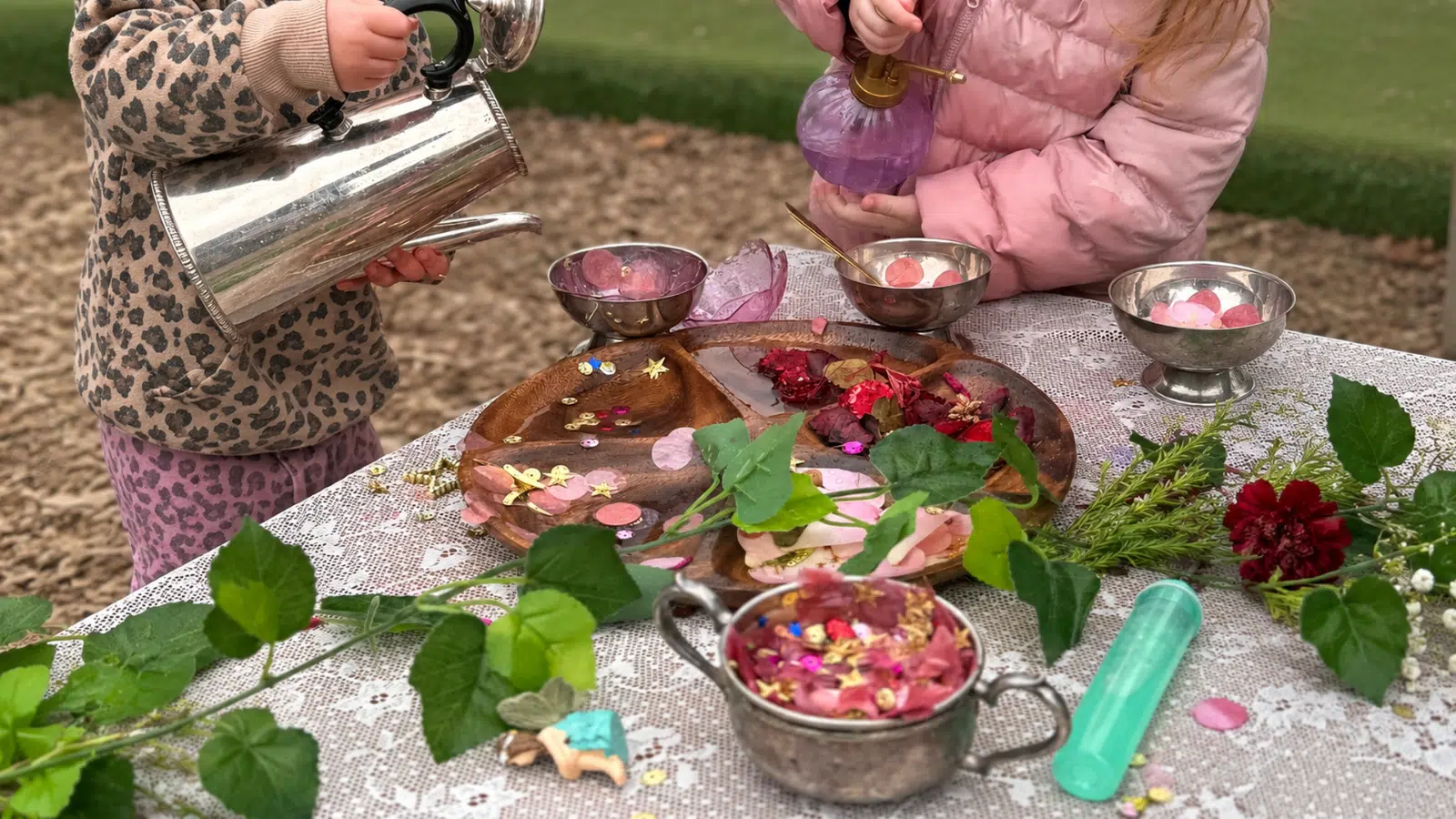
A silver teapot tips and pink water spills across a wooden tray already scattered with rose petals, gold stars and a sequin or two. Somebody is misting the whole scene with a purple spray bottle. Somebody else has decided the little tin bowl needs more petals, then fewer, then more again. It looks like a tea party for fairies, and in a way it is. It is also a stretch of deep, focused learning, and the child who walks away with wet cuffs and pink fingertips has been far busier than they look. This is messy play at Choklits. If you have ever wondered what your child actually gets out of it, beyond a good time and a change of clothes, this article is for you. Below we cover what messy play is, the benefits of messy play at each age from six months to five years, what the research says, and the themed sessions our messy play specialist Asten runs across our Croydon, Ringwood and Surrey Hills centres.
What is messy play, and how is it different from sensory play?
Messy play is open-ended play with materials that change when a child handles them. Water, paint, sand, mud, clay, foam, coloured rice, cooked pasta, shaving cream, bicarb fizz. There is no finished product and no correct way to do it. The child decides whether the paint is for painting, pouring or squeezing between their fingers, and that decision is where the learning starts.
Sensory play is the broader category. It covers any play that feeds the senses, including plenty that is not messy at all, like a basket of textured fabrics or a tray of dry autumn leaves. Messy play is the corner of sensory play where touch leads and the material gets everywhere. Most of the benefits below apply to both, but messy play tends to offer the richest version of them, because the materials keep changing as the child works.
One thing messy play is not: a craft with a mess attached. If every child is meant to finish with the same painted paper plate, that is craft, and craft is lovely. Messy play is when the material itself is the point and the child is the scientist.
Meet Asten, our messy play specialist
Asten has been part of the Choklits family since 2001. She is our Educational Leader and our messy play specialist, and she is the person our educators call whenever a room needs some inspiration to create an engaging sensory play activity.
What sets Asten apart is that she does not treat messy play as a generic tub of goop. She designs themed sessions, and she takes them to all three Choklits services, so children at Croydon, Ringwood and Surrey Hills each get to experience them. A theme might be a famous artist, a season, a favourite story or a place, and it shapes every choice on the table: the colours, the materials, the tools, the words the educators use, and the small surprises tucked into the setup.
Her Monet water lily potion play is a good example. Metallic paint swirled into water in a tuff tray until it looked like the surface of a pond. Teapots and cups filled with shimmering potions. Plastic lilies and leaves, green spaghetti standing in for pond weed, tapioca pearls in purple and pink, and small plates of bicarb and citric acid that fizzed to life the moment a child poured water on them. It opened a whole month themed around world famous artists, and from a few steps back it looked a lot like the painting.
Asten also works with rescued and recycled materials wherever she can. Strainers from risotto tubs, clean jar lids, cardboard from our nappy deliveries, and pasta and rice that local restaurants can no longer serve but that is perfect for play. She sources from Reverse Art Truck in Ringwood and NQR too. As she puts it, we do not waste food here.
If you would like to watch a setup come together, follow Choklits on Instagram, where we post one of Asten’s play setups every Sunday.
The benefits of messy play, and what the research says
It is easy to assume the main benefit of messy play is that children enjoy it. They do, and joy is reason enough. But underneath the fun, a great deal is happening. Here is what messy play tends to build, and why.
Sensory processing and brain development
Young children learn about the physical world mostly through touch. When a child squeezes cold paint, presses a palm into wet sand or lets tapioca pearls slide between their fingers, they are gathering information about weight, temperature, texture and resistance, and their brain is sorting that information into categories it will draw on for the rest of their life. Every new texture is another entry in the file. Children who get plenty of varied sensory experience in the early years often find new sensations easier to handle later on, from a scratchy school jumper to a food they have never tried.
Language and vocabulary
This is the benefit that surprises parents most. Researchers at the University of Iowa studied how 16-month-olds learn the names of non-solid things like applesauce and pudding, and found that toddlers who poked, squished and generally got messy with the substances were better at learning the words for them. The reasoning is simple once you see it: gooey things do not hold their shape, so a child has to explore what the stuff is made of before the word can stick.
There is an everyday reason too. Messy play is full of talk. Educators narrate what is happening (that one is cold, this is sticky, look, it is dripping) and children reach for describing words they rarely need at the block corner. Slimy, gritty, foamy, lumpy, drippy, fizzy. These are words you learn with your hands.
Fine motor skills and pre-writing
Pouring from a teapot without tipping it, squeezing the trigger of a spray bottle, pinching a single star out of the water, scooping rice into a cup. Each is a small workout for the muscles of the hand, wrist and forearm, and for hand-eye coordination. They are the same muscles a child will later use to hold a pencil, do up buttons and control scissors. Messy play builds them without a single worksheet in sight.
Early science and maths thinking
Messy play is usually where children first meet cause and effect in a form they can control. Pour water on the bicarb and it fizzes. Add more water and the paint goes pale. Tip the cup and the tray floods. Children make a prediction, test it and adjust, which is the scientific method in miniature. They meet early maths in the same way: full and empty, more and less, heavy and light, how many scoops it takes to fill the bowl. The Early Years Learning Framework describes this as children developing skills such as problem solving, inquiry, experimentation and hypothesising. In practice, that is a tuff tray on a Tuesday morning.
Emotional regulation, confidence and calm
There are no wrong answers at a messy play tray, which makes it a low-pressure place to try things. A child who worries about getting things right can pour and mix without any way of failing. For many children the repetitive, rhythmic parts of messy play (stirring, sifting, scooping) are also soothing, in much the same way kneading dough or running your hands through sand can be for adults. Our educators often use a tray to help a child settle after drop-off or after a big feeling, and Raising Children Network suggests messy play as one healthy outlet for toddlers’ emotions.
Social skills and communication
A shared tray is a shared project. Children negotiate who gets the teapot, notice what a friend is doing and copy it, hand over the spray bottle when asked (eventually), and talk about what they are making. For toddlers who are just starting to play alongside and then with others, messy play gives a natural reason to interact, with none of the pressure of a game with rules.
Creativity and imagination
Because there is no finished product, children are free to decide what the materials are. The pink water is tea, then potion, then soup. The petals are food, then decorations, then treasure. A theme gives that imagination something to hold onto, which is exactly why Asten builds her sessions around a story rather than a random assortment of stuff.
Messy play benefits by age
Babies (around 6 to 12 months)
Messy play for babies is all about safe-to-mouth materials and simple textures: cooked pasta, yoghurt with a drop of food colouring, cool water, edible finger paint, jelly. The benefits are mostly sensory and motor: learning to grasp, release, pass something from hand to hand, and get used to new textures. Sessions are short and everything is taste-safe, because a baby’s first instinct is to put it in their mouth, and that is a perfectly good way to explore.
Toddlers (1 to 3 years)
lets them find out at their own pace: pouring and filling, mixing colours, squishing, dumping out and starting again. The big gains here are language, fine motor control and the early cause-and-effect thinking that underpins later science and maths. It is also where many children first practise sharing space and materials with someone else.
Preschool and kinder children (3 to 5 years)
Older children bring more to the tray: stories, plans, predictions. A themed setup lets them connect what they already know (Monet painted water lilies; fairies would probably drink flower tea) to what they can make with their hands. At this age messy play supports more complex problem solving, longer concentration, richer descriptive language and collaborative play, and it strengthens the hand for the writing that is coming. The EYLF’s picture of a confident and involved learner, curious, persistent and imaginative, looks a lot like a four-year-old at a well-designed messy play table.
Babies (around 6 to 12 months)
Anyone can put out a tray of shaving cream, and there is nothing wrong with that. Asten’s themed sessions do something extra.
- A theme gives children a story to play inside. The Monet setup is not just paint and water. It is a pond, and ponds have weeds and lilies and creatures, and somebody at the pond might need a potion.
- A theme brings its own vocabulary. Petals, pond, potion, fizz, shimmer, mist. New words arrive with the things they name.
- A theme connects ideas across the day. When a month is about famous artists, the prints on the wall, the books at story time and the tray outside are all talking to each other.
- A theme travels. Because each session is built to move between centres, a child at Croydon and a child at Surrey Hills share the same rich experience, and the educators in each room extend it in their own way.
- A theme scales. The same story can be pitched to babies, toddlers and kinder children with different materials, so siblings in different rooms often end up playing the same idea at their own level.
How we keep messy play safe
Parents rightly want to know that the fun is safe. Every messy play session at Choklits follows the same rules.
- Materials for our youngest children are taste-safe.
- Where food materials are used, the play is closely supervised at all times, and the food we use is always food that is past its use-by date and would otherwise be thrown away. No food is wasted here.
- Materials are checked against the allergy information for the children in that room.
- Small loose parts, like the stars and sequins in a fairy tea party, are matched to the age of the group and used with close supervision.
- Every session is supervised by trained educators, start to finish.
- Hands are washed before and after, and yes, sleeves will get wet. A spare set of clothes in the bag is always a good idea.
What if my child hates getting messy?
Some children dive straight in. Others hang back, hold their hands out to be wiped, or point at the tray and say no. This is completely normal, and it is not a problem to fix. Sensory preferences vary a lot between children, and a child who cannot stand slime this month may love it by spring.
At Choklits, no child is ever made to touch anything. Educators offer a bridge instead: a spoon, a paintbrush, a cup, a long-handled scoop. Tools let a child take part at arm’s length and move closer only when they are ready. Watching counts too. A child who stands beside the tray narrating what their friends are doing is learning plenty. Over weeks, most reluctant children edge in on their own terms, and the confidence that comes from choosing to touch something new is worth far more than being hurried into it.
If you notice strong reactions to textures at home as well, from clothing labels to certain foods, it can be worth mentioning to your room leader or your maternal and child health nurse, who can help you work out whether any extra support would be useful.
Bringing messy play home, without wrecking the house
Parents tell us all the time: I love that you do this here, because I would never do it at home. Fair enough, and we are glad to handle the big messes. If you would like a small version at home, a few principles keep it manageable.
- Contain it. A baking tray, a large plastic tub or the bath keeps the mess in one place.
- Take it outside. Water play on the grass or mud in the garden needs almost no clean-up.
- Use what you have. Cooked pasta, a bowl of water with a drop of food colouring, a spoon and a couple of cups is a full session for a toddler.
- Keep it short and end well. Ten minutes with a bucket of warm soapy water nearby beats an hour that ends in tears.
For step-by-step ideas, including a sensory rice box and a recycled construction site, see our earlier post, The Magic of Messy Play.
Messy play and the Early Years Learning Framework
Messy play sits naturally under Outcome 4 of the EYLF V2.0, where children become confident and involved learners, and under Outcome 5, where they become effective communicators. It also touches the other three: children express preferences and make choices (Outcome 1), care for materials and learn about reuse (Outcome 2), and build physical skill and a sense of calm (Outcome 3). Messy play is part of our CHOKLITS+ program.
Frequently asked questions
What age can children start messy play?
From around six months, with taste-safe materials and close supervision. At Choklits, messy play begins in our nursery rooms.
Is messy play the same as sensory play?
Messy play is one kind of sensory play. Sensory play includes any play that engages the senses, messy or not. Messy play is the hands-on, gets-everywhere kind, and it tends to give the richest sensory experience.
How often do Choklits children do messy play?
Messy and sensory play is a regular part of the play based program in every room. Asten’s themed sessions run on top of that and rotate across all three centres.
My child has allergies. Is messy play safe for them?
Every room keeps up-to-date allergy information for its children, and the materials for a session are checked against it. If your child develops a new allergy or intolerance, letting your room leader know is the most helpful thing you can do.
Will my child’s clothes be ruined?
They will get wet and probably marked. Paint and food-based materials are generally washable, and a spare set of clothes in the bag means nobody has to go home damp.
Come and see the mess for yourself
The best way to understand messy play is to watch a child in the middle of it. You are welcome to book a tour at Croydon, Ringwood or Surrey Hills and bring your little one along. Ask about Asten’s next themed session while you are there, or follow Choklits on Instagram, where a new play setup from Asten goes up every Sunday. Questions about our program are always welcome through our contact page.