
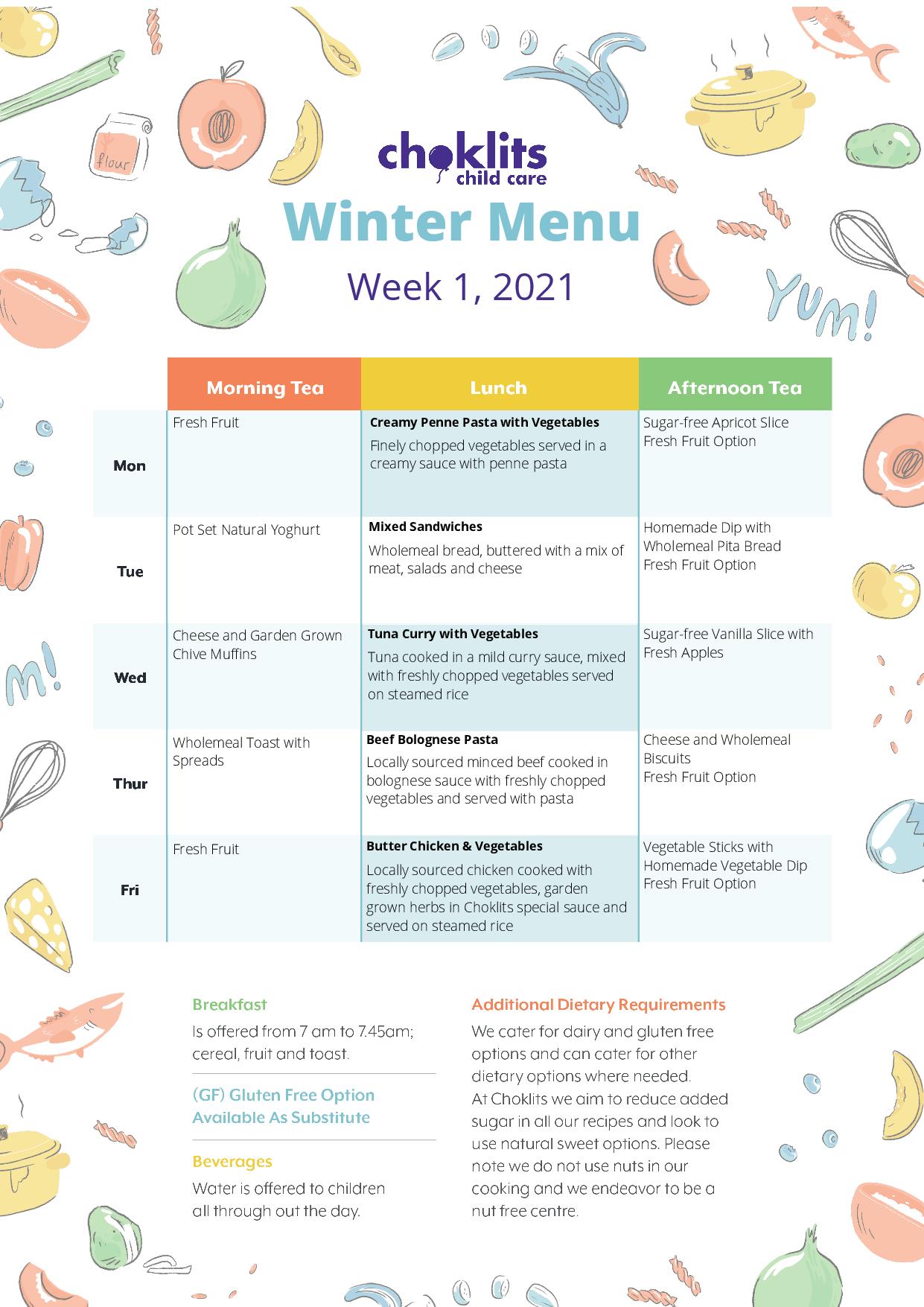
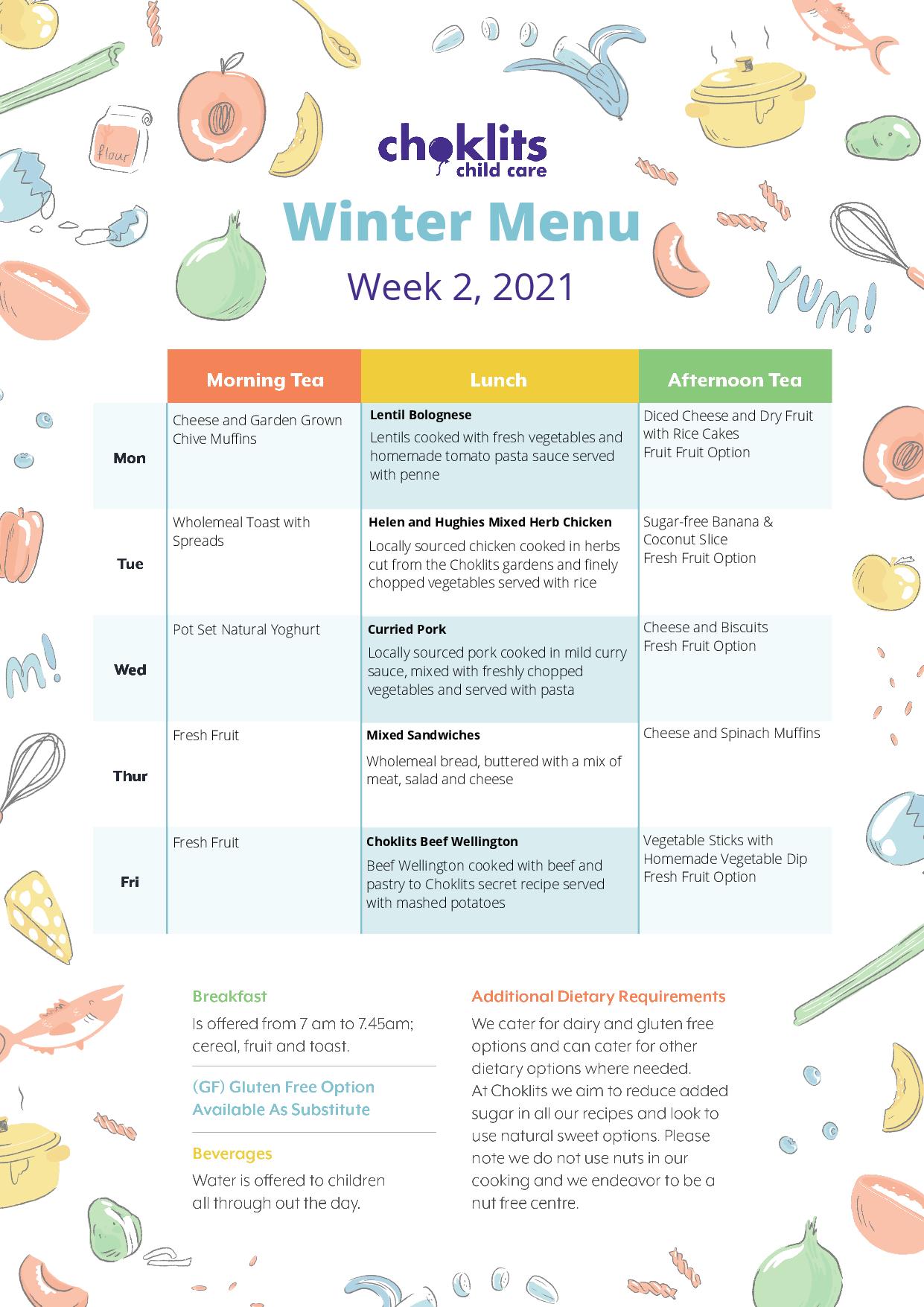
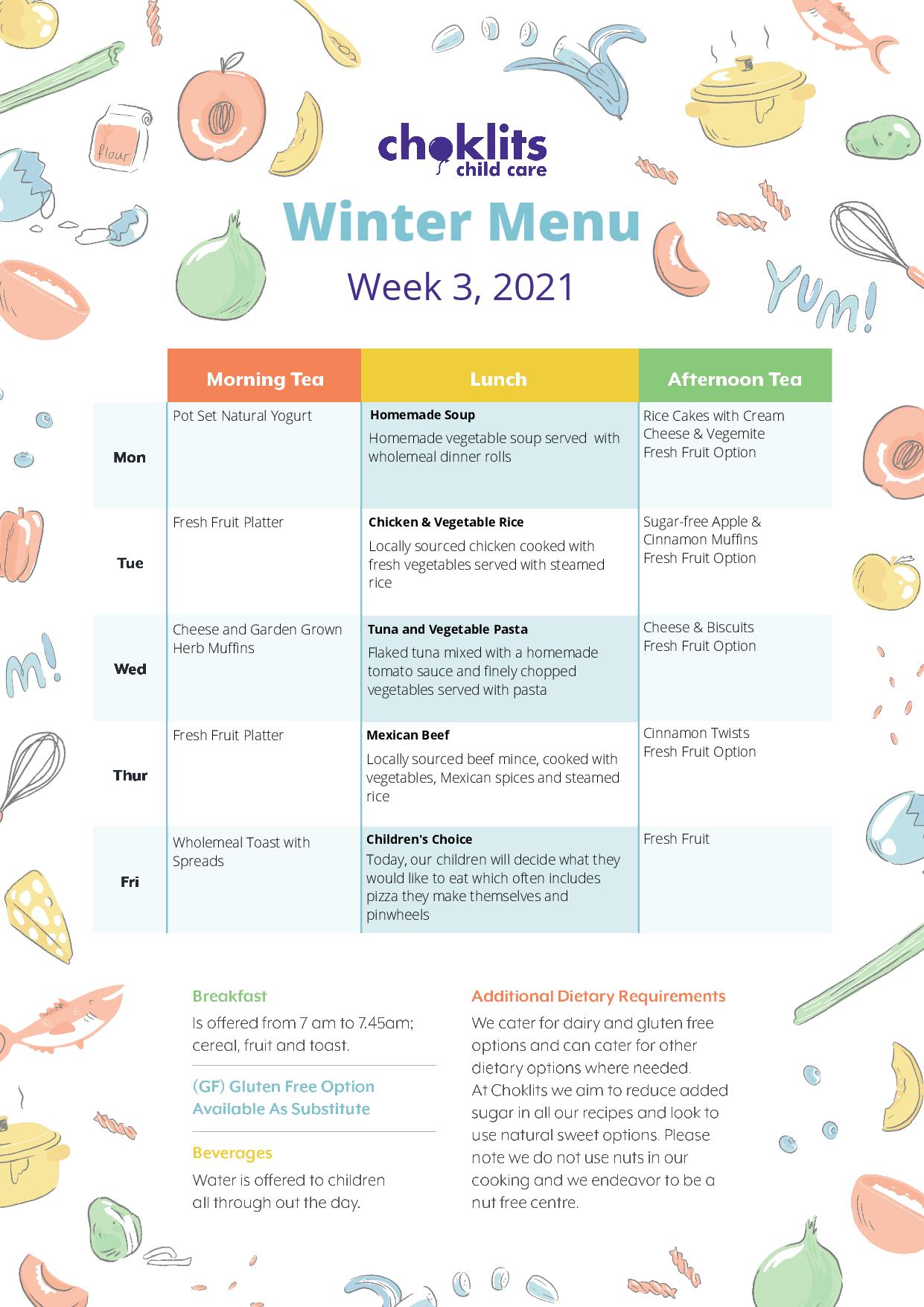
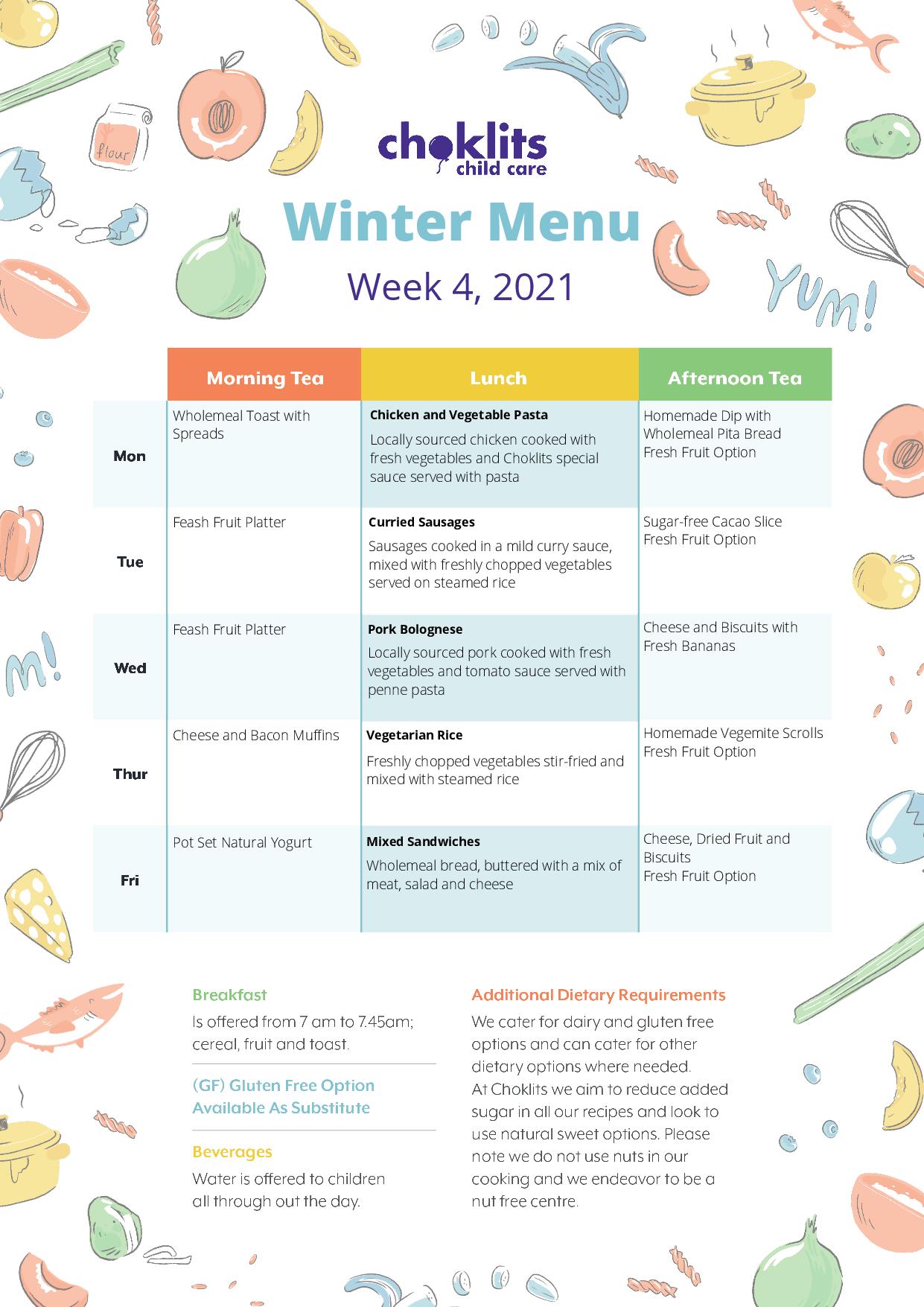
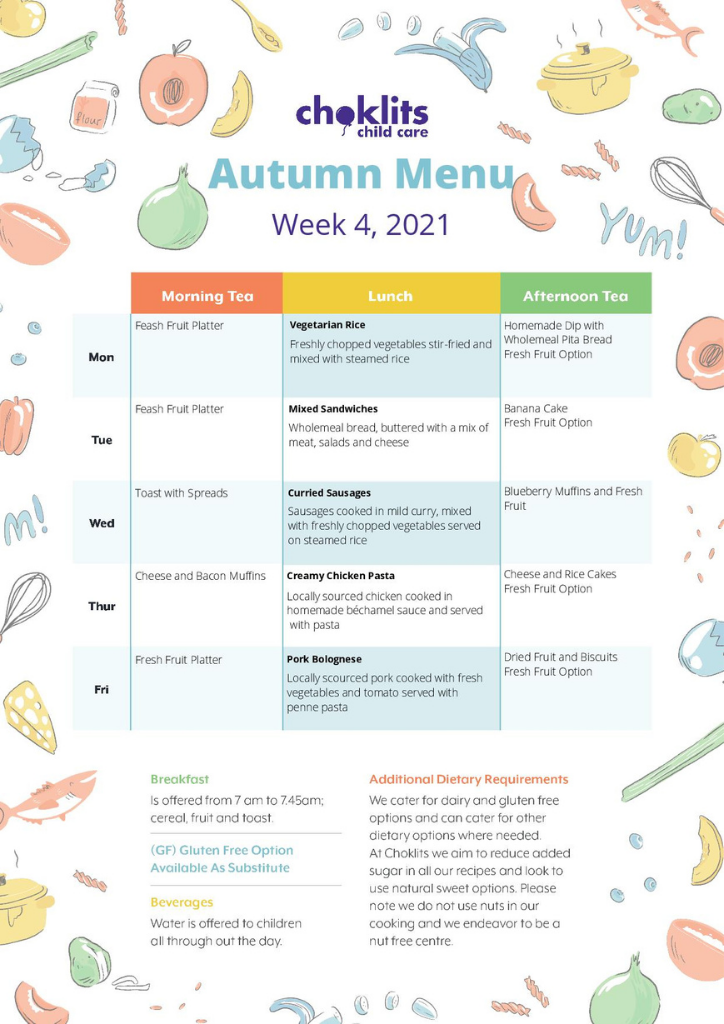
Hello Choklits Community, I’m pleased to share the new Choklits seasonal menu, Winter 2021!
We have been busy experimenting here recently and have added quite a few new dishes to our Winter menu, I really hope you like them. I already know our children love them because they have shared their ideas and have actually helped me create a few of them.
The children continue to enjoy all the real world experiences we facilitate at Choklits in relation to food. From setting up markets where the children “purchase” (with Choklits dollars) their own veggies to cook, to having lunch at the Choklits Cafe and, of course, coming into the kitchen and helping cook their own meal the children get so involved in the process, it really does melt my heart.
And the best part? As I’ve written many times before, as soon as the children become involved in the process and know they have some control over the outcome, they are much more willing to try new foods and over time become more open to further learning! It’s like kitchen magic!
In a first at Choklits, I was very happy to have the help for a couple of days over the past month from one of our past Choklits students, Hubert. After showing some interest in cooking, Hughie joined me for a couple of days to get some experience first hand from inside the Choklits kitchen. We cooked, told jokes, did plenty of taste testing and had a lot of fun. He even helped me with the kitchen paper work, I thought that was pretty special especially for a 6 year old! As you’ll see in the menus posted below, we even came up with our own recipe!
Anyway, the kitchen door is always open at Choklits so if you’d like to talk about food or cooking or basically anything really, please drop in and say hello as I love hearing your stories and learning about our families.
Don’t forget, I occasionally make a little extra food so if you connect with us on Facebook and follow us on Instagram you’ll know exactly when I have something for you to try.
Please enjoy our 2021 winter menu…
Helen Rooney
Choklits Chef, Choklits Child Care Centre
If lockdown has taught us one thing, it’s that getting out and about is massively beneficial for kids and parents alike. Outdoor play is vital for children, both for physical activity and brain development. Playing outside and exploring new spaces encourages independence, imagination, teamwork and develops problem-solving skills, with the added bonus of being exciting and fun.
Below is a list of some of the best kids parks near Ringwood with some info about the play equipment and facilities at each one. We hope you enjoy checking out our recommendations!
172 Maroondah Hwy, Ringwood, VIC 3134
Ringwood Lake Park is a hidden gem in the middle of busy suburbia. The playground was recently redesigned with the beautiful new play equipment highlighting the natural environment surrounding it.
It is perfect for children of all abilities, as it includes an accessible playground, with wide, railed ramps to link play areas, a liberty swing and a floor level carousel designed to accommodate wheelchairs.
There are also lots of tall towers to climb and a plethora of slides of all different shapes and sizes. Additionally, Ringwood Lake Park includes a large water play area that imitates a winding river along the back of an eel sculpture, with minimal equipment encouraging independent, imaginative play.
Other great features include a separate toddler area, large sandpit, lots of natural shade from trees and beautiful animal sculptures both large and small integrated within the playground.
The park has lots of facilities too, including barbeques, toilets, a water tap and undercover picnic tables. It’s set within bushland, alongside a beautiful lake with ducks for the kids to watch, and it has a lovely, relaxing walking circuit which parents are sure to appreciate and might encourage a little one to nap.
50-60 Mullum Mullum Rd, Ringwood, VIC 3134
Mullum Mullum reserve is a great, multi-purpose area. It features two ovals, a playground a new pavilion and connects to the relaxing Mullum Mullum creek trail.
Mullum Mullum reserve is definitely one of the best kids parks near Ringwood. The playground includes multiple slides, swings, monkey bars, seesaws and chain bridges which are awesome for developing balance for littlies. There is ample shade from surrounding large trees, but you should be mindful of swings getting hot on sunny days.
Parents will appreciate the onsite parking, drinking water tap, barbeques and picnic tables and benches, and if your family includes members of the furry, four-legged kind, parts of the reserve are also dog off-leash areas!
308-332 Mitcham Rd, Mitcham, VIC 3132
Halliday Park is under a ten minute drive from Ringwood and is a large park which is popular for gatherings of families, extended families, friends and kids parties. It has a great fenced playground with equipment that caters to a range of ages. The playground includes a fun play tower, basket swing, rope climbing pyramid and even flying foxes.
The play areas for children are shaded well, with a combination of shade sails and natural shade from large trees. Additionally, there is a water play space and a large grassed area which is perfect for picnicking, ball games and running or crawling around as well as for practising tummy time.
Halliday Park also has plenty of great facilities, including toilets, undercover picnic spots and barbeques, with the added bonus of a kid-friendly short 500m walking track.
73-75 Wonga Road, Ringwood North VIC 3134
McAlpin Reserve is truly picturesque, with a gorgeous backdrop of established trees, grassy expanses and water. Children will love the pond, with its ducks and little bridge proving lots of entertainment and opportunities for pretend play.
The reserve also has a sizeable playground, with a range of structures to suit children of all ages. There are swings, slides, a rope pyramid for climbing and network of little towers connected by bridges.
The facilities at this Ringwood North kids park include drinking water taps, toilets, barbeques, benches and shaded table areas. Another great feature is that there are paved walking trails throughout the reserve that connect up with the lovely Montery Bush Park, making this spot a great choice when you have some extra time to explore two areas and a relaxing walk for parents and bubs.
1 King Street, Bayswater VIC 3153
As its name suggests, the eye-catching retired red train engine is the highlight of this kids park, complete with train tracks, a platform and a ticket booth which is brilliant for imaginative games.
Only ten minutes south-east of Ringwood, this kids park is well worth the visit. The main play area is the giant wooden castle structure, with the slow incline ramps being great for crawling toddlers. The park also includes a climbing wall, monkey bars, shaded sandpit, slides and a rope climbing structure. Animals are heavily featured in this playground as well, with lots of lizards, hippos and even an elephant!
Other great inclusions are the network of paths perfect for bike riding or scootering and netball hoops at various heights to accommodate different ages.
Bayswater train park has a range of facilities too, including toilets, picnic grounds and walking tracks. It is worth noting however that there is limited shade, so this park is better on cooler days.
1 King St, Bayswater Vic 3153
Just east of Ringwood, Wyreena Reserve is a multi-purpose area which includes a sensory playground, the Wyreena Community Arts Centre and Conservatory café.
The play space was specifically designed for children under 12 and contains a combination of traditional playground structures, creative spaces and natural elements to stimulate their senses. The majority of the play area is shaded by large trees.
It has excellent accessibility, with disabled parking spots and a full wheelchair accessible site, with paths linking different areas and a ramp up to a raised deck with many activities.
Wyreena Reserve includes traditional kid playground favourites like slides, swings and climbing nets while also incorporating nature play through water, sand, soil and tree nuts. Other great features that encourage imaginative play are the natural tunnels, birds nest lookout and giant spider’s web.
Facilities include park benches and tables, toilets and the added benefit of being adjacent to a café – ideal for tired parents and caregivers to get a caffeine or hot chocolate fix!
99 Victoria St, Doncaster East Vic 3019
Whilst a bit of a further drive from Ringwood, Ruffey Lake Park is an excellent destination, with three different playgrounds to cater to range of different aged children. The most exciting one is on the eastern side, with fun snake sculptures, plentiful climbing equipment and higher towers. As such, it’s better for slightly older children, and one of the smaller playgrounds would be better suited to toddlers.
With lots of large trees on the edges of the playgrounds, there is abundant natural shade, so this playground is a good choice year-round.
It has plenty of facilities including large covered picnic tables, barbeques and toilets, with a carpark to ensure your visit is stress-free!
We hope you give some of these great parks a try, and agree they should be on the list for the best kids park near Ringwood. We look forward to hearing all about your little one’s adventures when we see them next at Choklits!
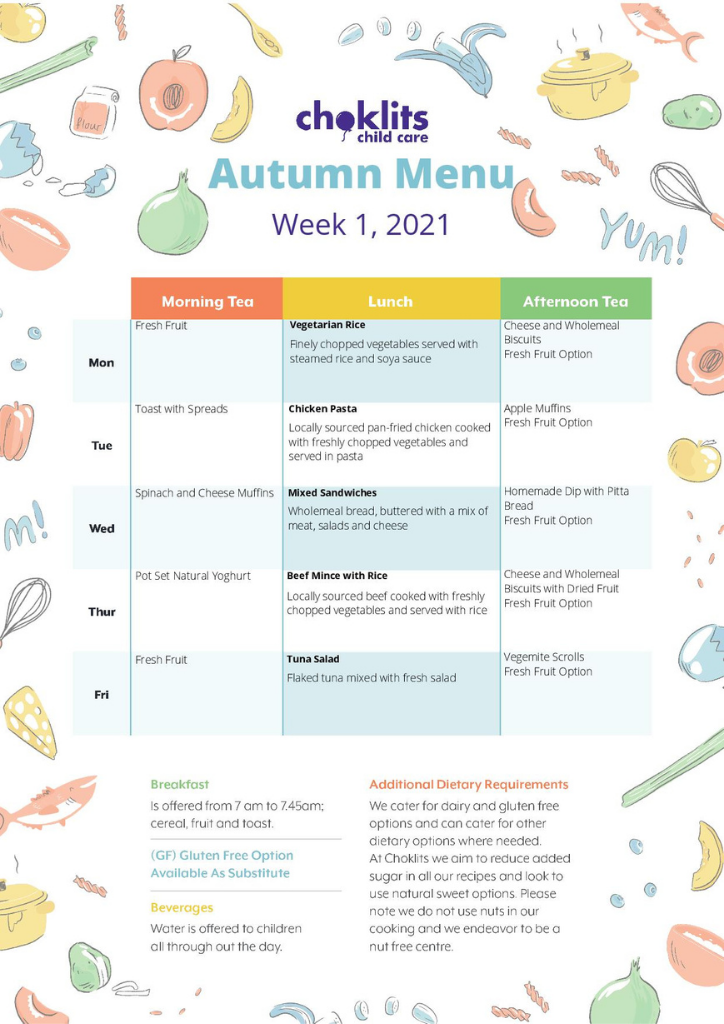
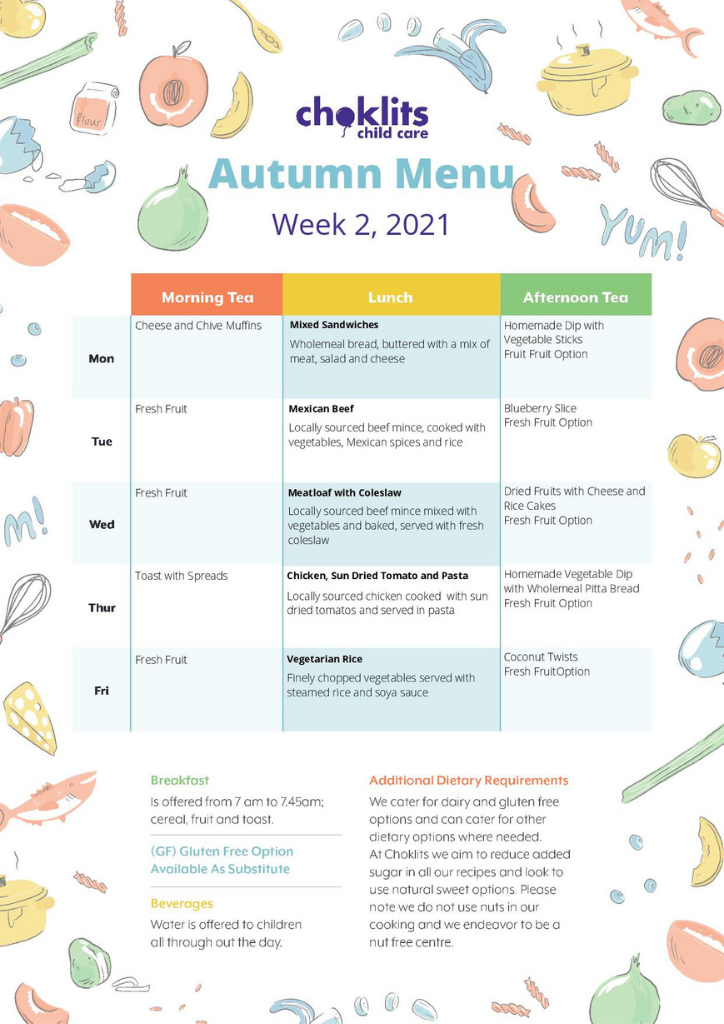
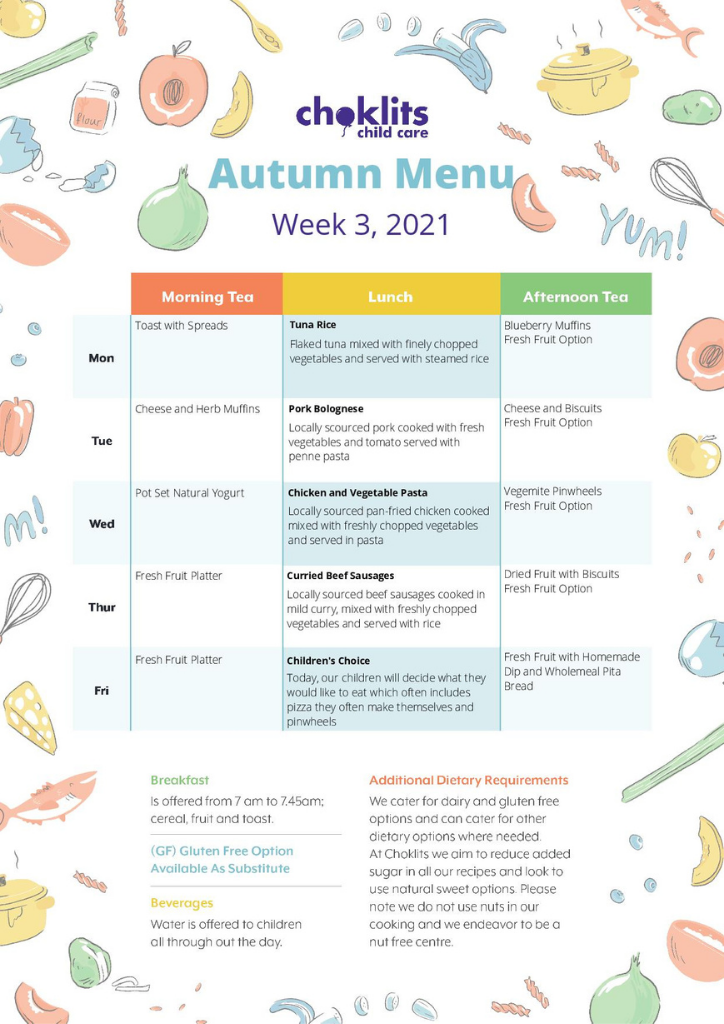
Autumn is almost upon us again, time sure does fly doesn’t it! It feels like all I need to do sometimes is blink and the children whom I’m used to serving in our Nursery are graduating from our Kindergarten program!!
A special mention and thank you to all the frontline workers who helped us get through a COVID flavoured 2020. We all appreciate everything you have and continue to do to keep all of us safe.
Now to the menus, I’m pleased to share the new Choklits seasonal menu, Autumn 2021!
There’s plenty of variety in this seasons menu combined with a few of the children’s favourite meals. They are really enjoying the meals they have input in, specifically the days when they get to choose what we have for lunch. Pizzas and pinwheels are always a popular choices. We also like to set up either a shopping experience to get our ingredients or a cafe experience to eat our lunch which really helps the children learn more about the whole cycle of meal preparation. Both ideas have come from our success of our Plant to Plate Program that we’ve found assists children in the understanding and appreciation of food. And, at the end of each meal, the children (Toddlers, Pre-Kindergarten and Kindergarten) all wash their own dishes.
I’m really looking forward to working with the children this autumn season and value any input from our community. We encourage everyone to get involved so please come and say hello if you have a spare moment when you’re passing through Choklits.
Occasionally, I make a little extra food so if you connect with us on Facebook and follow us on Instagram you’ll know exactly when I have something for you to try.
I almost forgot to mention, I’ve been lucky enough to be featured in Choklits first ever picture story book (picture above) called Meet the Chokliteers. How exciting! Our superstar Pre-Kindergarten Teacher Dee authored the book for the Choklits Community and its been real hit! You can learn more about the Chokliteers on this page Meet the Chokliteers.
Please enjoy our 2021 winter menu…
Helen Rooney
Choklits Chef, Choklits Child Care Centre
This blog brings great excitement to share with you our finished Gathering Circle!
If you haven’t already, you can catch up on the first half of the journey here.
Our finished Gathering Circle is now proudly standing in our front entrance way. It is a symbol that visibly translates our commitment to honouring Aboriginal and Torres Strait Islander culture. But more than that, it tells a story and represents our journey so far and the path ahead.
Before installation, there was a bit of work involved to prepare the space. After we’d cleared the area Tracey, our Choklits veteran, reflected on seeing the space underneath the ivy for the first time in years!
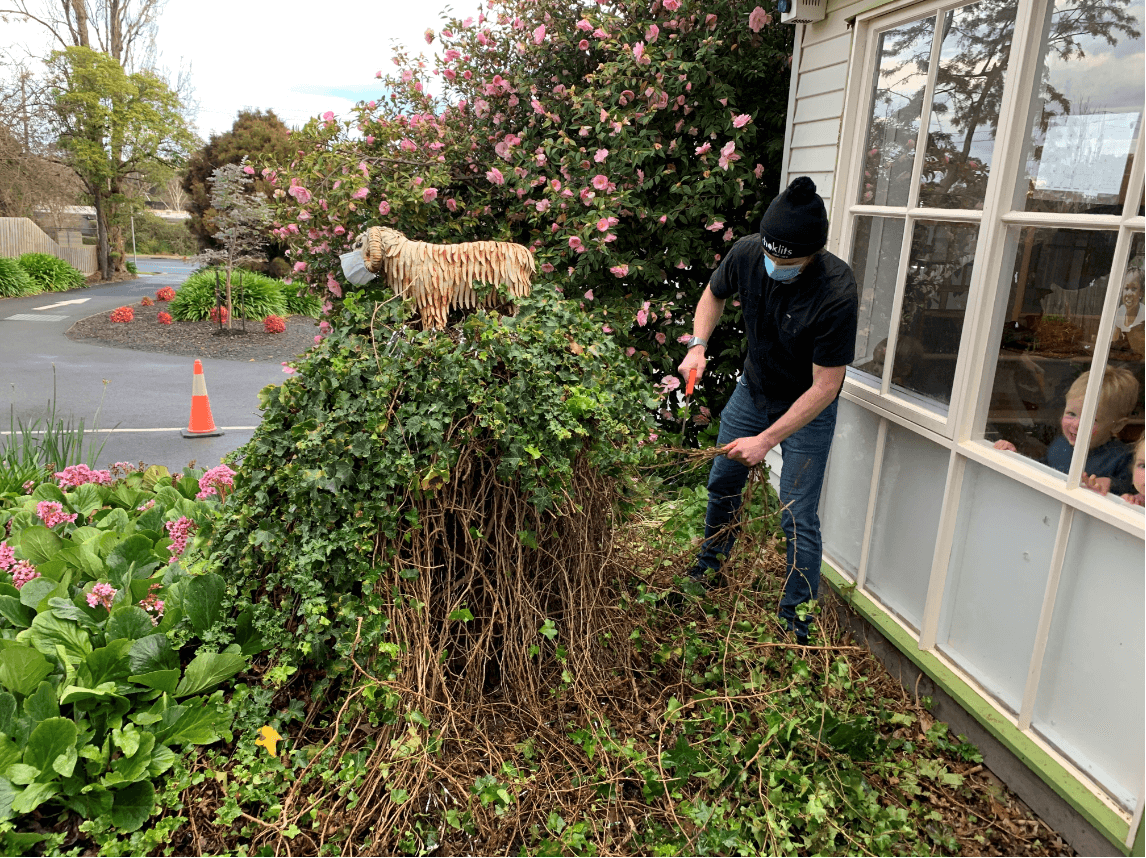
Once the space was ready, Simone (the incredible artist behind the paintings) joined us to guide our work with her creative talent. Here’s a look at how the installation went…
Once everything was “just so” and final adjustments had been made, we invited the children to cast their discerning eyes over our new space. Comments and observations included;
“Wow, there’s a goanna!”
“I love it!”
“Look, it’s Rainbow Snake!”
“The Australia’s my favourite”
With the stamp of approval it was offical, our Gathering Circle was complete!
So, what is Gathering Circle? Simone explained it this way:
“The Gathering Circle represents an unbroken circle and connected family; a place where people come to sit together, yarn and learn from their Elders”.
We sat together to share the first yarn. I could see the magic of this special place as Simone wove visions about her journey, her history and the story behind each piece.
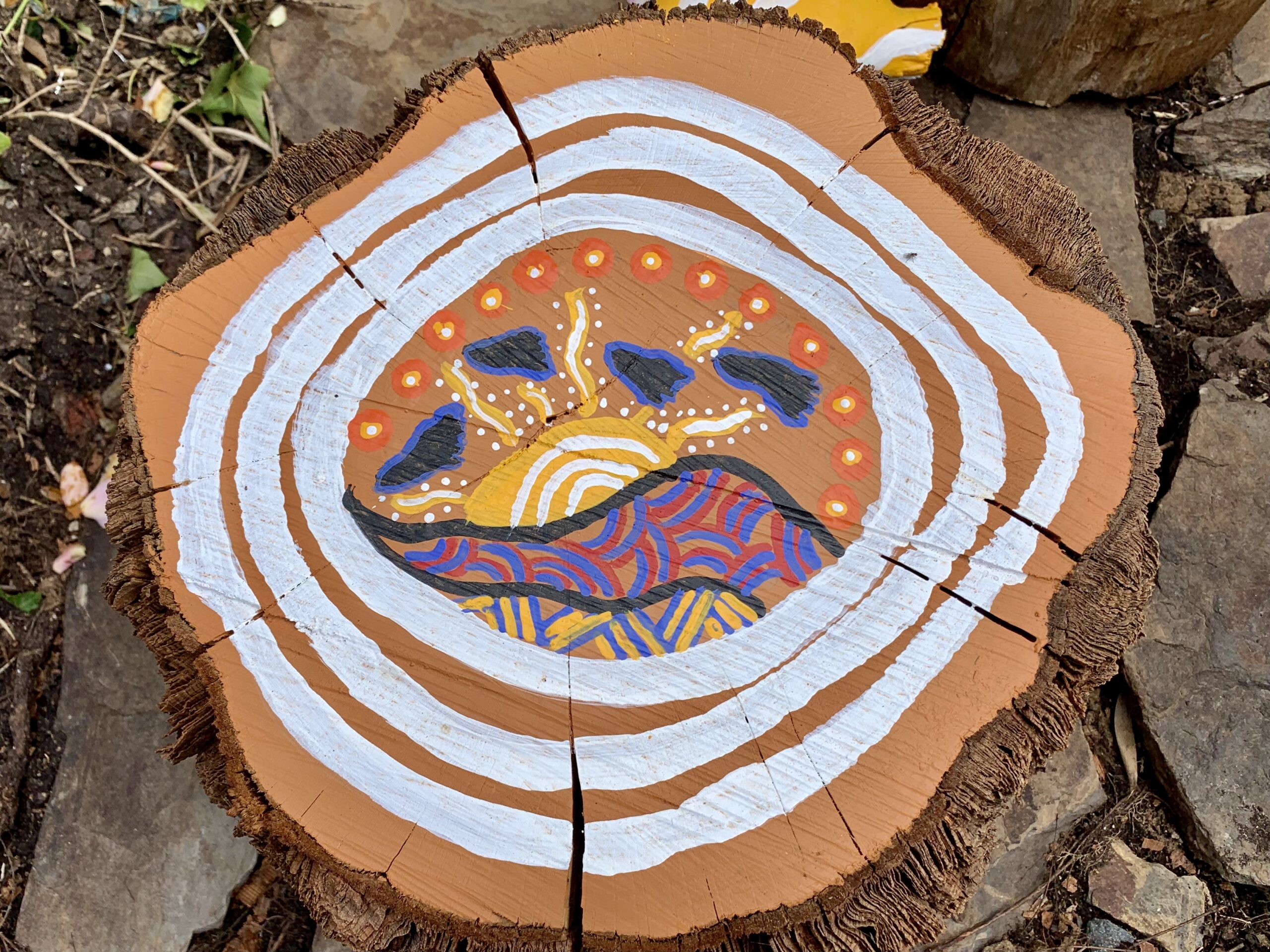
The yarn behind each piece, as shared by Simone:
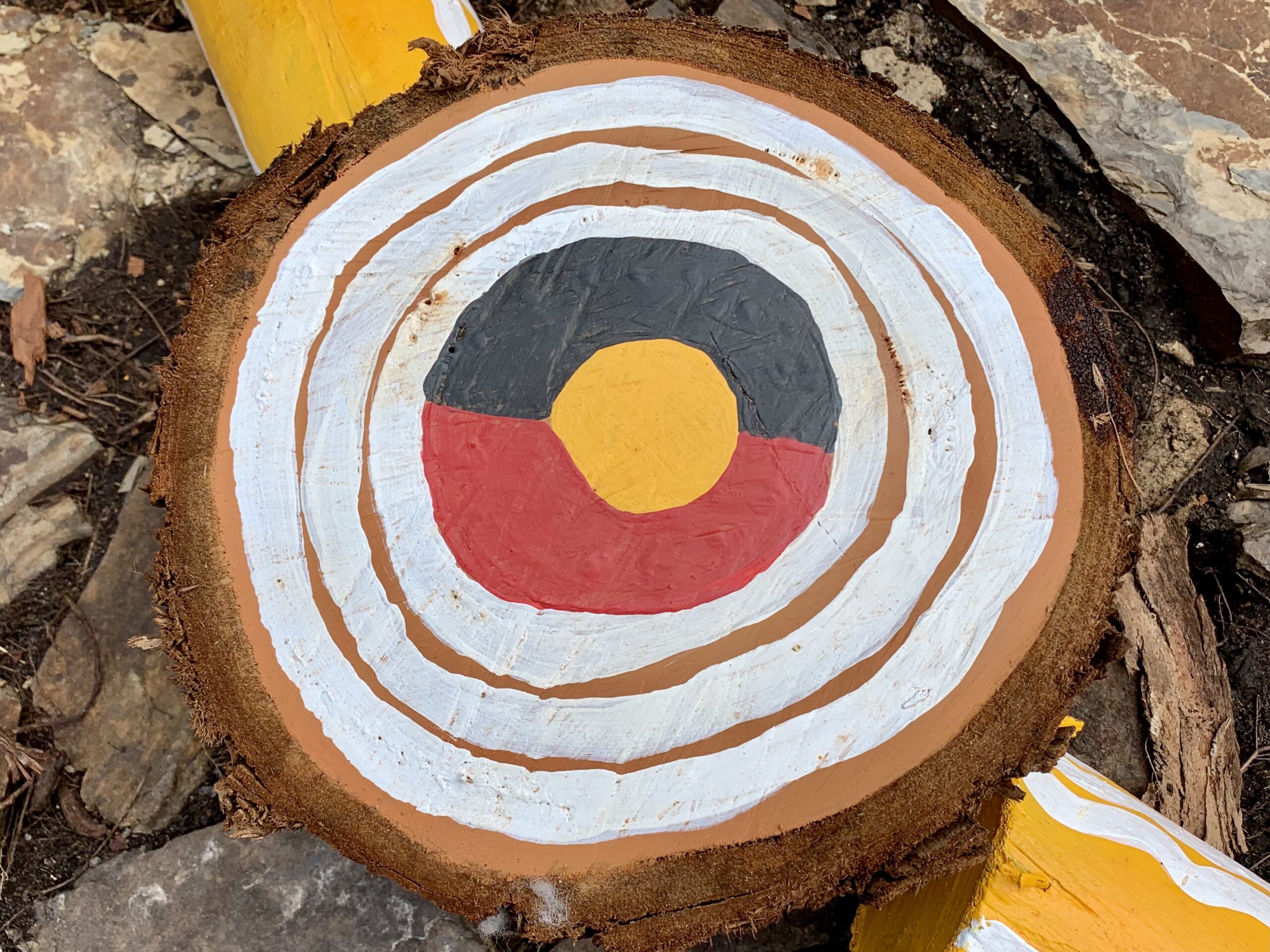
This piece incorporates the Aboriginal flag, a well-known symbol of Aboriginal people. The designer Harold Thomas says the colours of the flag represent the Aboriginal people of Australia, the red ochre colour of earth and a spiritual relation to the land and the sun, the giver of life and protector. You can find out more about the flag and its history here.
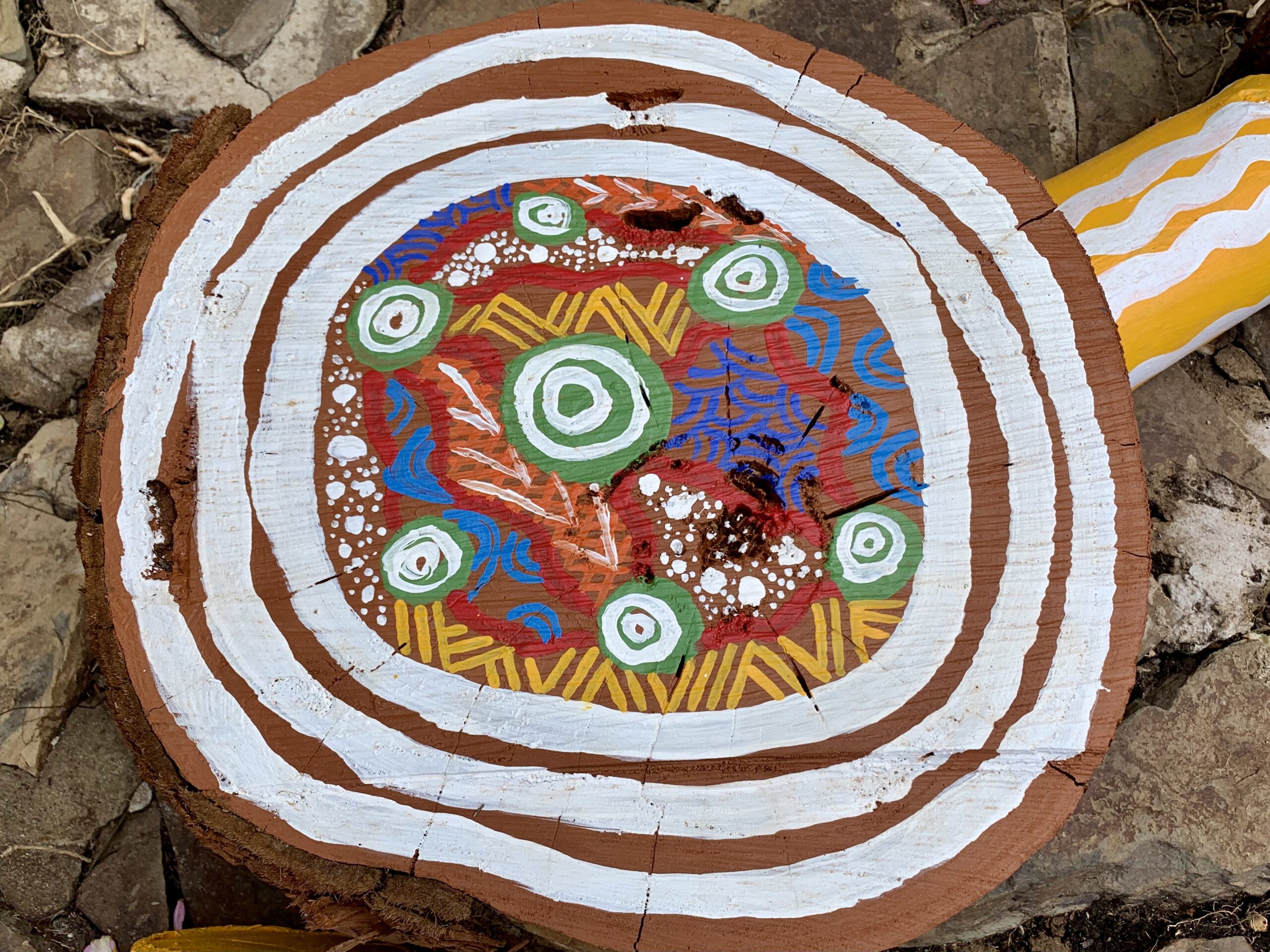
This piece represents the families that make up our Choklits Community. The green circles symbolise the family each child comes from. The shapes and lines connect the backgrounds, culture and places of each family.
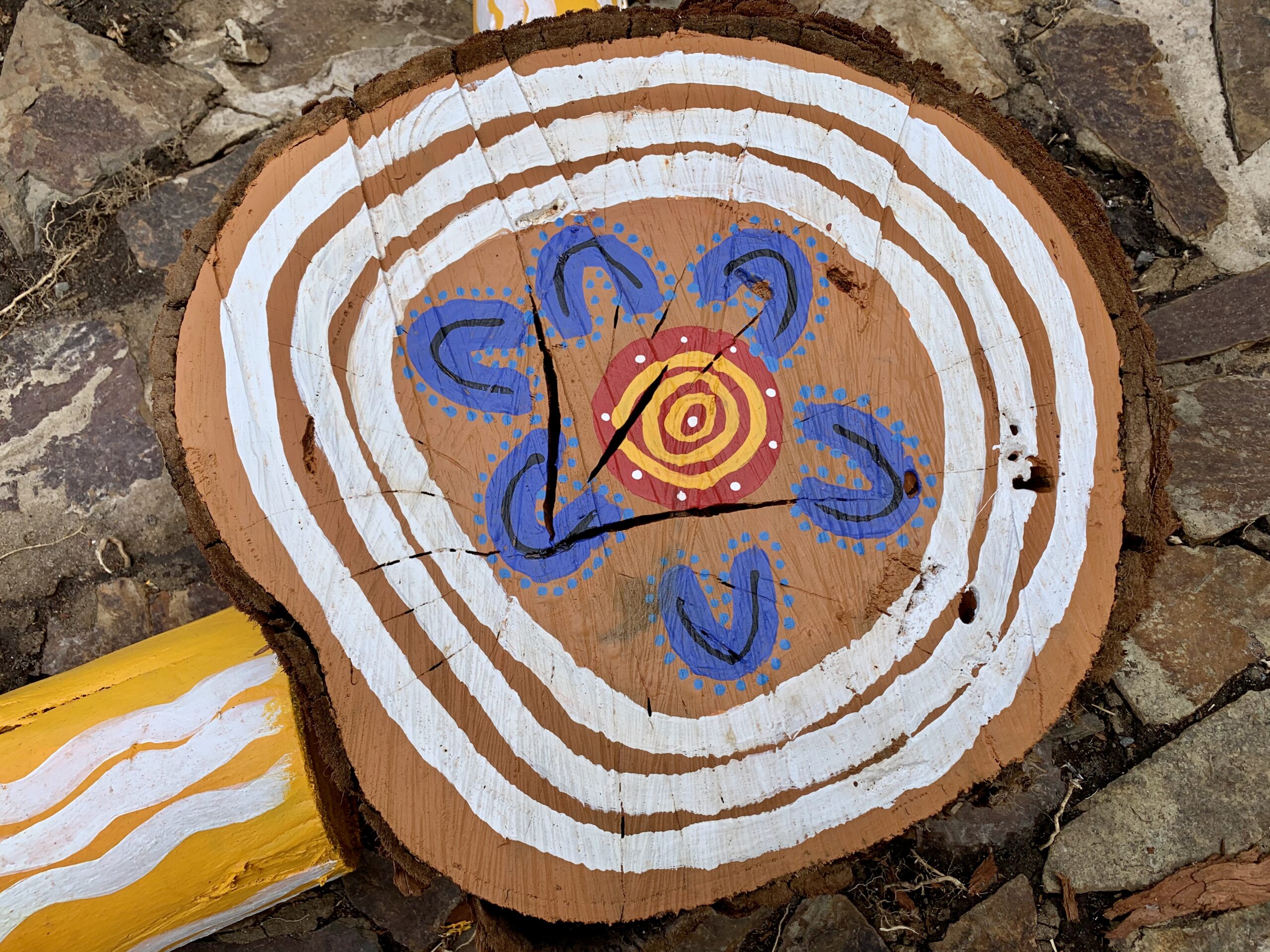
This piece represents the children of Choklits, their families and the Choklits Educators all coming together as a Community. The Choklits purple colour interwoven throughout helps shows the connection and unity of our Community.
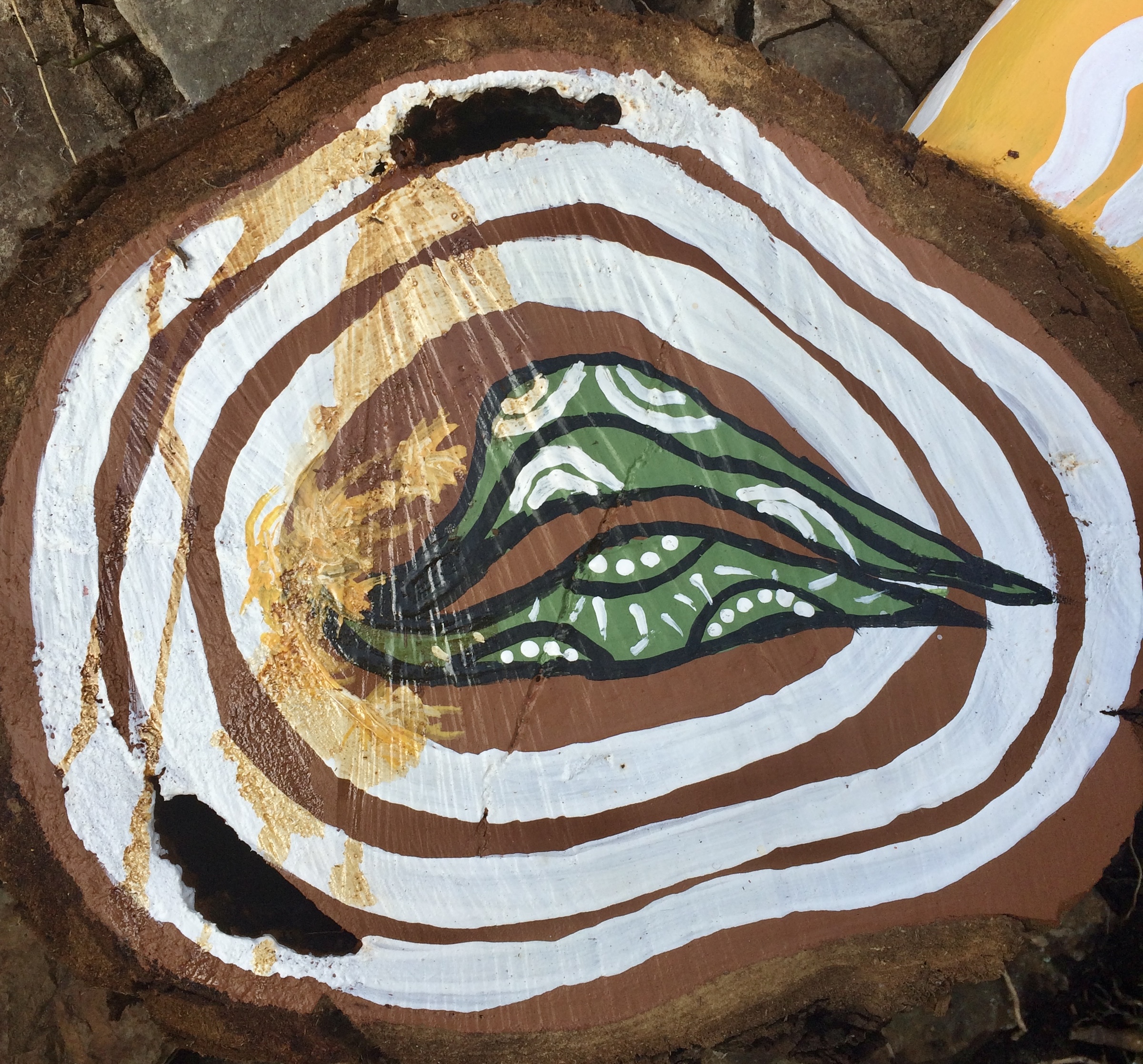
This piece is a sharing of the Wurundjeri land, which we learn and play on. Simone explained that ‘Wurun’ means ‘manna gum tree’ and ‘Jeri’ means ‘witchetty grub’.
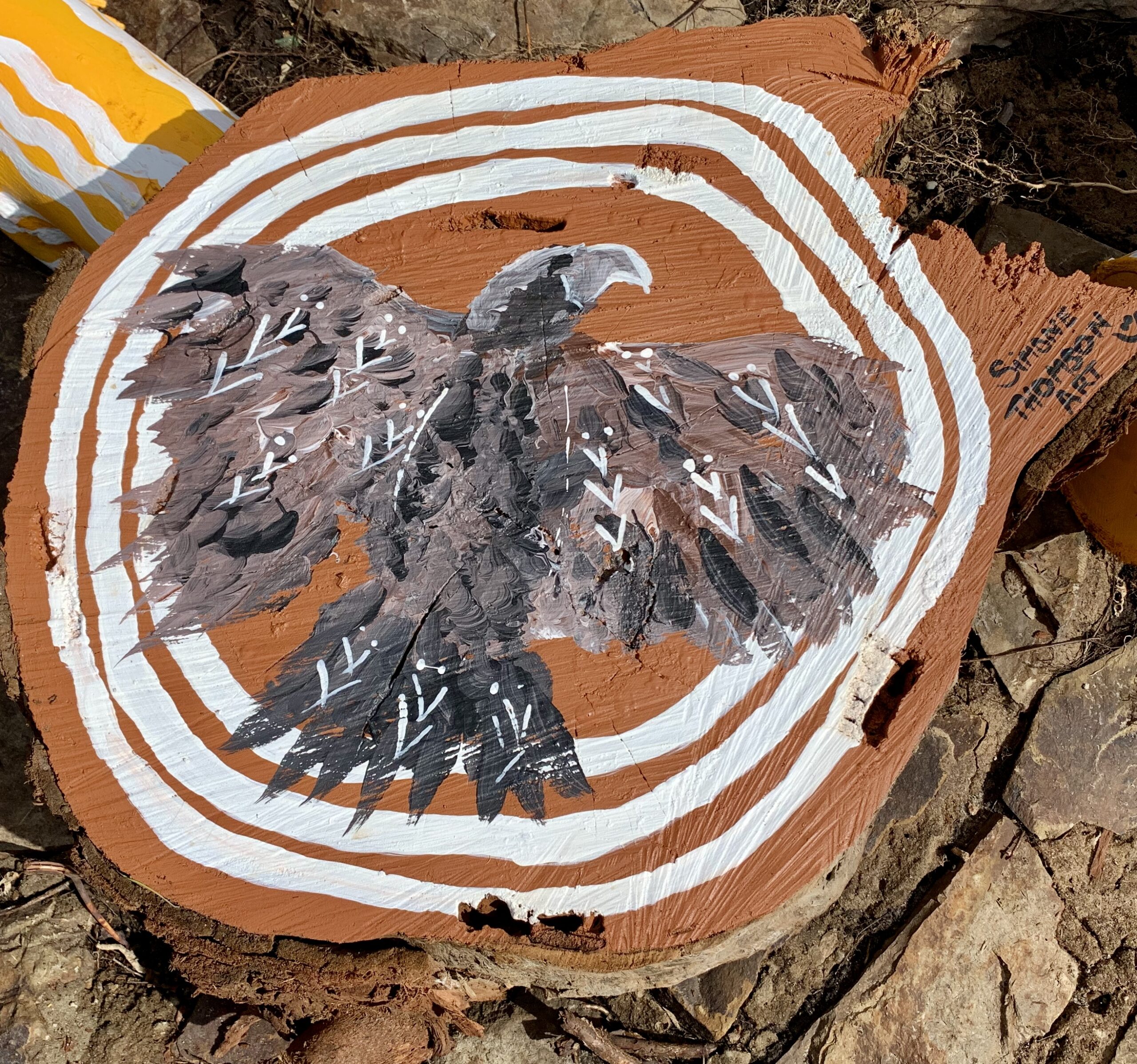
Bunjil, the creator spirit of the five Kulin nations, is often talked about at Choklits and this piece displays beautifully our favourite eagle. The five spirits are;
– Boonwurrung (Boon-wur-rung)
– Dja Dja Wurrung (Jar-Jar-Wur-rung)
– Taungurung (Tung-ger-rung)
– Wathaurung (Wath-er-rung)
– Woiwurrung (Woy-wur-rung), commonly known as Wurundjeri.
You can find out more, watch and listen to the story at these two locations Bunjil – First Australians and Bunjil and Wah Story (as told through paper animation by children from Monash)
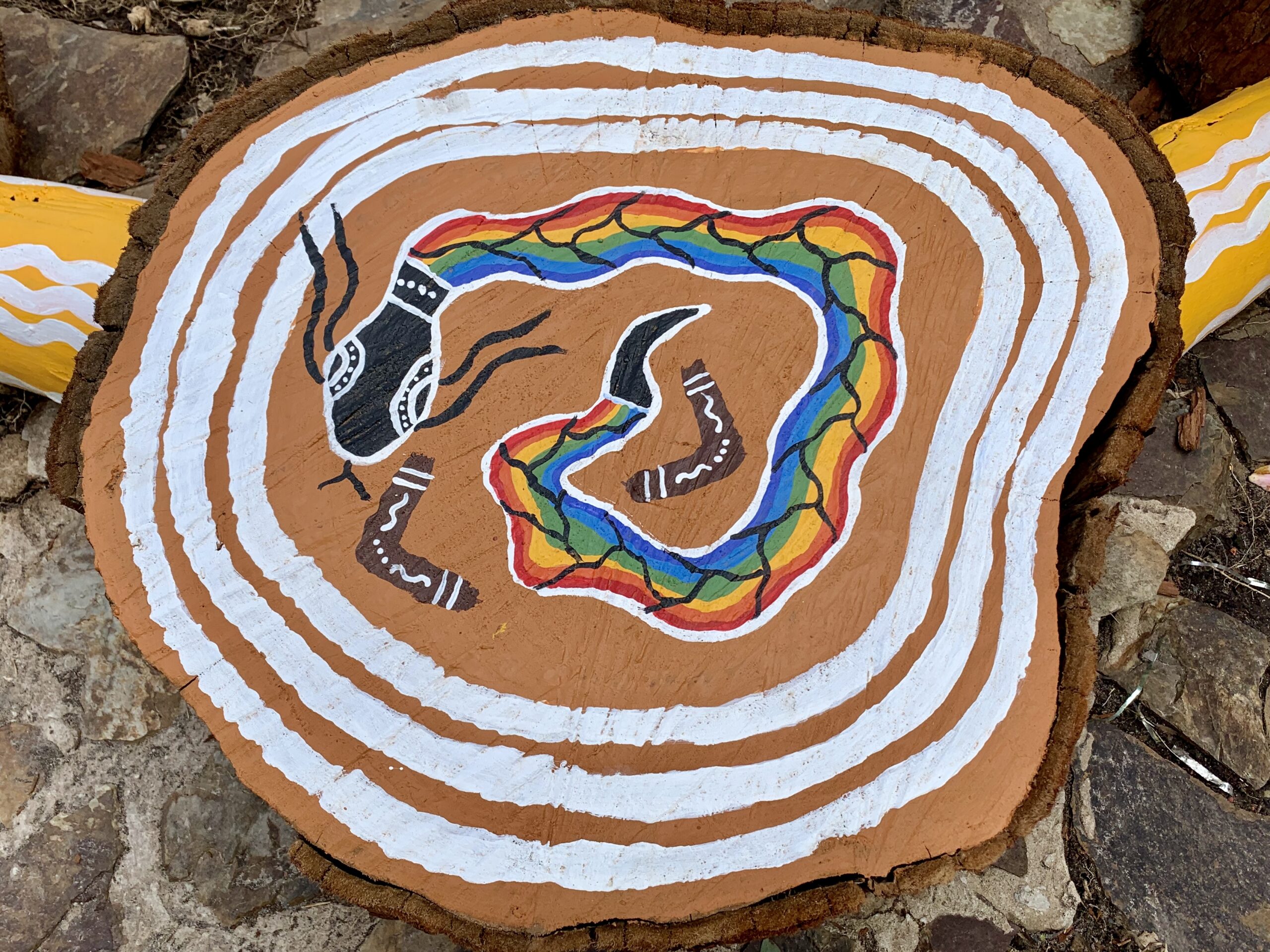
This piece depicts an often-told Dreamtime story of Rainbow Serpent. There are many versions of the story, depending on where and who tells them. This is the one Simone shared with me, and it comes from the Yorta Yorta mob.
“In the time of creation there was a calm over the vast, mist-covered land. Biami the Creator Spirit saw the old woman, Gumuk Winga, with her empty coolaman. She looked very hungry. Biami then told the old woman to go and search for some yams. So she then picked up her digging stick and set out across the land with her dog.
The old woman walked and walked a long way away and could not see any yams. As time went on she became very weary, walking slowly with her digging stick dragging along the earth. Day turned to night, she walked far under the moonlit sky, singing softly and hoping for some yams to appear. Biami waited for the old woman but could not see her anywhere. Biami called out to Gane, the great rainbow Snake, who was laying asleep beneath the earth. When Gane heard Biami calling out to him, he lifted his head and made his way to the surface of the earth. He lay there looking out over the dry land when Biami asked him to go and find the old woman and bring her back safely.
Gane then set off following the marks in the earth left by the old woman’s digging stick. His great body moved across the land pushing the earth into hills and valleys, leaving deep crevices in the earth. Beautiful colours from his body spread throughout, covering trees, plants, birds, butterflies and all other creatures.
Then Biami called out in a loud voice, and thunder cracked as lightning flashed across the sky and rain fell. It rained for days, filling up the deep crevices in the earth that were made from the rainbow snake’s body. Then the rain stopped and the mist cleared and the river Dungala was formed. This is the name used by the Yorta Yorta people. Others know it as the Murray River” – extracted from this webpage.
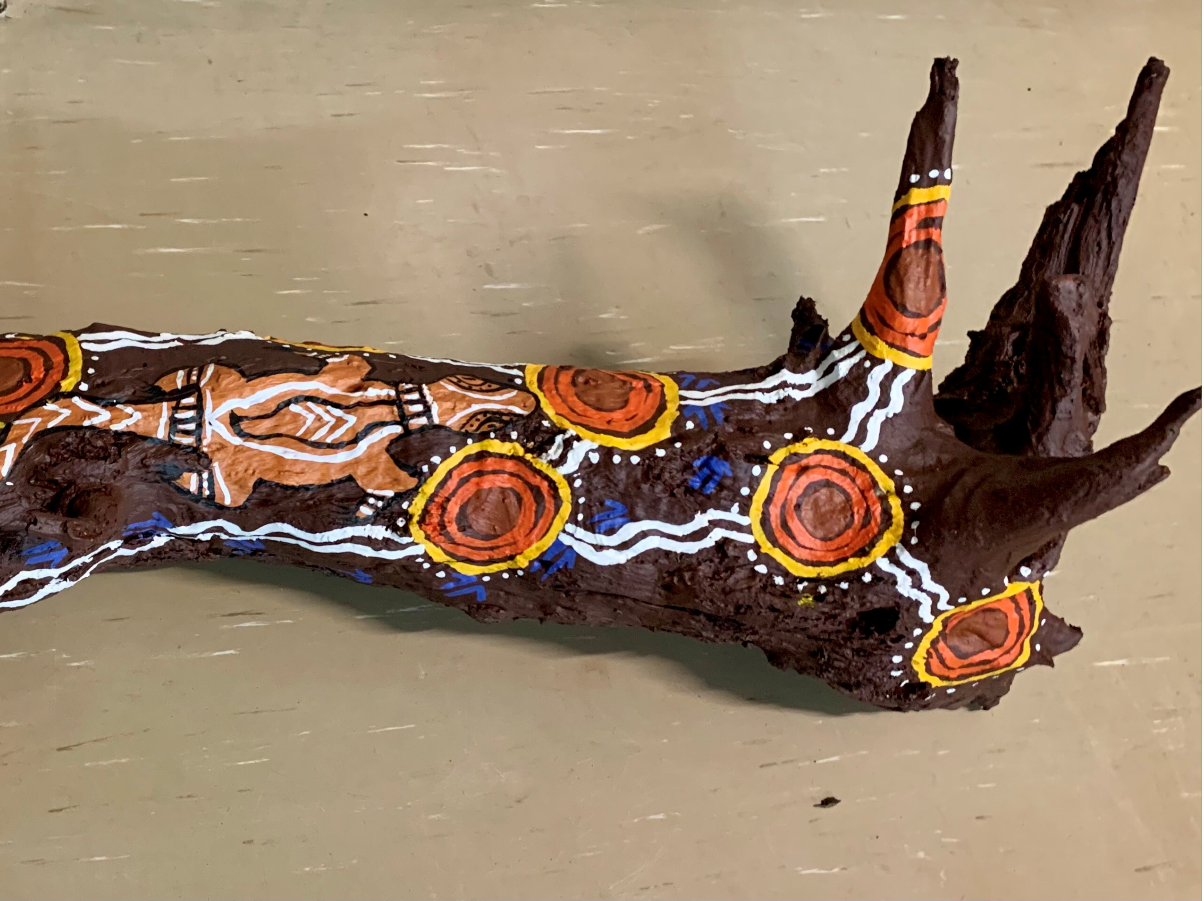
For this piece, Simone used symbols to tell a story. You can see kangaroo tracks going toward watering holes and goanna looking for food. The symbols highlight the way stories can be recorded to share culture and teach others. They represent Aboriginal culture and tradition.
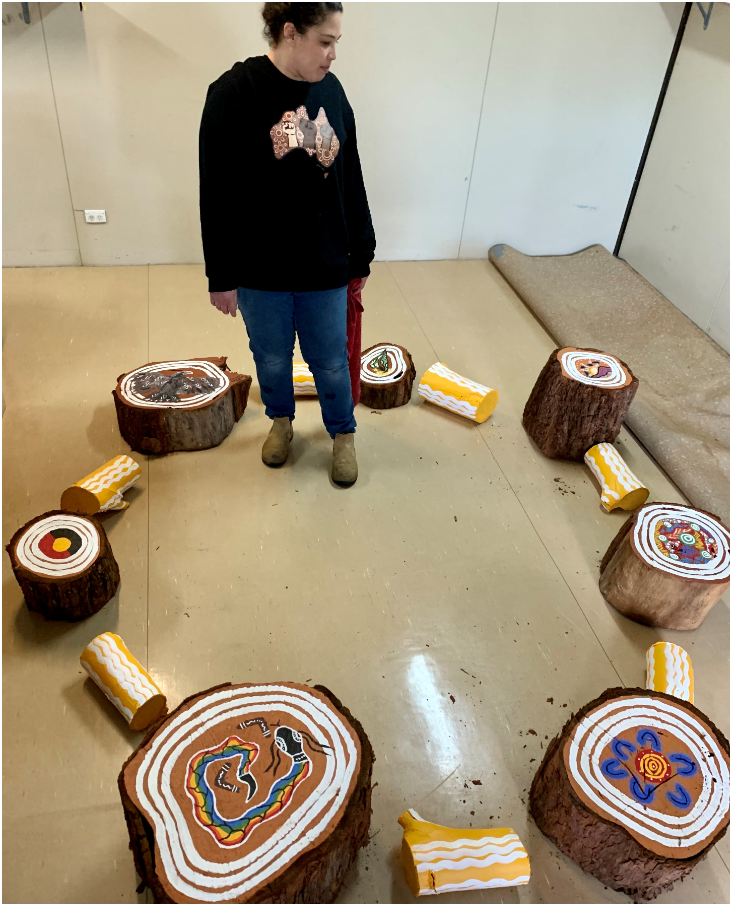
The yellow pieces join the Gathering Circle together. They create the shape and connectors so that it’s an unbroken circle, which means and symbolises an unbroken family. This picture was taken before we installed our Gathering Circle, we laid out the different pieces to ensure the design would work perfectly with our entrance area.
After my yarn with Simone, I came away with the feeling of appreciation for the relationship we’d built and the insights shared, hurt for some of the things I’d learned, wonder at the stories Simone had inscribed onto each piece, and with lots more to find out.
I can’t wait to see the many more moments and opportunities our Gathering Circle will bring us at Choklits.
Simone’s last thoughts were “to be respectful”, a sentiment we share with the belief that we can make our thoughts and actions count for current and future generations.
This Choklits blog post authored by Dee Wasserfall, Choklits Child Care Pre-Kindergarten Room Leader.
PS- Choklits is a busy place so join the conversation on Facebook and follow us on Instagram for updates from in and around our great Ringwood community!
—
Choklits Child Care, 319 Canterbury Road, Ringwood (opposite the Ringwood Golf Course near the Canterbury Road Eastlink offramp).
In early 2019, we were given an amazing opportunity to begin a community project here at Choklits. From collaboration to celebration, we hold our community participation in very high regard because we believe in, and see the advantages of, education for our early learners that extends well beyond our own grounds.
As you can probably guess, we were thrilled to continue growing and strengthening our involvement with the community.
This particular project involved EACH, a community group whose vision is for inclusion and health for all. The brief was to extend on our current practices around community and Aboriginal and Torres Strait islander perspectives. Our application was approved based on our pillars of growth and collaboration.
Then it was time to get creative…
A meeting with Choklits owner Jade, some of our educators and the team from EACH prompted discussion about the vision we wanted to achieve and how we could execute it. We identified that our teaching and learning was already visible and evident throughout the centre and learning program, but we wanted anyone who stepped foot in our front door to know that firstly, our centre valued Aboriginal and Torres Strait Islander perspectives and secondly, that culture was welcomed and recognised in all its forms.
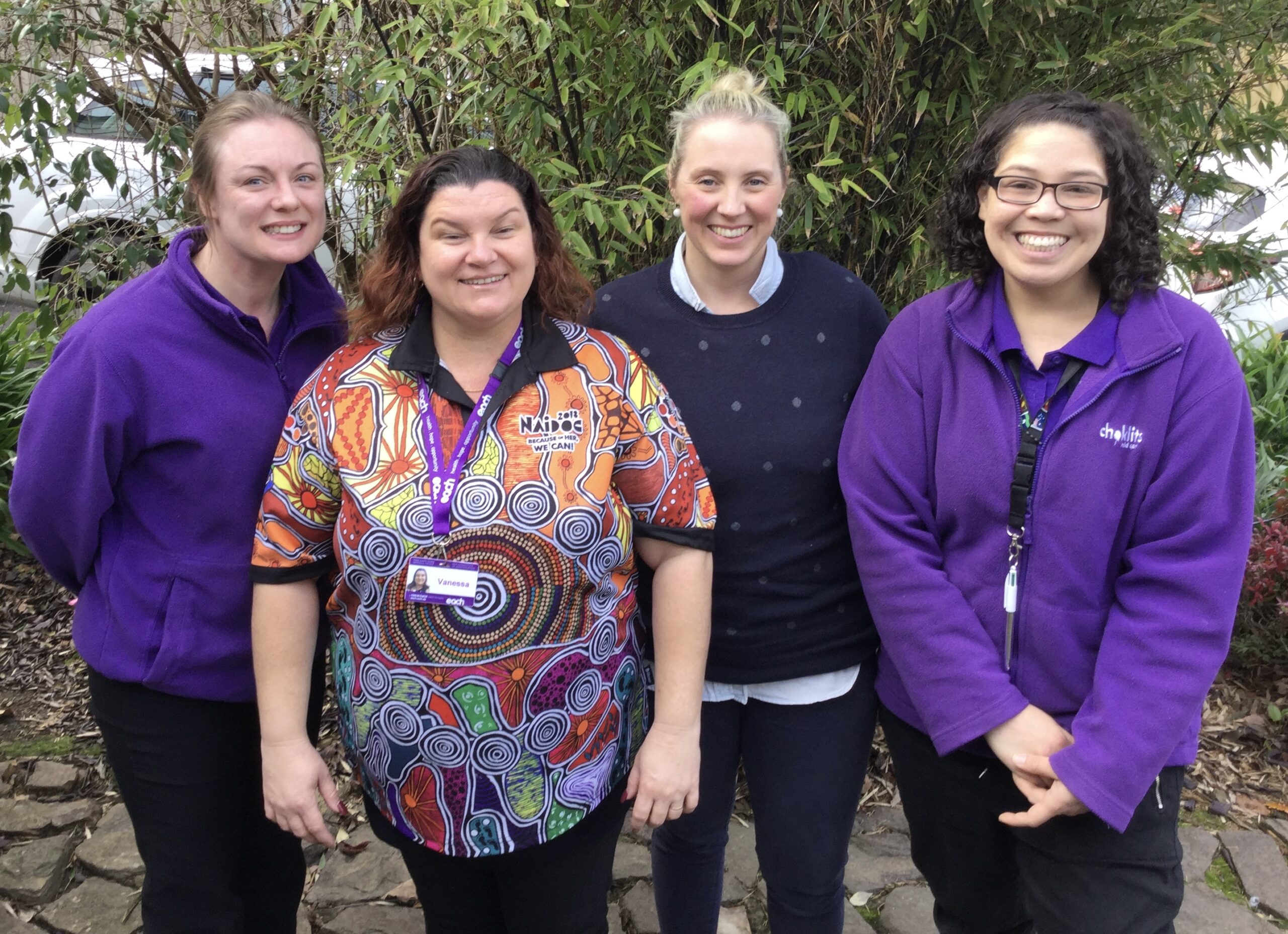
Gathering our own ideas with the help of paint, flowers, leaves and pencils many themes emerged; sustainability and recycled materials, a link to the land and animals, the children we want to teach and empower, the custodians and the language of our land’s Traditional Owners (Wurundjeri/Woiwurrung) and the colours of the flags we have grown to know so well. There was talk of statues, gardens, murals and many other forms our vision could take.
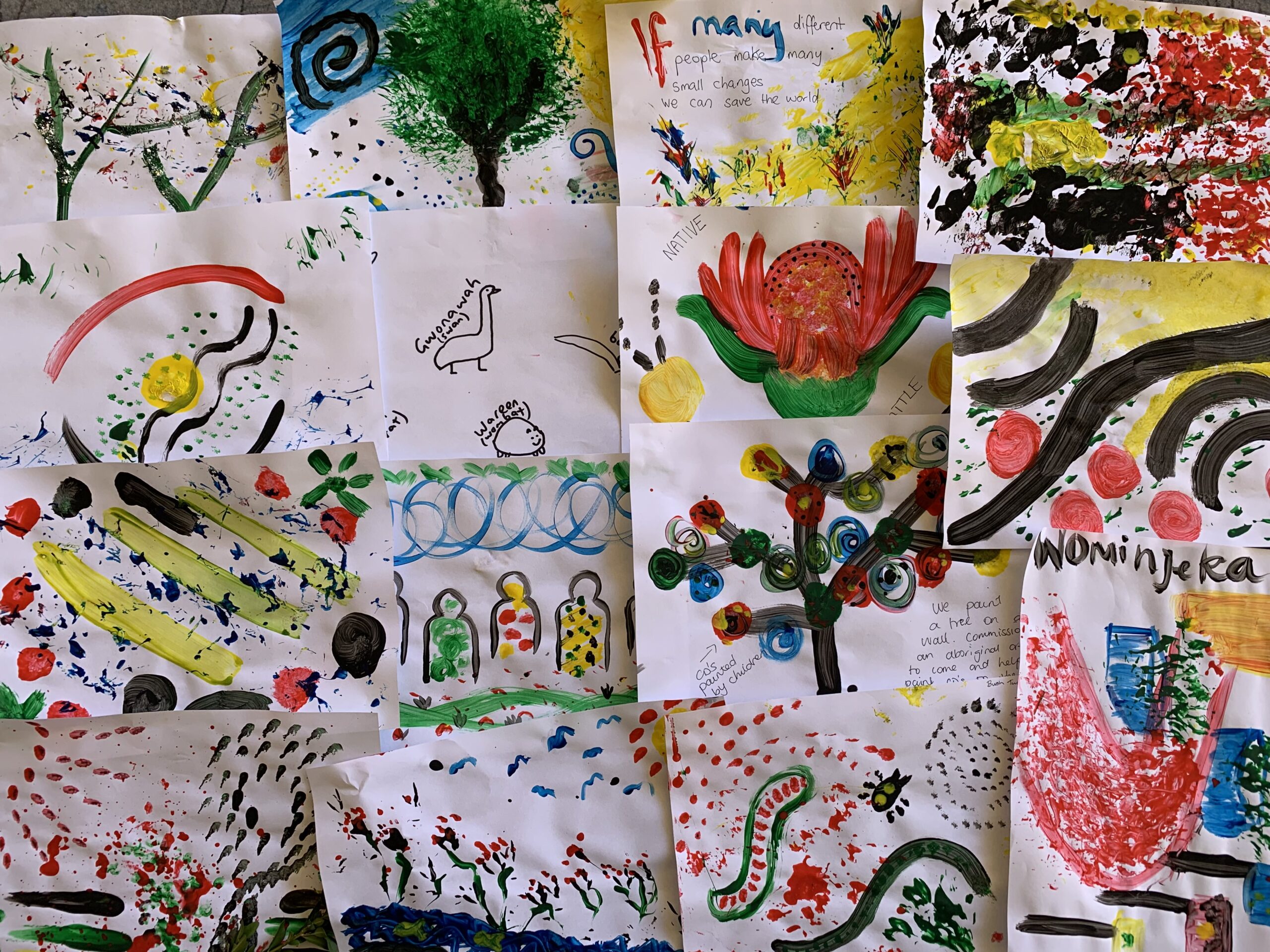
The more we began to delve into our ideas, the clearer it became that we needed to further define the statement of our long-term vision for Choklits. Thankfully, we were able to draw on the wealth of resource provided by Nurragunnawali, an organisation developed by Reconciliation Australia to support schools and early learning services in Australia to develop environments that foster high levels of knowledge and pride in Aboriginal and Torres Strait Islander histories, cultures and contributions. This platform gave us the tools to formalise our commitment through a Reconciliation Action Plan (RAP), which would help us to continue to authentically embed teaching and learning opportunities throughout the centre and to guide our project vision.
As we began forming our RAP working group (the team from Choklits involved in creating actions and documenting the RAP), the universe began aligning chance encounters, meetings and connections to help us in our journey.
While at a local community event, Knox Festival, one of our educators visited a stall hosted by one of the community organisations we had been researching. It just so happened that Elke, the CEO of Mullum Mullum Indigenous Gathering Place, struck up a conversation that led to Choklits and our current project. Elke said she had just the artist in mind to help bring our vision to life, and so we were introduced to local artist, Simone Thomson.
As we entered the crazy COVID-19 adventure that has dominated 2020, we got to know Simone through phone chats and emails and bounced a few ideas around. We spoke about our ideas and what we wanted to achieve, Simone just seemed to intuitively “get” what Choklits was all about. Ideas began to take form as our discussions turned to the creation of a gathering circle or totem poles as our entrance piece.
We brainstormed on the themes that where important to us, some of them included:
We passed these ideas onto Simone; whose brain began sparking with creative visions and dreams.
Meanwhile, we also began researching the materials we should to use. This part of the process brought an unexpected but valuable insight. After deciding to source logs of wood to use in the entrance piece, we arranged to meet a gentleman who had the logs we needed available.
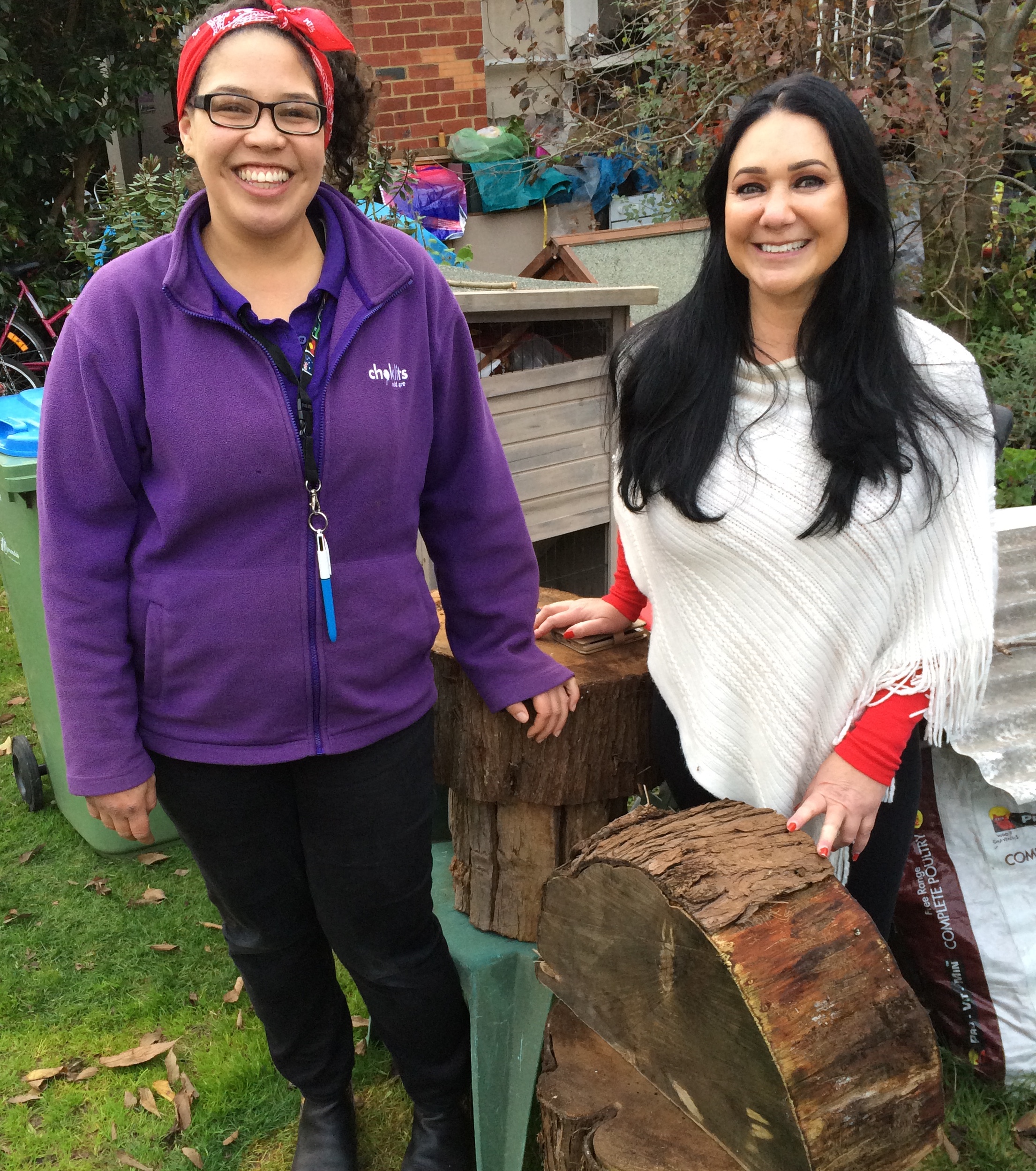
Simone and educator, Dee, met to view the wood and had some interesting conversations that led to a massive discovery about the intent of our project. After some confronting comments and attitudes toward Aboriginal culture, the team and Simone reflected on how this interaction should fit in to our learning journey.
Simone put it best when she said that the best way forward was to “educate younger generations to stamp out those ways” and that actions like our upcoming project would “contribute to teaching respect for the oldest living culture on earth and inspire knowledge seeking little minds to accept”.
What a mission statement, encapsulating exactly what we want to achieve at Choklits! We decided more of our community should be invited to take an active part in our project.
Much to our surprise and delight, our call for wood was quickly answered by many families, educators, friends of families and past Chokliteers! Over the weeks, a small collection was gathered.
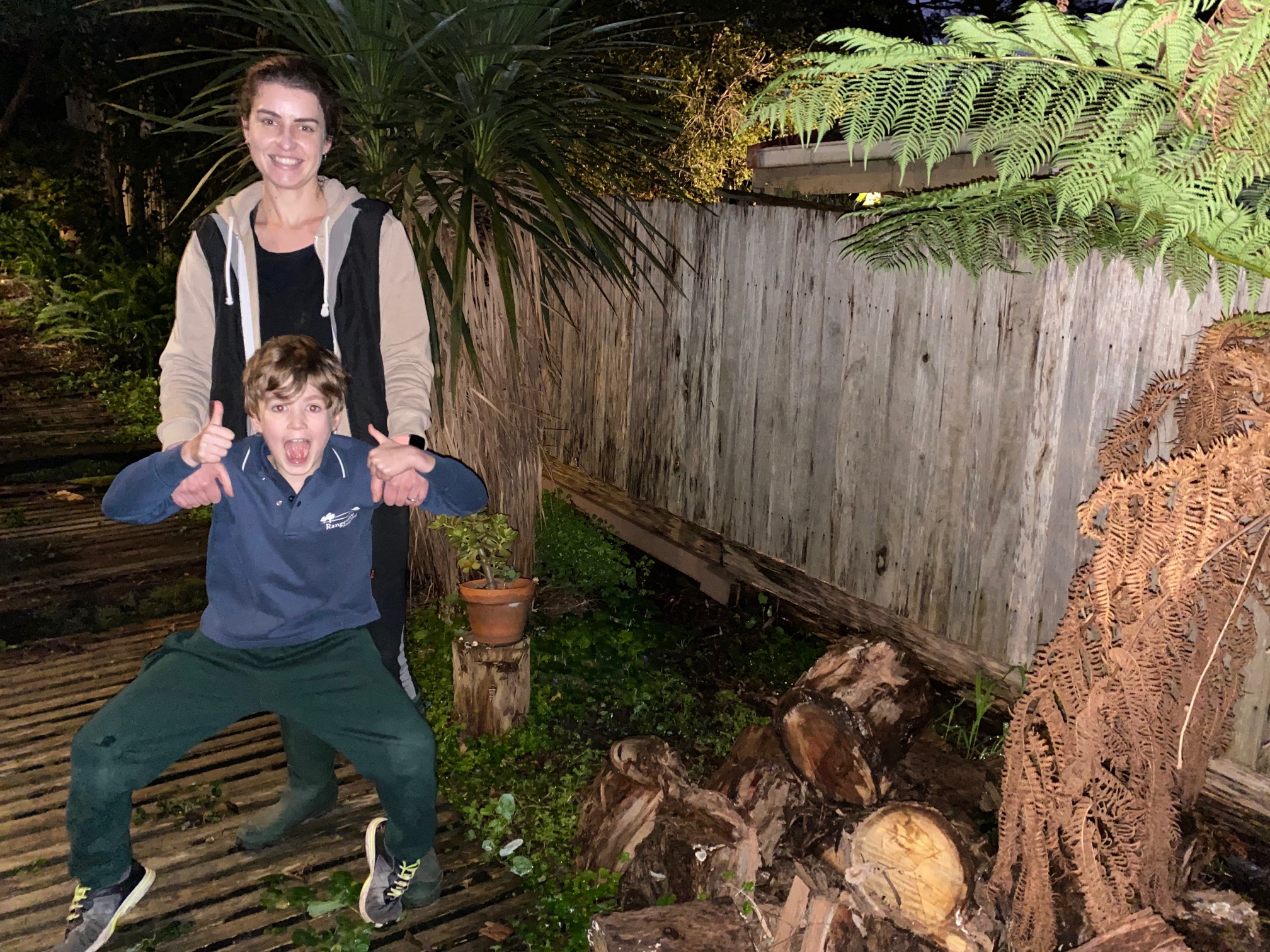
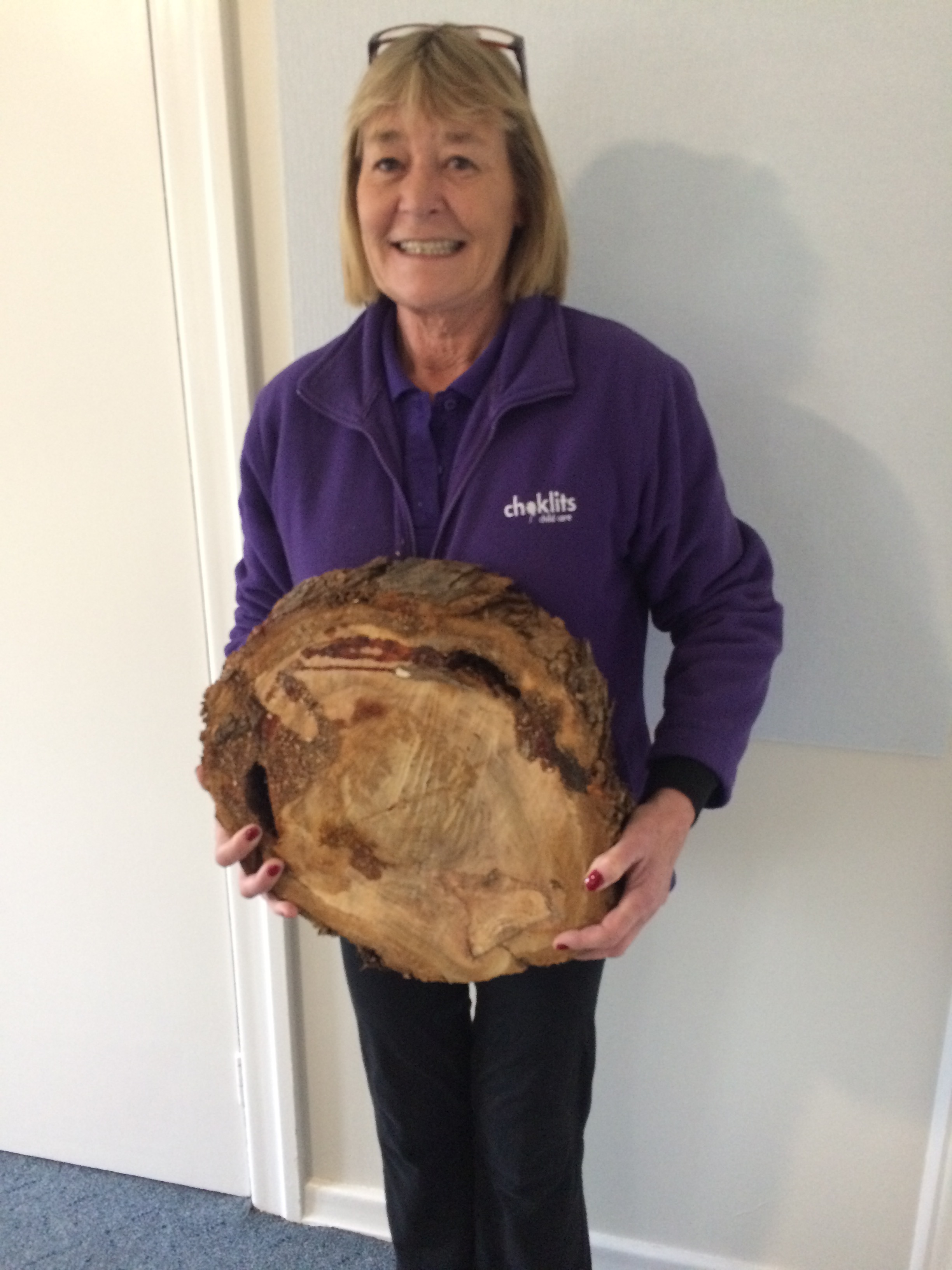
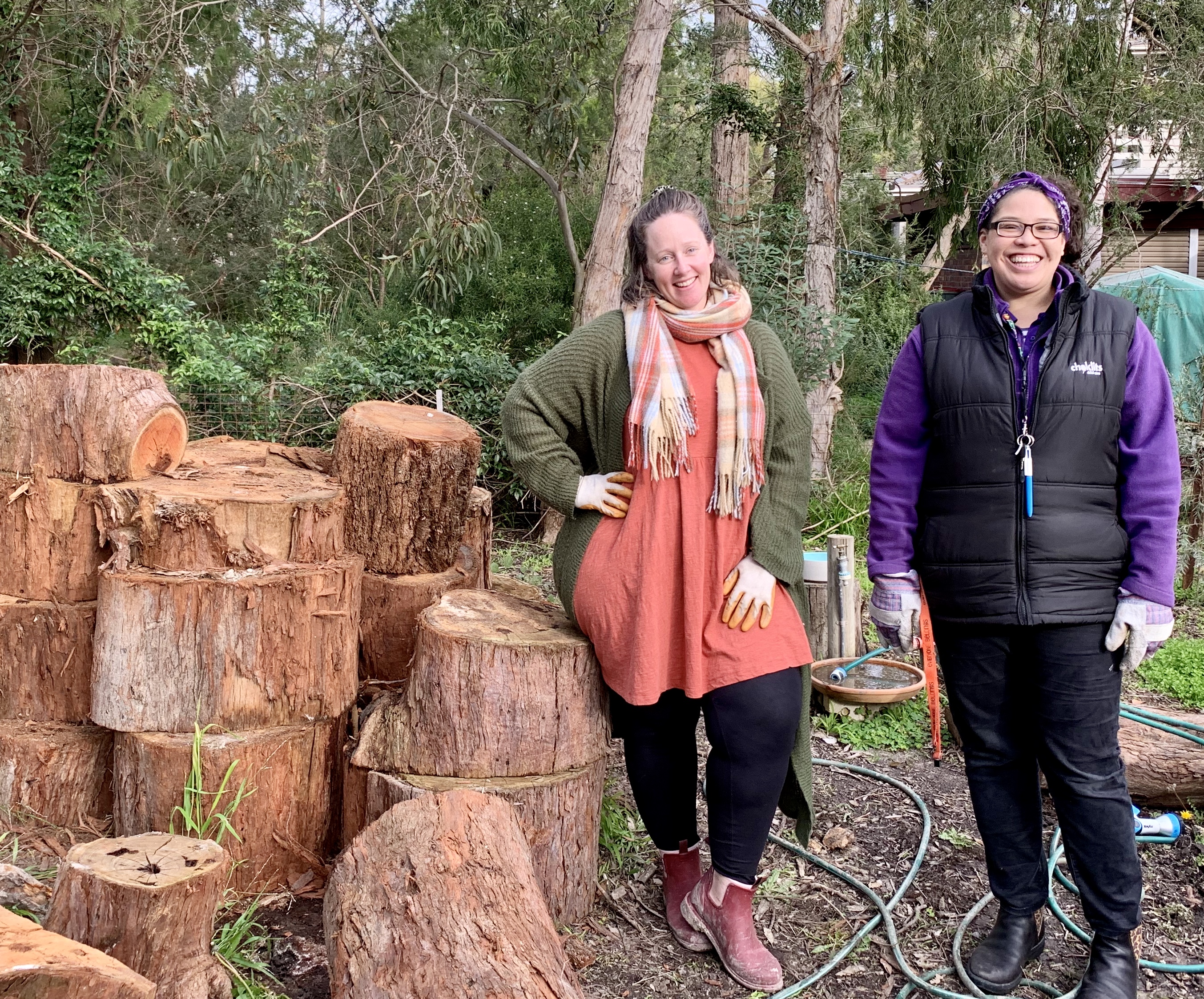
Slowly but surely, our vision was coming together!
With the thought of stretching our available funds and creating the best possible project, we reached out to our local Bunnings store to invite any donation towards the costs of supplies. Like us, Bunnings values opportunities to support local community and were very happy to help us with a donation which we soon put to good use. Thank you, Bunnings!
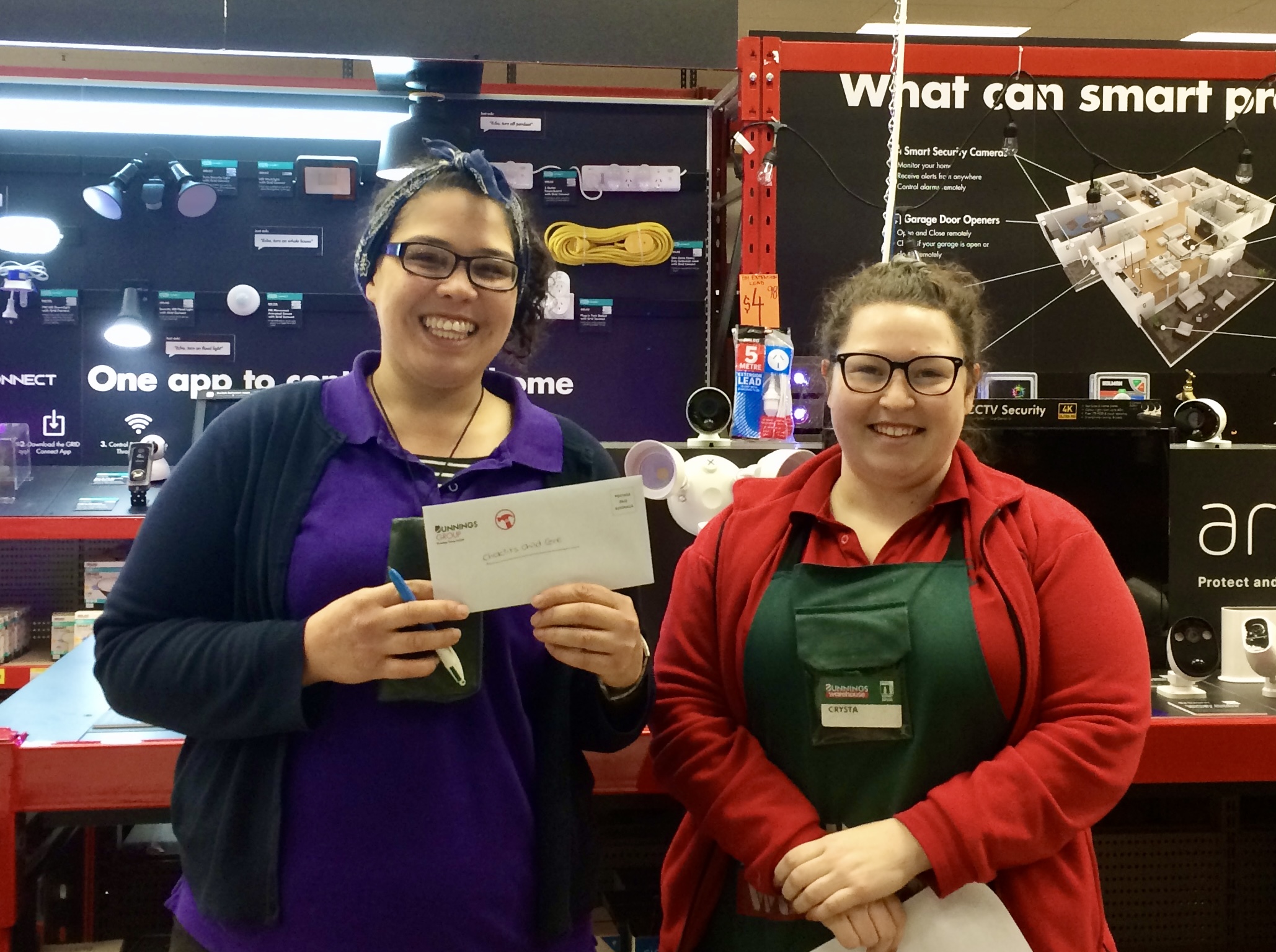
The educators involved in the Reconciliation Action Plan continued to collaborate and identified more important aspects of embedding Aboroginal and Torrers Strait Islander perspectives at Choklits and we shared these thoughts with Simone.
Once the pile of wood had grown (and those pesky but necessary COVID-19 restrictions had eased, briefly!), we invited Simone to visit the centre and see for herself, firsthand, what we at Choklits were all about. After we welcomed Simone into Choklits, she shared some insights into what she could see and feel about our community.
She noted that cultural respect was evident throughout the centre, every wall, every room, the children’s learning experiences, dolls, flags, artwork, posters and displays included. In watching the educators and children interact, she could see everyone’s enthusiasm.
We talked about how, if Simone felt welcome, other people who visit (whether identifying as Aboriginal or not) would too and understand how important this 60,000-year-old culture is.
“How amazing is that these little learners have the opportunity to be familiar and comfortable with understanding and respecting Indigenous culture? We (along with our valuable Community elders and partners) are so proud to play a part in creating sparks for life-long acceptance” Simone said.
The opportunity to take part in the Each Grant Project has led us to many valuable and rich learning moments; team brainstorming, community collaborations, the ongoing process of creating our Reconciliation Action Plan, attitudes and behaviour towards Aboriginal people (and from that, the tolerance, respect and acceptance we hoped to instil in future generations) and connections and partnerships with generous and knowledgeable people.
The journey toward the outcome of our entrance piece has provided rich and meaningful opportunities to connect with local organisations and people in the Aboriginal and Torres Strait Islander community. Our learning hasn’t come from the finished product, but from the moments the journey has invited.
Currently, our wood logs are in Simone’s studio, at mercy to her creative mind and talented brush. We cannot wait to see what happens in the next step of our journey and invite all the learning and possibilities that this project continues to bring!
This Choklits blog post authored by Dee Wasserfall, Choklits Child Care Pre-Kindergarten Room Leader.
PS- Choklits is a busy place so join the conversation on Facebook and follow us on Instagram for updates from in and around our great Ringwood community!
—
Choklits Child Care, 319 Canterbury Road, Ringwood (opposite the Ringwood Golf Course near the Canterbury Road Eastlink offramp).
I first wrote this blog in early 2020, during the first round of COVID-19 related remote learning.
As I recently revisited it in August, I reflected on my feelings and thoughts about remote learning and, as both a mother and educator, how they have changed.
We’ve all been challenged this year and are likely to continue to be challenged for some time yet, COVID-19 is proving to be much more than a few weeks of inconvenience.
Has any parent navigated this period without feeling overwhelmed, tired and even hopeless at times? It turns out home schooling is really hard! In the middle of a pandemic, it’s even harder.
My goal here is through sharing some ideas so we can begin to look at the challenges of these current times as a great opportunity for both children to broaden their learning and for us as parents to form stronger connections with our children.
Here are my thoughts on remote learning…
Firstly, know that the fundamentals of teaching young children haven’t changed and you’re probably already doing lots of things really well.
Some may argue it’s unfortunate, but there’s no new secret app, no hidden website or mysterious piece of technology that solves all our parenting problems either.
Learning is based on relationships. The bond between parents and children, between educators and students, and between families and early learning environments. COVID-19 doesn’t change the fundamentals, we simply need a new approach to help protect the fundamentals we know to be true.
Relationships are based on good communication which is key to remember because the ways we naturally communicate have changed. Hugs and kisses are gone, and our face masks are on.
So, what does pandemic proof communication look like?
It’s important to acknowledge that, even with the foundation of a strong relationship and great communication, the quality of engagement is dependent on a few external factors including circumstances, time, resources and access to technology.
Any of these external factors can derail us from time-to-time, the important thing to keep top of mind is the goal of staying connected through this period. If your internet connection goes down during one of our Choklits online sessions, it’s obviously not ideal and can cause frustration. But it doesn’t make any of us bad people. It’s actually a great opportunity.
Children tend to remember and learn much more about how we respond to challenges, rather than the problem itself.
I’d also like to be clear that none of the families engaged in learning from home are expected to be formal educators. As parents and carers, your competence and confidence should be boosted by that fact that your in-depth knowledge of your child is the most important part of teaching them.
As educators we come to you when we need information that’s relevant to your child so you’re already in best placed to understand their basic needs, how they learn, their strengths, challenges and interests.
Don’t be afraid to stop thinking about teaching and focus more on having some fun, it’s not all about numbers and letters. Encourage children to do what they do best, play!
If you look into academic learning versus play-based learning, you’ll find that play provides much of the learning needed to build emotional, literacy, reasoning and problem-solving skills.
So, throw out your worksheets, grab some play dough or a tea-set, grab a pile of Lego or head outside and play!
“What’s the time Mr. Wolf” is great opportunity for numeracy, turn-taking and spatial awareness.
Board games are a great way to learn turn-taking, social skills and numerous language and numeracy skills.
Painting with water on the fence helps develop fine-motor skills as children hold and manipulate a brush, also a great opportunity for us to get creative with them.
Remote learning is an invitation to try a variety of new play and learning activities!
I want us to all take comfort in that fact that we are exceptionally well placed (regardless of skills and resources) to thrive in response to COVID-19, because of the relationships we have already built.
So again, don’t get hung up on the academic aspects of learning and embrace the flexibility to deepen the connection with your child.
A strong relationship can spark the fire that becomes a lifelong love of learning and growth. And, right now, we may well have the biggest opportunity we will ever get to spark that fire.
Choklits blog post authored by Dee Wasserfall, Choklits Child Care Kindergarten Educator.
PS- Choklits is a busy place so join the conversation on Facebook and follow us on Instagram for updates from in and around our great Ringwood community!
—
Choklits Child Care, 319 Canterbury Road, Ringwood (opposite the Ringwood Golf Course near the Canterbury Road Eastlink offramp).
Choklits takes pride in acknowledging many significant community events throughout the year. We want our future generations to have a strong understanding of these important events, as well as feel linked to the community they come from.
The foundation of this learning begins early, from our nursery babies all the way through to the kindergarten children. Our knowledge of how early learners best understand and grasp new concepts helps us to build a program that takes into account their levels of development. This includes imagery and symbols, open-ended experiences and lots of invitations to unleash creativity.
This year, the circumstances around self-isolation and COVID-19 mean that we’ve had to be extra creative about experiences, given that we can’t physically connect with the community and lots of our families at home. Some rooms have connected with our house-bound companions via technology, while others have created experiences that can be shared and replicated at home.
In each room, the educators have taken time to plan experiences that reflect each child’s level of development and understanding. You’ll see this reflected in experiences that support a range of abilities, from independent to assisted by a familiar educator. The experiences are set up to be interacted within categories that reflects each child’s stage of development; either completely independently, with minimal educator support or with close educator support. Repeated exposure to the activity over time helps the child move comfortably through the stages at their own pace, while providing a challenge they can rise to meet and learn from.
In the nursery room, each child was given the opportunity to complete a pasting. They were provided with a pot of sticky glue, shiny red patty pans to represent poppies, and paper printed with lots of words (“The Ode” from Laurence Binyon’s “For the Fallen”, a remembrance poem).
With the older children seated on a chair at a small table and the younger babies in a high chair, their ability to sit unsupported gave them the opportunity to develop core muscles in their back and abdomen. Their grasping potential was developed by providing them with a chunky brush to hold for the glue, while also supporting their hand-eye coordination and ability to track items visually as they brushed the glue from the pot onto the paper.
The children’s natural curiosity was guided by their interest in exploring the materials provided. Paper to scrunch and sticky glue to feel appeal to our youngest of learners, with their social connections supported by a familiar educator alongside them to guide them and offer instruction and reassurance.
The children’s brain pathways and cognitive abilities were also enhanced by the guidance of familiar educators, providing cues verbally and non-verbally to complete each step. This instruction, as well as the use of their name also built on their language skills. By speaking though each step and adding a visual hint by showing them physically, the children’s ability to imitate actions helped in language development as well as cognition.
Cognition was also extended by exploring the cause and effect nature of the glue; “when I touch the glue it feels sticky, when I connect it to materials, they get stuck”. Experimentation and predictable results are a natural way of learning for these little learners, which we see reflected in the way the play (banging to create sound, throwing toys/balls, all which lead to cause and effect exploration and an understanding of “a+b=c”).
In the Pre-Toddler room, the children were given an experience that challenged their fine-motor skills and concentration. A piece of string with one end tightly taped, red cardboard petals, green foil circles and cut-up pieces of black straws formed the materials to create a threaded ‘poppy hanging’.
With this group of children showing more purposeful and controlled movements of their small muscles group (like fingers), they were given a variety of little objects to thread onto the string. Their fine motor skills were challenged as they worked to pick up and hold the small, thin objects. Their hand-eye development was supported by the visual task of coordinating their hand movements to line the hole in each object up with the string, and to push it through successfully.
In this task, their emotional capacity was guided by their own persistence and response to the encouragement of familiar educators. In watching them, some easily picked up the idea of what to do to get the materials on the string, while others benefited from physical help and verbal clues from the educators. All the children showed their ability to keep trying, even when it took a few goes to succeed; the difficulty of trying to get a thin string in a small hole gave lots of opportunity to develop resilience, persistence, and the joy and pride of success.
This age group loves physical exploration, which we could see as they manipulated the materials, turning them over and feeling them with their fingers. The pieces of straws seemed to be the most popular amongst the group, while the more fragile foil pieces seemed the least attractive.
Ability to concentrate on a task showed in the children’s focus and determination during the experiences. Their emotional development was also shown through clapping hands and joyful “Yay!” sounds when pieces were threaded onto the string; the self-evident pride was well-earned and acknowledged by both the children and their educators!
We saw their language development, both expressive through the phrases they repeated after educators and receptive by responding to and following instructions given to them. By copying words and actions of the educators, the children showed that they are cementing familiar vocabulary and learning new words to build on their own understanding.
Through the whole experience, we also saw the children’s bonds with trusted educators, and how they used their relationships to help learn from and respond to the experiences. Their willingness to explore a new activity with the support of trusted adults shows the firm bonds and confidence given through their connections.
The Toddler children show their enthusiasm, curiosity and hunger for learning about the world around them. True to the age, they also show their head-first attitude, strong emotions and desire to be independent (“I do it!” is a well-used phrase among these ‘three-anagers”!).
Educators take into account all these factors in planning captivating and provoking activities for the group. For ANZAC Day, this took the form of poppy pastings and a loose parts playdough activity.
Physically, we know that this group begin to use a more refined ‘pincer-type grip’ to control small objects. Their tiny finger muscles are continuing to prepare to for the skills and technique involved in holding pencils and crayons as they prepare to write in much later years. To support this, educators provided black playdough (courtesy of Nanna Tracey’s renowned playdough kneading techniques) and a range of small poppy-themed items (red buttons, green pipe-cleaners). Provision of open-ended materials allows the children to pace their own learning and create their own visions. A wider understanding and comprehension through conversation allows for discussion about what they’re making and why. This allows for a deeper meaningful conversation about poppy flowers and their link to ANZAC day.
The children were also invited to create a pasting, using tissue paper and paper plates. As well as continuing to support their language through discussions about poppies and verbal instructions, the children’s learning was supported through visual representation of poppy flowers as they constructed their wreaths. Combined with the ANZAC Day loose-parts table (a display of ANZAC symbols, books and other imagery-rich materials) and the playdough experiences, the children’s learning was reinforced in a way that appealed with their age and development.
In creating their pastings, the children were given materials that they were familiar with. This meant that they could engage independently. Exploration with paper plates, red and green tissue paper and glue allowed the children the freedom to create their pasting in any order they chose. Of course, a close educator allowed them to show off their creations and respond to the praise for their wonderful finished products.
We also know that this age group love to ask lots of questions to further their understanding and when they want to seek help. The fast-growing ‘boom’ of words and vocabulary amongst these toddlers shows in their fast-talking and commentary on much of what they do. For that reason, it’s also why an educator is strategically close by to respond to and answer to the comments and questions.
Determination goes hand in hand with these toddlers, so activities like this allow them to persist in an achievable level. That is, they may not succeed the first time with the tricky tissue paper or sticky glue, but by persisting when challenged, they are able to succeed and feel the pride of their achievements, readily shared with educators and peers around them.
By the time the children have reached the the space for our oldest learners at Choklits (the Pre-Kinder and Kinder groups), the children show the ability for longer concentration on tasks, and a greater capacity for more difficult tasks. This means more ownership of creating their artwork. Instead of getting their materials ready for them, the children are able to practice their cutting, drawing and precise actions as they create their “Poppy Wreaths”.
They continue developing the muscles used in fine-motor activities, manipulating materials with precise movements like cutting, tearing paper with precision and using a thin brush to apply glue.
Small groups are involved in the activity, allowing for developmentally appropriate turn-taking and sharing of materials. This planning of a small-group activity develops the cooperation needed as the next step in their social learning.
Cognitively, we see the children able to engage with more purposeful experiences, referencing a finished model to create their own replica. A longer attention span and the ability to follow simple instructions helps to guide their learning as they create their wreath.
Language development in this age group allows for more detailed instructions, like, “The red paper goes on top of the green.” While it seems a simple sentence, it requires the child to understand colours, positional language (“on top”) and put it all together in the right order. Reciprocal (back-and-forth) conversations are part of the experience, using each child’s language skills to further their learning.
As with the other age groups, self-pride is one of the major aspects of the experiences. Through each of the steps mentioned, the children are able to create their own individual wreath, all with slight differences, and all proudly displayed.
Choklits is currently adorned with all of the hard-work of the children, with each room decorated with child-made displays. What great experiences that the children have engaged with to learn about ANZAC Day, as well as supporting their learning and development in many other areas. We also love having the children take ownership of their own spaces by displaying their creations to see and identify with pride!
“Lest we Forget” – ANZAC DAY 2020
Resources and references:
Choklits blog post authored by Dee Wasserfall, Choklits Child Care Kindergarten Educator.
PS- Choklits is a busy place so join the conversation on Facebook and follow us on Instagram for updates from in and around our great Ringwood community!
—
Choklits Child Care, 319 Canterbury Road, Ringwood (opposite the Ringwood Golf Course near the Canterbury Road Eastlink offramp).
Last year, the Kinder children took part in a long-term project to capture their literacy skills and share them with the Choklits community. Beginning in Book Week (a much-loved annual Choklits event celebrating books), the project spanned over several weeks, and culminated in a bus trip (or two) and lots of new books purchased by the children.
After creating many story books throughout the year with great success, the Kinder room educators saw the learning potential in creating a book together about the children’s talents. As with many Choklits ideas, the learning didn’t end there. Why just create a book for the children, when we could plan a long-term project? And so, the motions were set in place for an exciting adventure for the children…
First came the creation of the books. Each child was interviewed about what they were great at. Listening to the children identify and take pride in their talents led to many heart- melting moments. Their talents included helping friends, climbing trees, hugs & kisses, belly dancing, loving girls and writing letters.
“I’m great at hide and seek – I find places that no-one knows who I am! Giving my brother hugs, giving my Mum kisses, helping my Dad do stuff, like packing up. I love giving my family lots of hugs at the same time!” – Abigail
“I’m good at scribbles and I know lots about Pokemon. My next superpower is loving girls.” – Dean
Next came the drawing and writing.
“And…by helping to make this book together, we’ve all discovered that we also have the super powers of being authors (writing the words) and illustrators (drawing the pictures) – amazing!”
Once the children had finished writing and drawing their pages, the families were given the opportunity to purchase a book bound by their child. The children loved practising sewing as they used wool and pre-punched pages to put the book together.
After a few weeks, we sold more than 20 copies of our book, “The Super Powers Of Choklits Kinder”, the proceeds of which were matched by Choklits owner, Jade.
As a group, we talked about different ways to spend the money. Including the voices of the children was important, not only because they had worked hard to create the book, but because the opinions and voices of each child help to drive the program and decisions that influence the children themselves. After many suggestions of different toys, games and books, the children were happy with the final outcome; and an excursion to visit a local Op Shop was planned.
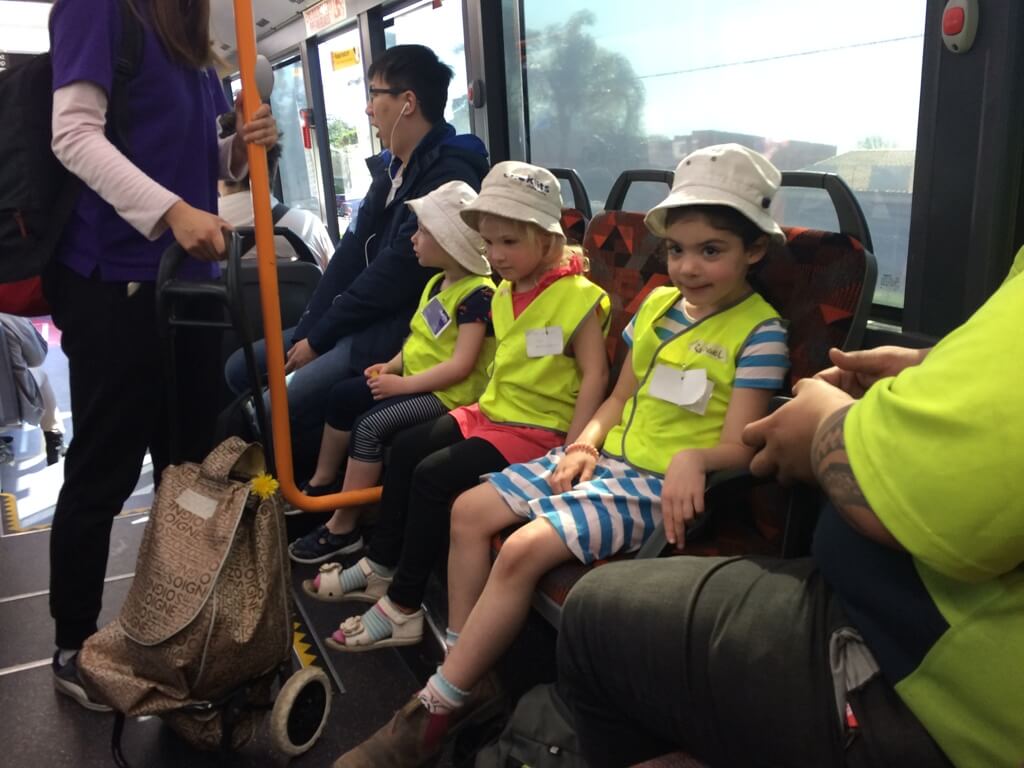
The day was eagerly anticipated and when it finally arrived, you could feel the excitement in the air! Having been on many excursions to a local library and an aged care residence, the children knew what to expect when it came to the routine: something to eat, a quick toilet stop and drink, sunscreen and hats, putting on our ‘hi-vis’ vests and lining up with their partner. The walk to the bus stop was filled with chatter and observations of the sights around them (flowers and plants were a much loved sight!).
Next came the bus ride. Again, the experience was one that was familiar to the children and it showed through their safe and responsible behaviours. Although familiar, I don’t think joy and excitement was any less apparent (bus rides are pretty amazing when you see them through the eyes of a 5 year old!).
After arriving and disembarking from the bus, it was a short walk to Sally’s Boutique (a local opportunity shop in Ringwood). Many of the children were excited to note that they recognised the area and point out the directions of their house and local shopping centre, Eastland. The chatter continued while the sun continued to beam down….and then we reached our destination. We began to note some curiosities….the closed door, the empty car park and then, a note on the door.
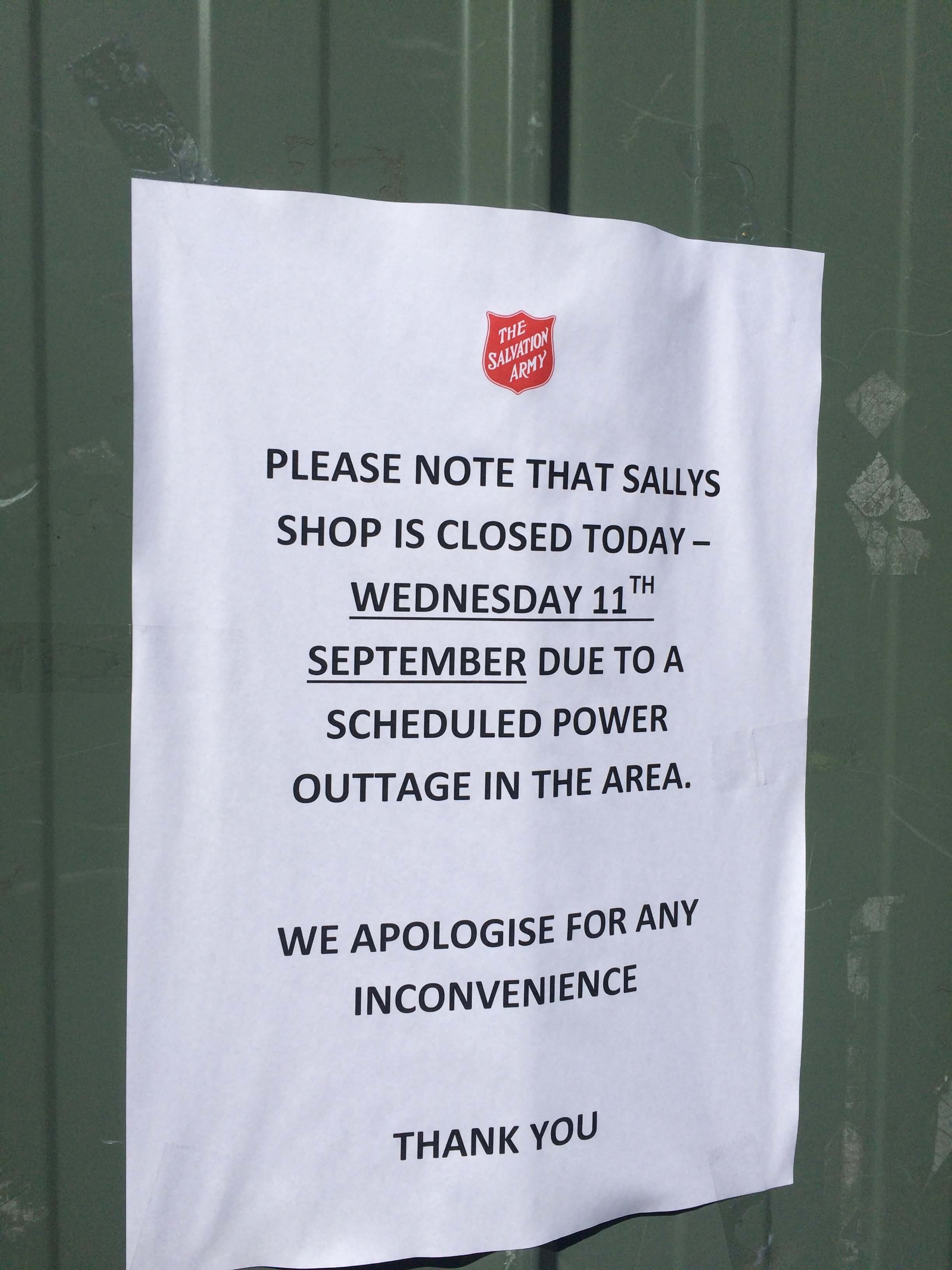
It would seem as though a power outage in the area had not taken into account the group of Kinder children who had been anticipating the purchase of some books and some exploring!
So, together we sat in the carpark and talked about how we felt and what we could do next. Disappointed and deflated summed up the initial reactions (educators and children alike!), but we spoke about how that meant we we get to have another trip to visit the shop again soon. The children were pretty elated at the idea of another bus ride – and definitely not displeased at the extra time for playground fun that the unexpected turn of events allowed for.
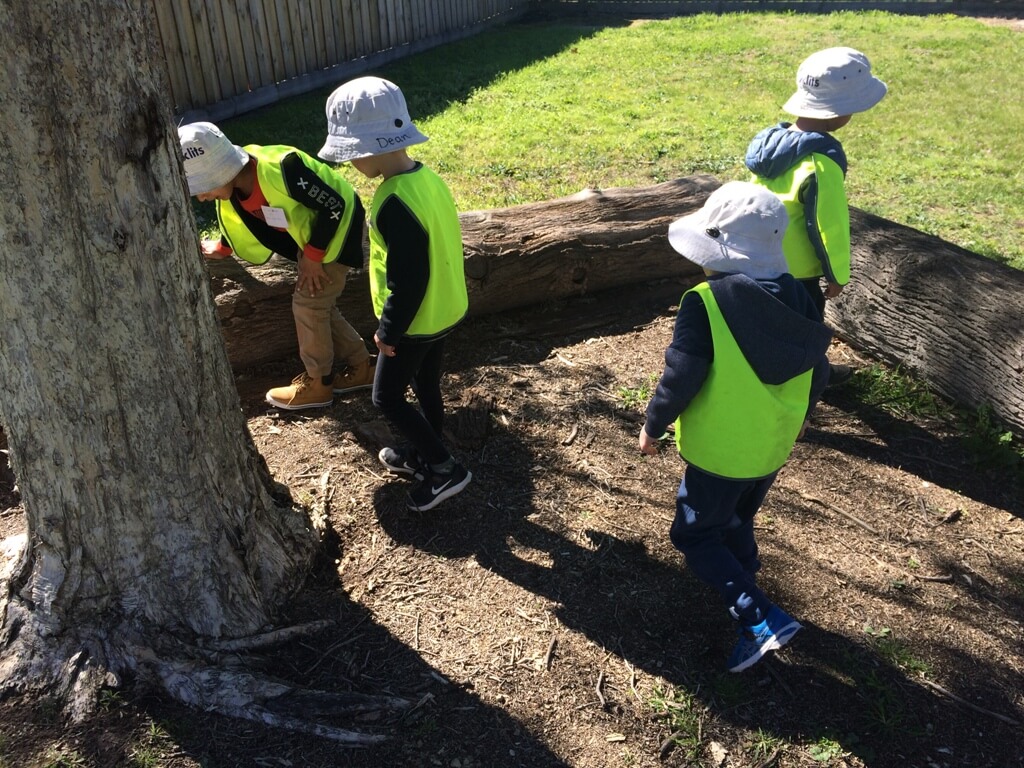
And so, the walk back began, with more beautiful gardens to view, flowers to pick and a much-enjoyed stop at a small local park. With equipment to climb, swings to swing on and some great hiding spots for mini-beasts, the children were in their element, enjoying outside exploration.
A few weeks later, we set out for a repeat of our journey; this time, with much more success given that the shop was open! After careful selection, the children proudly purchased the new books to take back to Choklits.
“Resilience is the ability to cope or ‘bounce back’ to previous levels of emotional wellbeing after encountering a difficult situation or negative event. Put simply, it is being able to adapt to challenging circumstances and still thrive (Benard 2003).”
While the literacy learning opportunities are evident from an experience like this, there are other aspects that I’d like to unpack.
Firstly, the pride of children who know their identity and strengths, and can voice them to others. The book we created captured the conversations and answers to the question “What are you great at?” and we were very proud to hear the children list their talents (my favourites included showing kindness and loving their families.). What a fantastic way to consolidate their own self-esteem and contribution to a group project as valuable members of the Kinder group!
Every time the children venture further afield than the centre, I’m always struck by the connections they make to those we see. Whether it’s on a library visit, trip to a local aged care residence or walk to the park, the importance of connecting with the community shows. This can take the form of waves, smiles of fellow bus passengers, chats with the locals (gardeners, shop keepers, neighbours enjoying a stroll) and the general enjoyment of connecting with the world around them. Who doesn’t love seeing an adorable group of excited children out and about as a group?
Lastly (my favourite aspect of the whole experience), what the children gained in terms of their emotional well-being. Resilience (namely, coping with setbacks or the unexpected) helps children to bounce back from disappointment. Not only is there a wealth of research behind resilience (see links below), but our guiding curriculum, the Early Years Learning Framework, notes resilience as a vital part of identity and emotional well-being.
“Children become strong in their social, emotional and spiritual well-being. This is evident when children manage change and cope with frustrations and the unexpected”– (Department of Education and Early Childhood Development, EYLF Outcome 3)
The unexpected disappointment of the shop being closed really highlighted the strong foundations and relationships that the children have built with educators. These relationships help to guide them through the experience with a positive outcome.
Our goal at Choklits and in the early education setting is to empower little beings to be strong in their own identity, rising to challenges and secure in their own sense of self. When we see their learning evident in an experience like this, we know that we’re doing something right.
Useful links:
Choklits blog post authored by Dee Wasserfall, Choklits Child Care Kindergarten Educator.
PS- Choklits is a busy place so join the conversation on Facebook and follow us on Instagram for updates from in and around our great Ringwood community!
—
Choklits Child Care, 319 Canterbury Road, Ringwood (opposite the Ringwood Golf Course near the Canterbury Road Eastlink offramp).